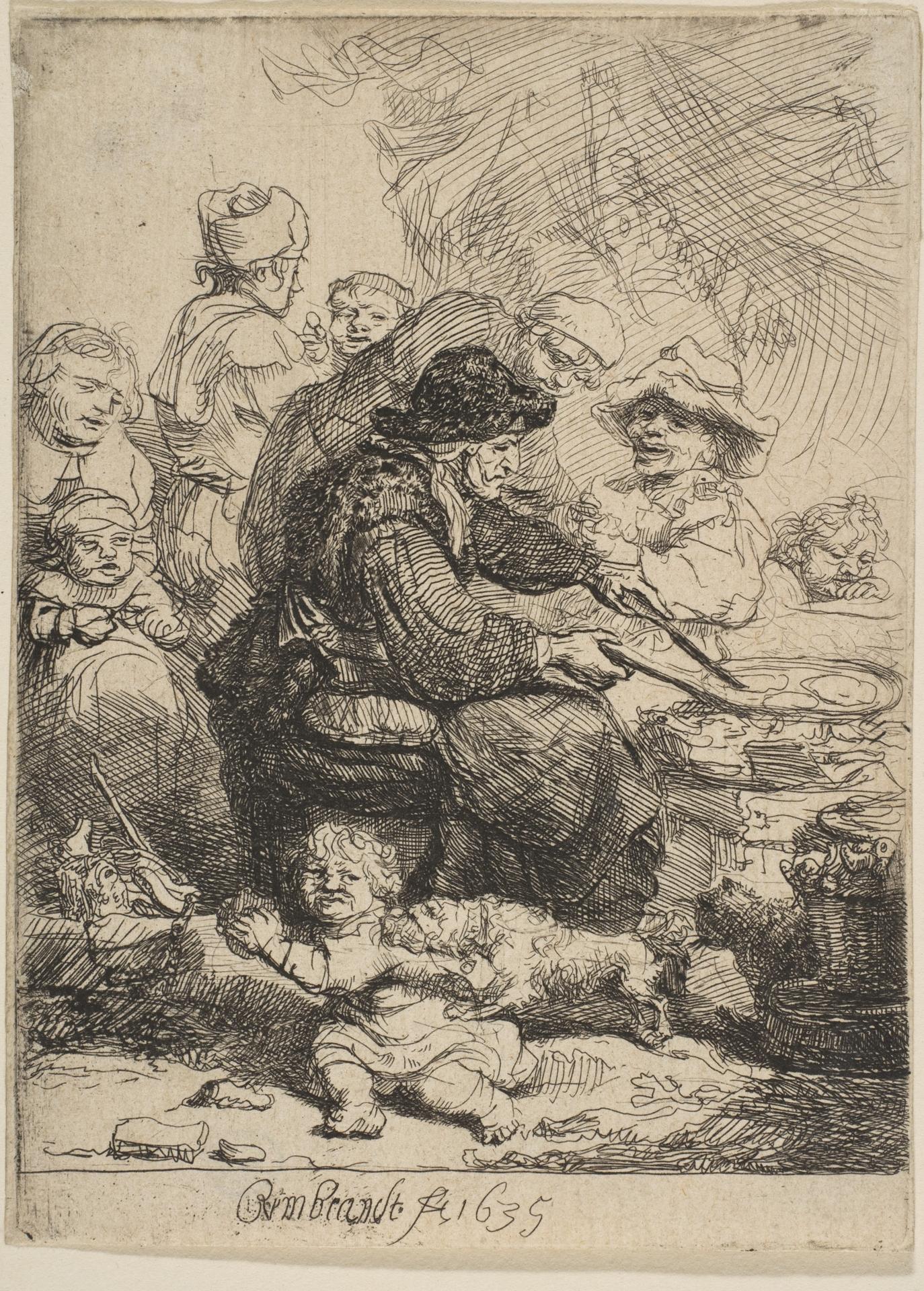
The Pancake Woman (1635, Met-Objekt 5281)
Original title: The Pancake Woman
kurzbeschreibung
Rembrandt van Rijn etched Die Pfannkuchenfrau in 1635: a woman baking pancakes, with children and adults gathered around her. The print belongs among his early etchings, part of the printed work he produced in those years.
Description
A woman in a fur cap and jacket stands at the middle of the plate, a pan in her hand. Before her a child kneels, watching her closely, while other children and adults stay further back, some standing, some seated. The arrangement feels restless, the figures' gazes pulling in different directions. Everything stays monochrome; light and shadow come from fine hatching and line.
Context
The plate dates from 1635, a period when Rembrandt turned more and more to scenes of daily life and to figures on the margins of society. Street vendors and ordinary people were popular subjects in seventeenth-century Dutch art. Rembrandt was then working in Amsterdam, where he had lived since 1631 and was enjoying success as a portraitist.
Impact
This view of everyday life feels alive: the relaxed posture of the figures and the varied handling of line bring the action close to the viewer. The curiosity, patience and busyness of those taking part give the image an intimate, almost genre-like tone.
Technique
For this etching a metal plate was bitten with acid, and the lines formed in the process. Rembrandt worked with lines of differing weight and with hatching to draw out depth and effects of light. The method allows fine detail and soft transitions between light and dark.
AI-generated description text
Source: Metropolitan Museum of Art · Public Domain (CC0 1.0)