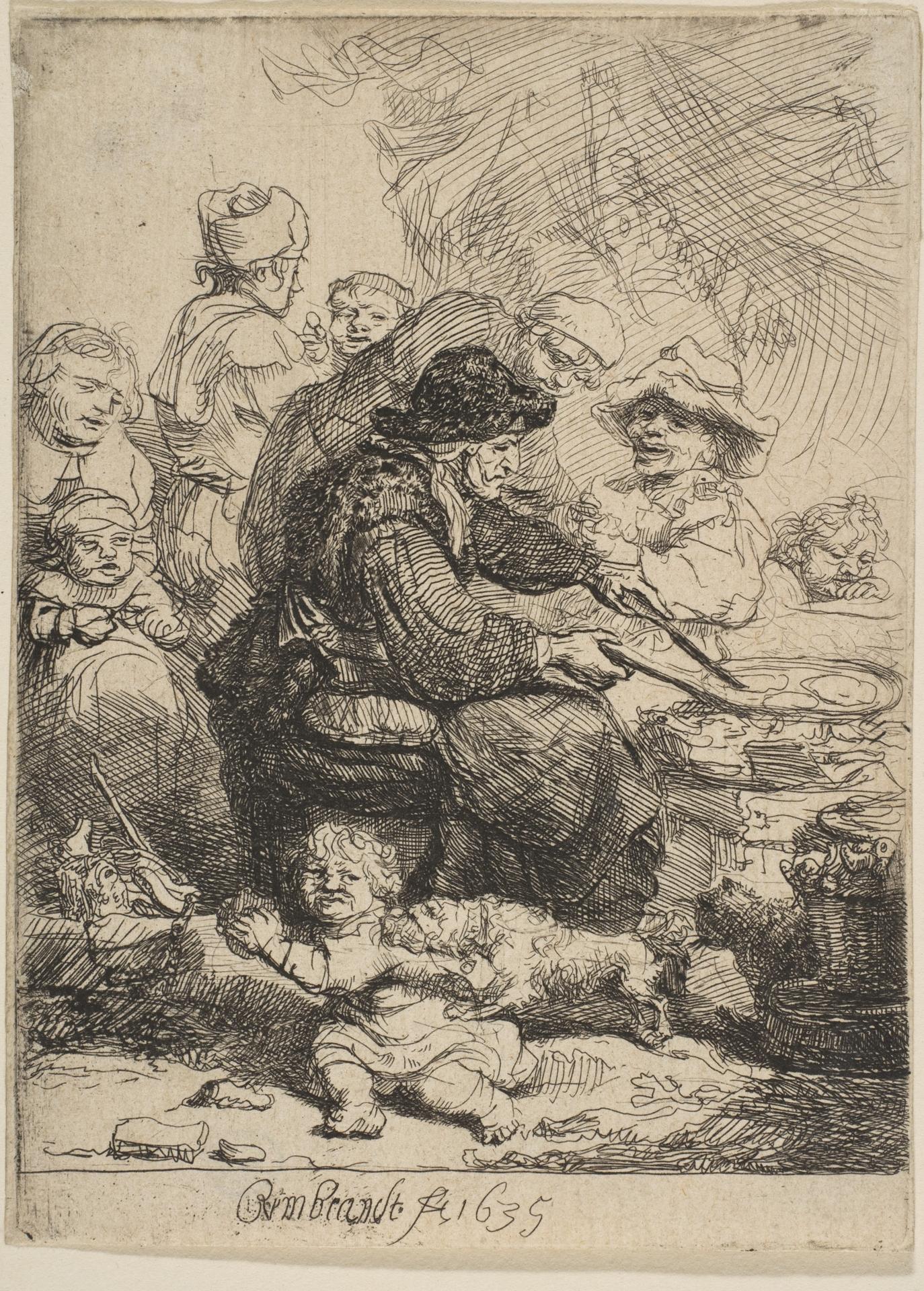
The Pancake Woman (1635, Met-Objekt 5280)
Original title: The Pancake Woman
kurzbeschreibung
A woman baking pancakes—Rembrandt's 1635 etching invites us into an interior where children and an adult watch the action. Light falls through a window, illuminating the scene.
Description
Seated on a stool, the woman holds a pan tightly; a fur hat and long dress define her appearance. Several children crowd around her, some with spoons or plates, watching eagerly. Another adult stands behind, observing attentively. The arrangement feels lively, as figures look and move in different directions. Fine hatching and lines model bodies and objects, creating the play of light.
Context
This print was made in 1635, when Rembrandt had already established himself as a portrait and history painter in Leiden and Amsterdam. Scenes of everyday life—such as a market woman cooking—were highly popular in 17th-century Dutch art. Rembrandt often took up such genre motifs to test effects of light and shadow. The etching belongs to a period of intense graphic experimentation, in which he also captured ordinary events with a social eye.
Impact
The tight group of figures and their expressive faces make the event feel immediately alive. Incoming light creates an intimate mood that draws the viewer into the scene. Realistic touches and a slight dramatic tension give the print its particular appeal.
Technique
As an etching, the print is an intaglio process: the drawing is scratched into a metal plate, which is then etched with acid. Fine lines and hatching model light and shadow, producing the monochrome effect. Rembrandt used this technique to make detailed, high-contrast impressions.
AI-generated description text
Source: Metropolitan Museum of Art · Public Domain (CC0 1.0)