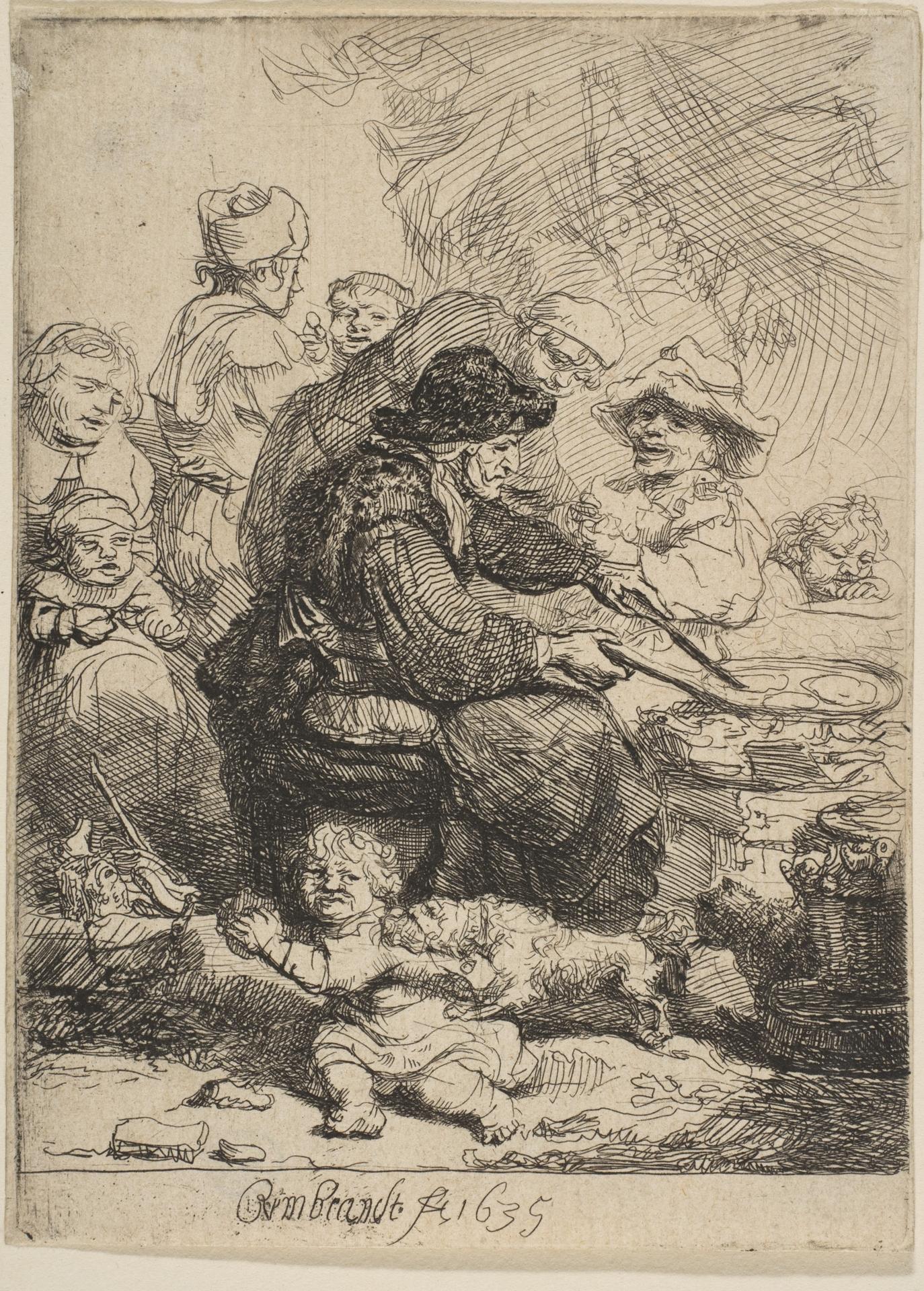
The Pancake Woman (1635, Met-Objekt 5279)
Original title: The Pancake Woman
kurzbeschreibung
Where many related genre pieces from those years keep their distance, Rembrandt's 1635 etching moves a woman to the fore as she bakes pancakes among children. What at first looks like a passing street scene is held in finely graded lines and hatching as a black-and-white print, with the everyday made into the main event.
Description
A woman in a fur cap and fur jacket crouches at the center, spoon in hand, bent over the pan. Children press around her: some giggle and romp, others watch closely what happens in the pan. Behind this group, further figures can be made out, filling the space. The layout feels crowded, with almost no air between the bodies, and keeps drawing the eye back to how those present interact. Graduations of light and dark give the monochrome sheet tension and movement.
Context
The print was made in Amsterdam in 1635, during a phase when Rembrandt turned more strongly to everyday life. Scenes of common people were widely popular in seventeenth-century Dutch art and were often read morally or jestingly. This etching takes its place among works that reveal his handling of light, shadow, and the characterization of people.
Impact
Because the figures stand so close together and their gestures are so lively, the sheet feels immediate and moving. Delicate lines and strong contrasts lead the eye to the woman in the middle and create an intimate, genre-like mood.
Technique
The print was made as an etching in intaglio: the drawing is scratched into a wax layer over the copper plate, then the metal is etched. Rembrandt worked with both faint and forceful lines, shaping light and shadow into a lively surface. After inking the plate with black printing ink, he pulled it onto paper, producing the monochrome image.
AI-generated description text
Source: Metropolitan Museum of Art · Public Domain (CC0 1.0)