Rembrandt's Wife and Five Other Heads
Original title: Rembrandt's Wife and Five Other Heads
kurzbeschreibung
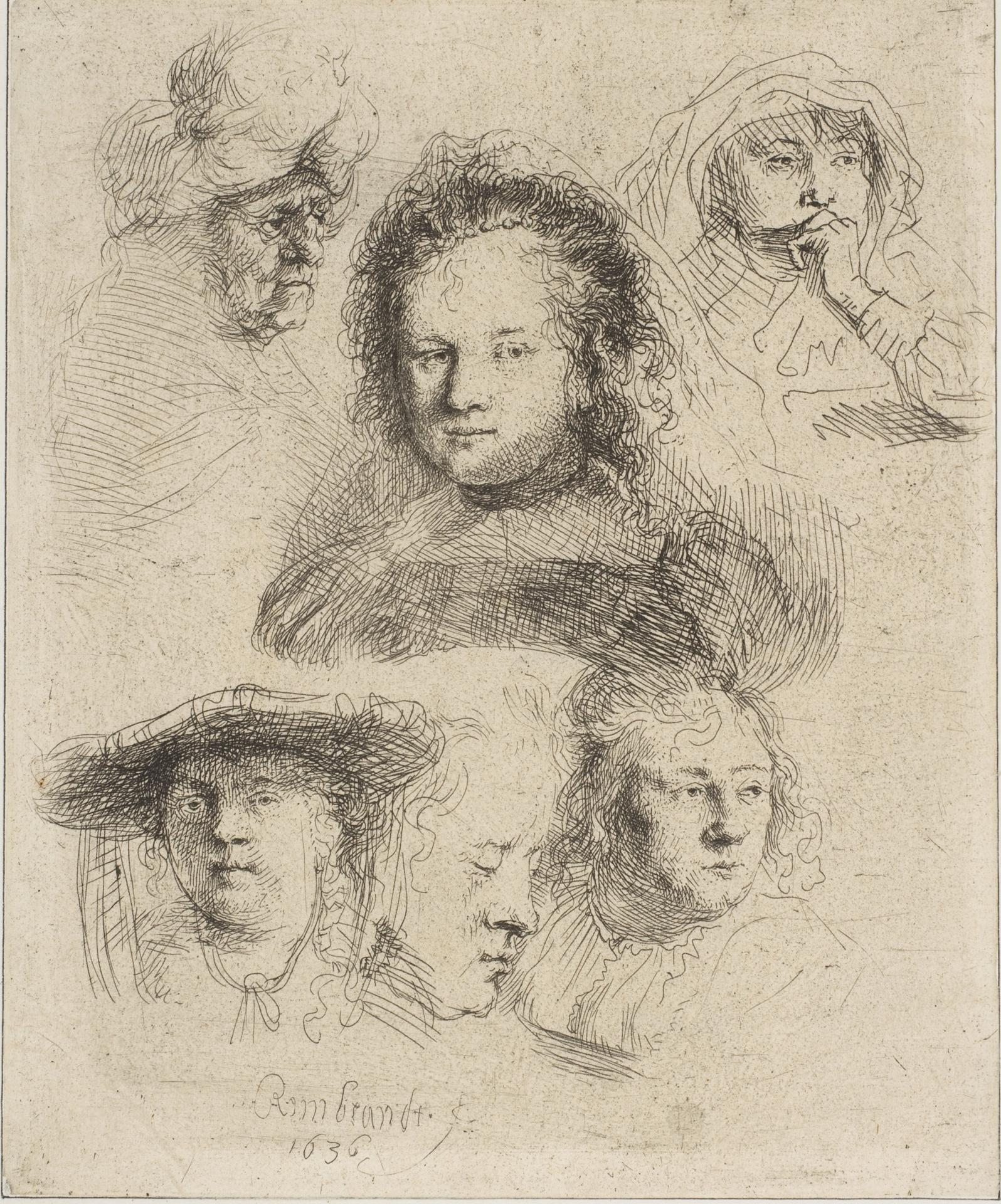
Six heads gather on a single sheet in Rembrandt van Rijn's etching Rembrandt's Wife and Five Other Heads, made in 1636. Each face meets the viewer differently: some look straight out, others seem lost in thought or turned away. Hair and the folds of clothing are built up in delicate strokes and lines.
Description
The six heads sit loosely scattered across the page, each with its own pose and expression. A few faces address the viewer directly, while others look pensive or glance aside. Precisely placed strokes shape hairstyles and garments; shifts in line weight and direction give the monochrome print its movement and carve out areas of light and shadow. The figures thereby gain spatial depth and a sense of physical presence.
Context
The sheet dates from 1636, a period of intense activity for Rembrandt in Amsterdam. It reveals how confidently he handled character studies and portraits in printmaking. Bringing several heads together on one plate was a common exercise for testing modes of expression and technical means. One of the upper heads is thought to be Saskia van Uylenburgh, the artist's wife, a personal note that gives the work its particular character.
Impact
The graded expressions and differing directions of gaze lend the sheet something intimate, almost narrative. Finely drawn lines and assured lighting make the heads feel immediately present. It becomes clear how Rembrandt, with economical means, captures a wide range of human feeling.
Technique
The print was made as an etching, an intaglio process in which the drawing is bitten into a metal plate. Ink settles in the recessed lines while being wiped from the smooth surface. Rembrandt varied line strength and direction to draw out light, shadow and surface texture. The sheet measures 15 x 12.5 cm and belongs among his experimental prints of the 1630s.
AI-generated description text
Source: Metropolitan Museum of Art · Public Domain (CC0 1.0)