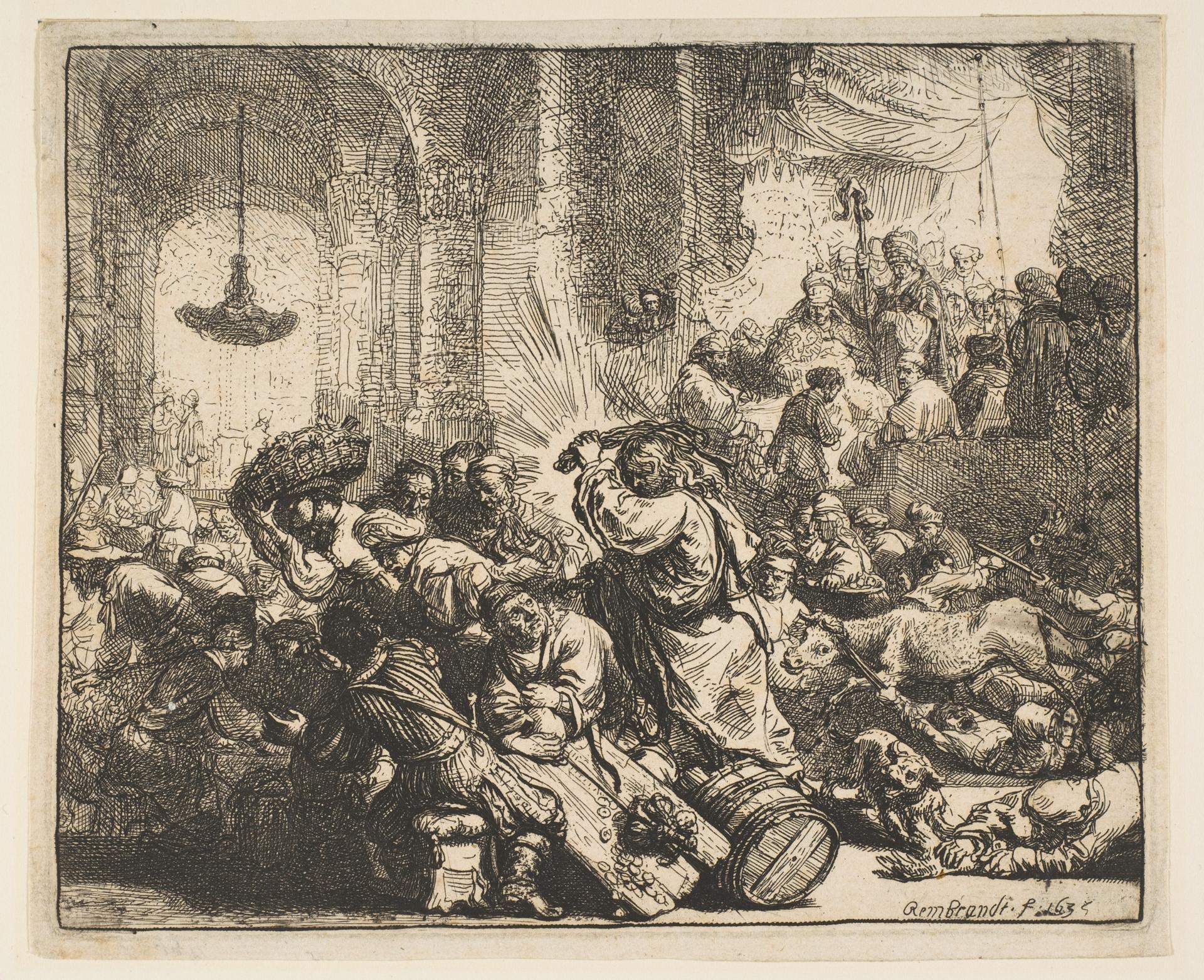
Christ Driving the Money-Changers from the Temple
Original title: Christ Driving the Money-Changers from the Temple
kurzbeschreibung
Rembrandt van Rijn made this etching, Christ Driving the Money Changers from the Temple, in 1635. It presents the biblical moment when Jesus drives the merchants and money changers out of the house of God. Executed as a detailed etching in shades of grey, the print belongs among his biblical works.
Description
Disorder governs the layout: part of the crowd falls to the ground, others flee in haste. The figures' clothing comes from Rembrandt's own time, bringing the event close to the viewer's present. Behind them rises a temple with columns and a baldachin, partly hidden by a curtain. Light falling from above casts strong shadows and heightens the drama of the moment. Fine lines and hatching convey the texture of the garments and the movement of the bodies.
Context
The print was made in Amsterdam, during the years of Rembrandt's greatest success as a portraitist and history painter. The cleansing of the temple was highly popular in seventeenth-century Protestant art, as it stood for the rejection of venality in the church. Rembrandt departs from traditional, rigid pictorial orders and relies on the emotional and physical force of the event. The sheet belongs to a series of biblical scenes he produced for the art market.
Impact
The lighting and the immediate force of movement draw the viewer's gaze into the midst of the action. Finely placed lines and lively figure handling give the print an almost cinematic tension. Because colour is absent, attention focuses entirely on the arrangement and the feelings of those acting.
Technique
The image is etched: the drawing was scratched into an acid-resistant layer on a copper plate and then exposed to the acid bath. With fine lines and cross-hatching, Rembrandt worked out light and shadow and rendered the quality of the fabrics. Printing was done with printer's ink on paper; he reworked the plate several times, resulting in different states.
AI-generated description text
Source: Metropolitan Museum of Art · Public Domain (CC0 1.0)