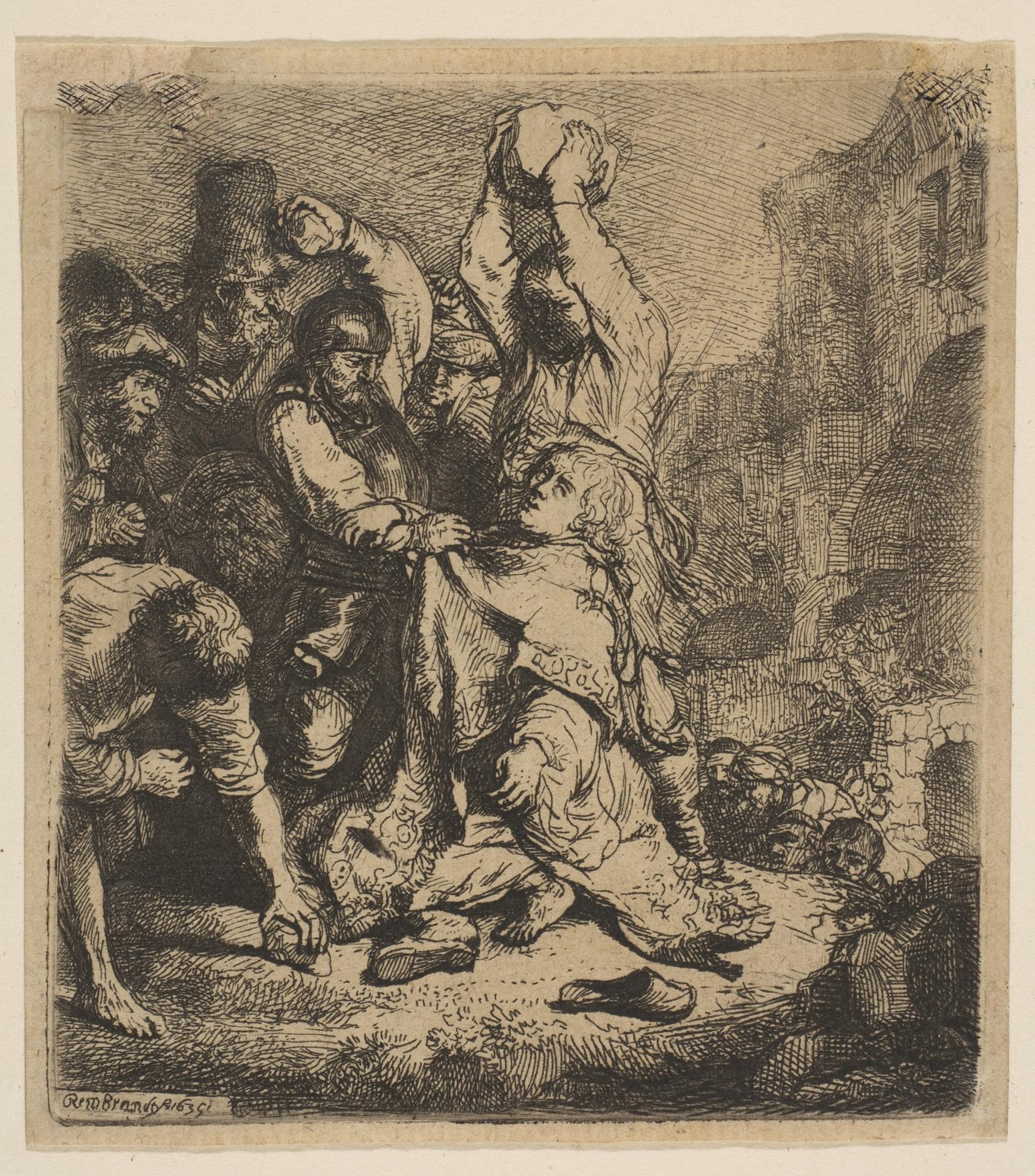
The Stoning of St. Stephen (1635, Met-Objekt 5268)
Original title: The Stoning of St. Stephen
kurzbeschreibung
Rembrandt turns to the biblical stoning of Saint Stephen in this 1635 etching. The kneeling saint anchors the image, surrounded by figures who carry out the act or stand watching. Through the etching needle's nuanced strokes and layered hatching, the print builds a taut visual fabric.
Description
Stephen kneels at the heart of the picture, marked out by his ornamented robe and a headband; a man beside him draws back his arm to throw a stone. Other figures spread around them, some in hats and contemporary dress, looking on or joining in. Ruins and a wall in the rear point to the biblical setting. Crisp drawn lines, a monochrome palette and a soft light coaxed from fine hatching define the sheet.
Context
Rembrandt made this etching in Amsterdam in 1635, a period when he was deeply engaged with biblical subjects and moments of high drama. The stoning of Stephen, taken from the Acts of the Apostles (7:54–60), counts among the rarer themes in his work. During this phase he was testing what etching could do for rendering light and shadow.
Impact
The restless arrangement and graded shadows create a dense, charged atmosphere. Because everything converges on the action at the centre, the sheet feels immediate and pulls the viewer's eye into the event.
Technique
For this print Rembrandt scratched his drawing through a wax ground on a copper plate and then bit it with acid. Delicate strokes and differentiated hatching let him modulate light and shade with precision, a hallmark of his printed work.
AI-generated description text
Source: Metropolitan Museum of Art · Public Domain (CC0 1.0)