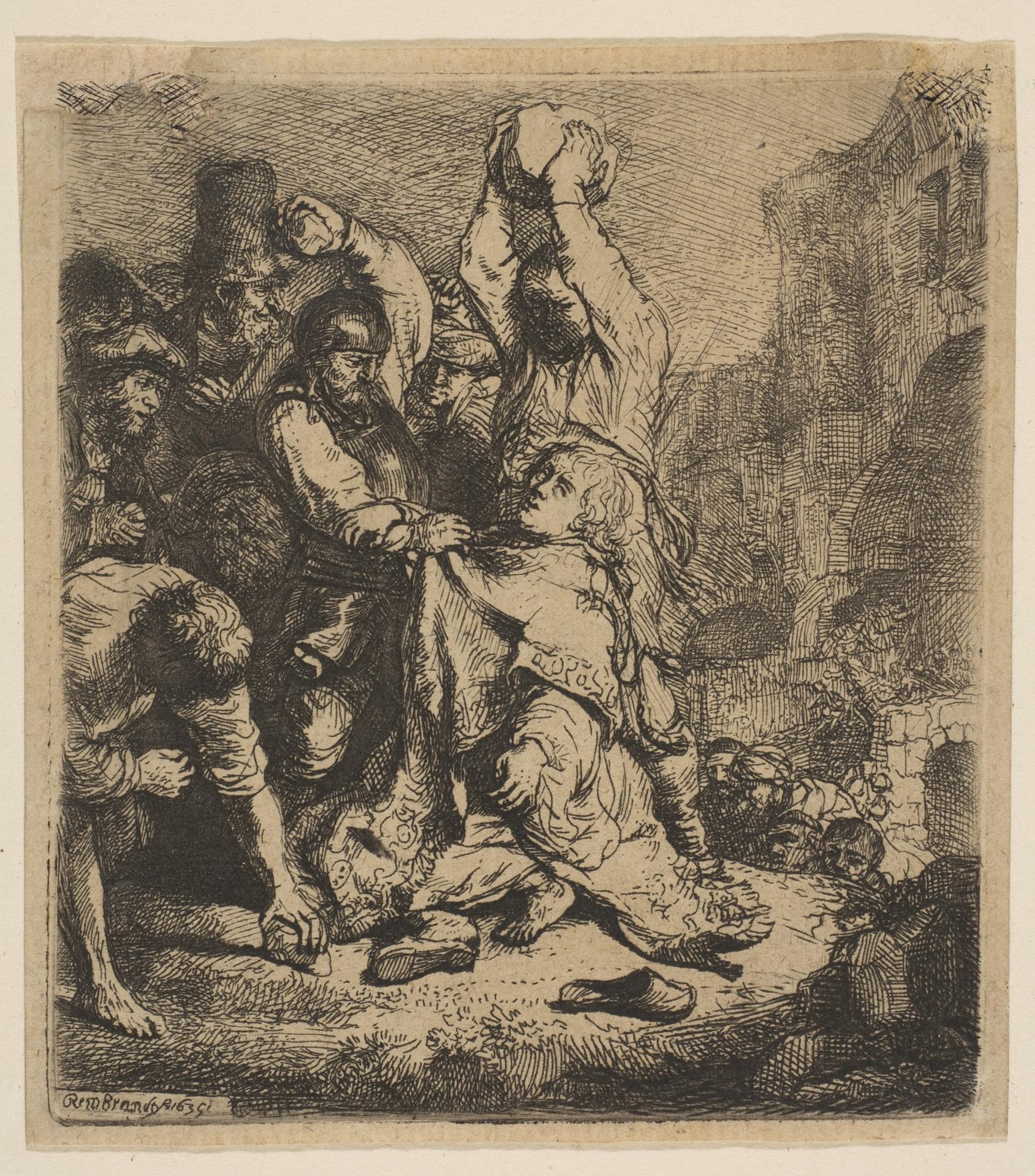
The Stoning of St. Stephen (1635, Met-Objekt 5267)
Original title: The Stoning of St. Stephen
kurzbeschreibung
A man seizes a woman while men around him stoop to gather stones from the ground: this is Rembrandt's 1635 etching of the stoning of Saint Stephen. Walls and buildings enclose the action, placing it firmly in a town. The artist worked out the subject in a printmaking technique he was exploring intensively during those years.
Description
Stones are lifted high, arms drawn back to throw. Men crowd around the central group, where one figure grips a woman tightly. Behind them rise walls and houses that mark the site as an urban space. The clothing of those involved points to a bygone era. Worked in black on white, the sheet gains its depth solely from lines and hatching, which layer surfaces and spaces.
Context
In 1635, during his Amsterdam years, Rembrandt turned repeatedly to biblical subjects. The stoning of Stephen is one of the motifs he took up only rarely—a sign of his preference for dramatic, violent narratives. In this period he tested various printing techniques and probed the limits of the medium.
Impact
Dense strokes and a restless arrangement of figures carry the tension of the moment directly into the image. A soft, diffused light falls over the scene, deepening its somber mood while drawing the eye to the central action. Realistic details and expressive shading combine for an effect that borders on the theatrical.
Technique
For this sheet Rembrandt chose etching: a copper plate was bitten with acid, and he used fine lines alongside closely spaced ones to create shading and spatial depth. The monochrome print depends on the direction of its lines, which draw out textures and sustain the drama of the subject.
AI-generated description text
Source: Metropolitan Museum of Art · Public Domain (CC0 1.0)