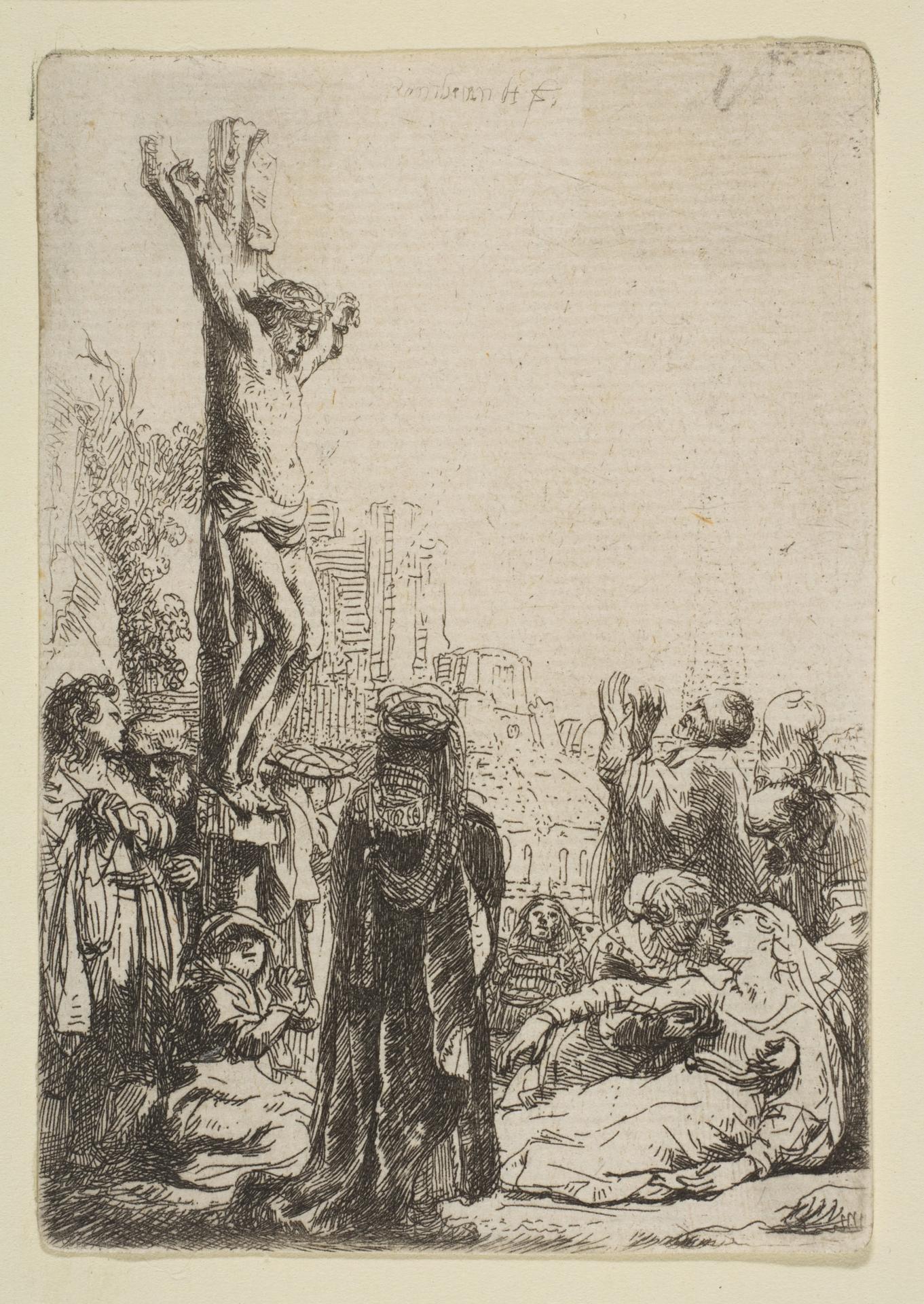
The Crucifixion: Small Plate
Original title: The Crucifixion: Small Plate
kurzbeschreibung
Rembrandt van Rijn made this etching around 1635, presenting the Crucifixion with Christ at the center, surrounded by people who mourn and pray. Among his early graphic works on biblical subjects, this print stands as one of his first approaches to the theme.
Description
Christ hangs on the cross, clad only in a loincloth, his hair marked by suffering. Figures stand to either side in varied attitudes: some are deep in prayer, others reveal grief or despair. Behind them appear trees and ruins that suggest a desolate city; the clothing of those present follows traditional forms. The layout is uneven, yet the eye is drawn to the cross. The motif is executed in black and white.
Context
Around 1635 Rembrandt was living in Amsterdam and devoting himself intensively to biblical subjects; this print dates from that period. It belongs to a series of Crucifixion depictions made in the 1630s. The 'Small Plate' is a reduced version of a larger etching of the same subject. Rembrandt often turned to etching to vary and disseminate his compositions.
Impact
A dense, tense mood greets the viewer, sustained by the dark setting and the very different reactions of those present. Delicate lines and graduated shading guide the gaze toward the cross and heighten the drama of the moment.
Technique
The print was made as an etching, with an etched metal plate serving as the printing surface. Rembrandt used fine strokes and graduated hatching to work out light and dark. This process allows both precise details and a wide range of tonal values.
AI-generated description text
Source: Metropolitan Museum of Art · Public Domain (CC0 1.0)