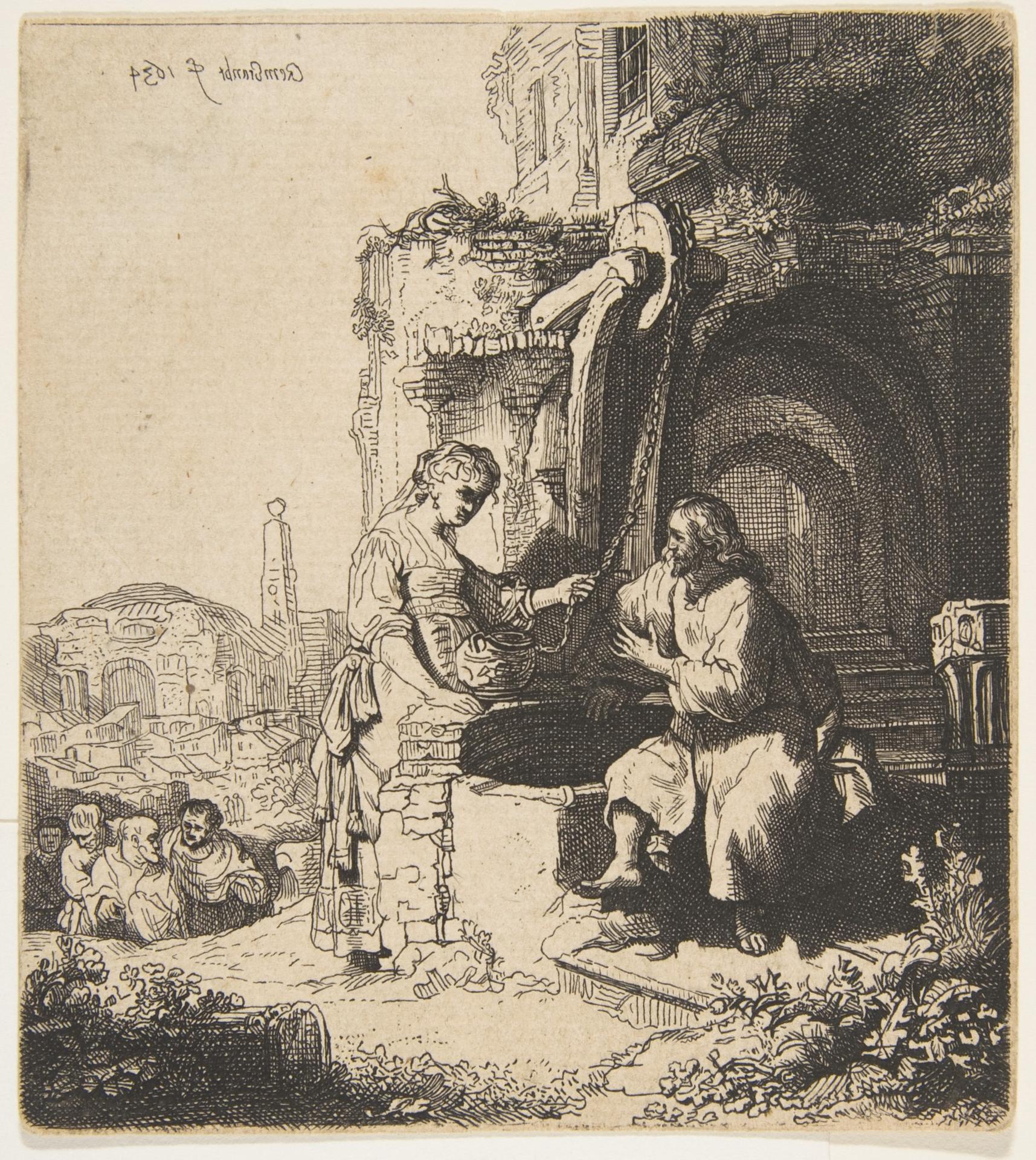
Christ and the Woman of Samaria among Ruins (reverse copy)
Original title: Christ and the Woman of Samaria among Ruins (reverse copy)
kurzbeschreibung
William James Smith made this etching, Christ and the Samaritan Woman at the Well amid Ruins, between 1824 and 1826. It presents a biblical encounter set among crumbling surroundings. The model was a seventeenth-century composition, which Smith reproduces in reverse.
Description
A kneeling Christ holding a bowl meets the Samaritan woman, who busies herself with a basket at the well. Ruins and a town view step back into the distance, adding to the historical mood. Both figures wear traditional garments, while flowers and plants grow in the foreground. The layout places the two main figures symmetrically at the centre; subdued light comes from fine hatching and lines in monochrome tones.
Context
Smith produced this print between 1824 and 1826 as a reversed copy of an older model, probably after a seventeenth-century painting. Reproductions of this kind were common practice in the nineteenth century, bringing artworks to a wider audience. That Smith chose a biblical subject points to the continuing interest in such narratives in the art of those years.
Impact
A calm, reflective mood emanates from the print, carried by the ruined setting and the soft light. The even arrangement and careful linework give the view a classical balance that invites close attention to its details.
Technique
The print was made as an etching, an intaglio process in which the drawing is scratched into a metal plate and then bitten with acid. The monochrome effect and graduated shading arise from varying density and depth of line. In this way, textures and lighting of the model can be transferred precisely.
AI-generated description text
Source: Metropolitan Museum of Art · Public Domain (CC0 1.0)