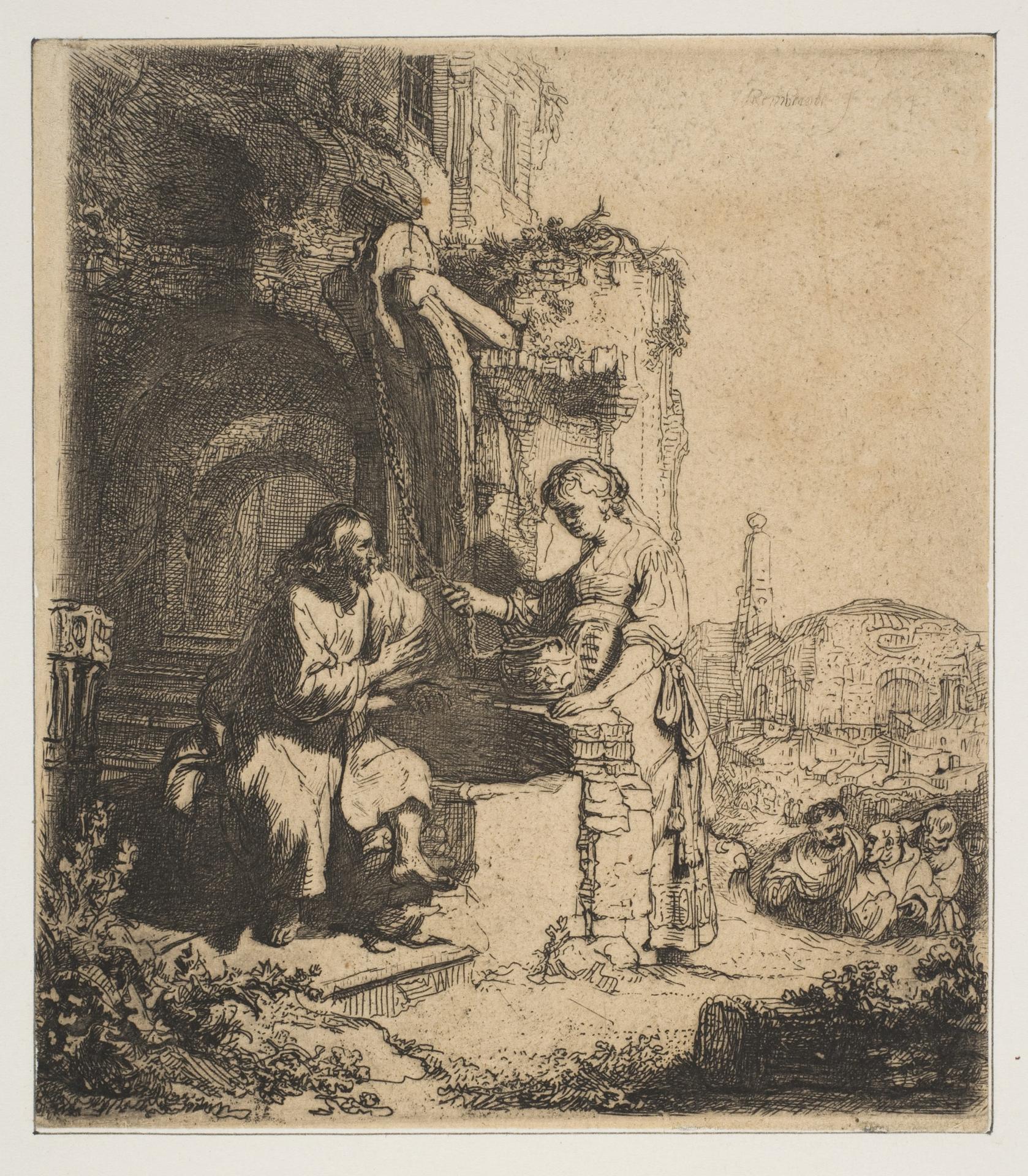
Christ and the Woman of Samaria among Ruins
Original title: Christ and the Woman of Samaria among Ruins
kurzbeschreibung
In this undated etching, Rembrandt van Rijn takes up the biblical encounter between Christ and the Samaritan woman at the well. The print belongs to his etchings and renders the meeting in a sketchy, detail-rich hand.
Description
At the well, Christ kneels with a vessel in his hand, while the Samaritan woman sits and holds out a second vessel to him. Ruins and a destroyed city suggest a historical or biblical setting behind them. To the right, two further figures sit, apparently talking to each other. The layout stays simple and sketchy, as is typical of etchings. The monochrome gray palette comes from linework and hatching; diffuse light stresses the contours of the figures and their surroundings.
Context
Rembrandt made numerous etchings of biblical subjects, often foregrounding human interaction and emotional depth. The meeting with the Samaritan woman is a well-known parable from the Gospel of John. The ruins may allude to the destruction of Jerusalem, a recurring motif in the seventeenth century. An exact date is missing, which is not unusual for Rembrandt's etchings, since he frequently produced undated impressions.
Impact
The sketchy linework and diffuse light create an intimate, thoughtful atmosphere. The ruins heighten the contrast between transience and the timeless encounter in the foreground. The print feels immediate and spontaneous, drawing the viewer into the scene.
Technique
In etching, a drawing is scratched into a wax layer on a copper plate and then bitten with acid. Lines and hatching produce the fine gray tones and contrasts. The sketchy quality suggests a rapid but controlled working method, characteristic of Rembrandt's etchings.
AI-generated description text
Source: Metropolitan Museum of Art · Public Domain (CC0 1.0)