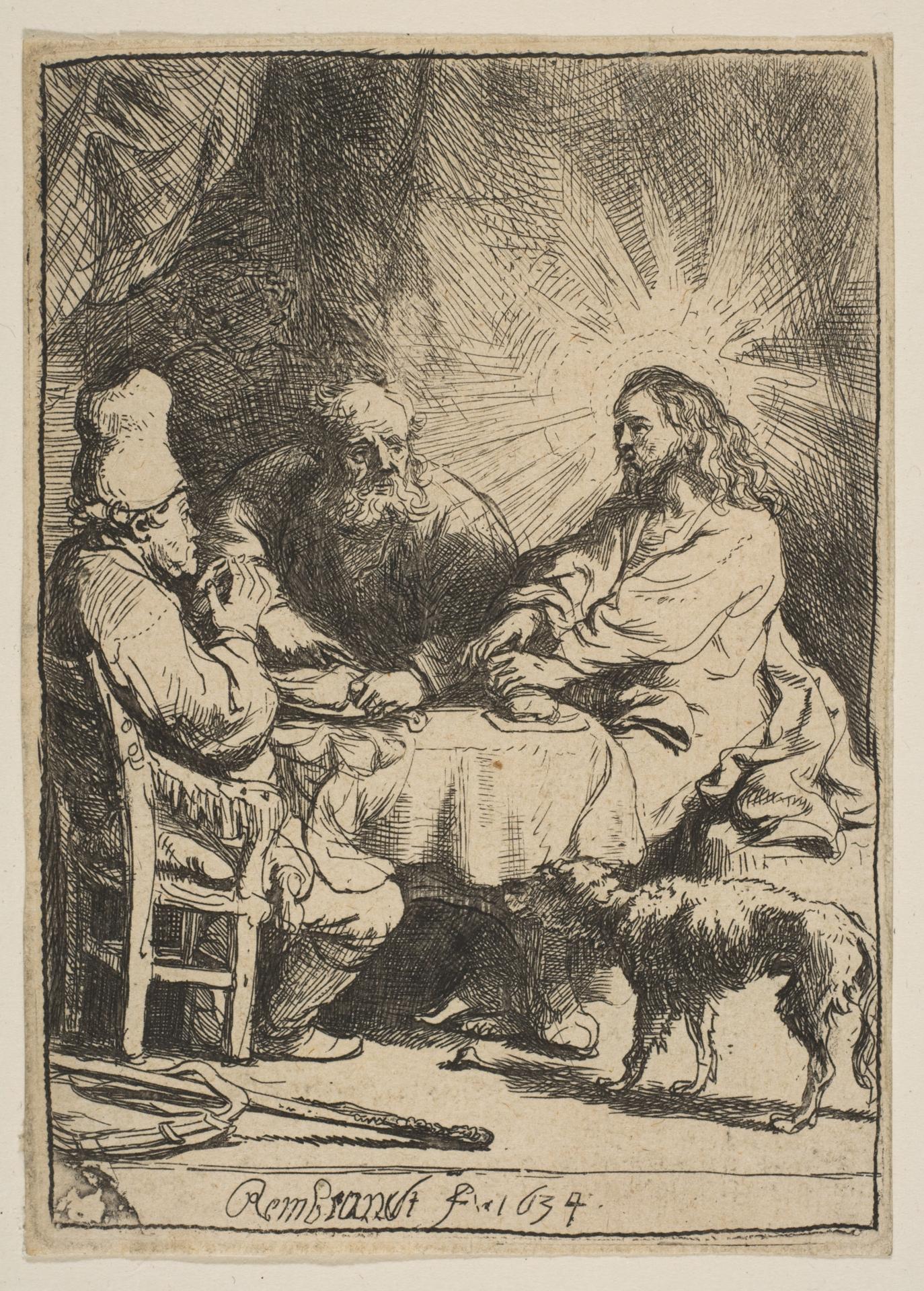
Christ at Emmaus: The Smaller Plate
Original title: Christ at Emmaus: The Smaller Plate
kurzbeschreibung
Unlike most related prints of the same subject, Rembrandt's 1634 etching places the Emmaus encounter in an unusually concentrated format. The artist made the work in etching with drypoint accents; it ranks among his early explorations of this biblical theme.
Description
Three figures anchor the layout: on the left a man tilts his head and rests his chin on his hand; in the middle an old man with a white beard sits; on the right stands Christ with curly hair and a halo of rays above his head, his hand resting on the old man's. A dog crouches beneath the group, and dark strokes suggest a wall. The print remains monochrome, with stark contrasts of light and dark highlighting the light around Christ.
Context
In 1634, the year of his marriage to Saskia van Uylenburgh, Rembrandt was working in Amsterdam in a phase of high productivity. The theme of the Emmaus encounter was widely popular in 17th-century Dutch art because it deals with divine revelation in everyday life. The so-called smaller plate is one of several versions the artist made of this subject.
Impact
A quiet, intimate mood pervades the print and captures the moment of recognition. Light and shadow draw the eye to the figure of Christ and give the image a spiritual depth characteristic of Rembrandt's biblical works.
Technique
For this etching, Rembrandt had the plate bitten with acid and then worked details with drypoint, producing fine, slightly blurred lines and soft transitions. This combination yields a nuanced rendering of light and texture, visible in the shading of the figures.
AI-generated description text
Source: Metropolitan Museum of Art · Public Domain (CC0 1.0)