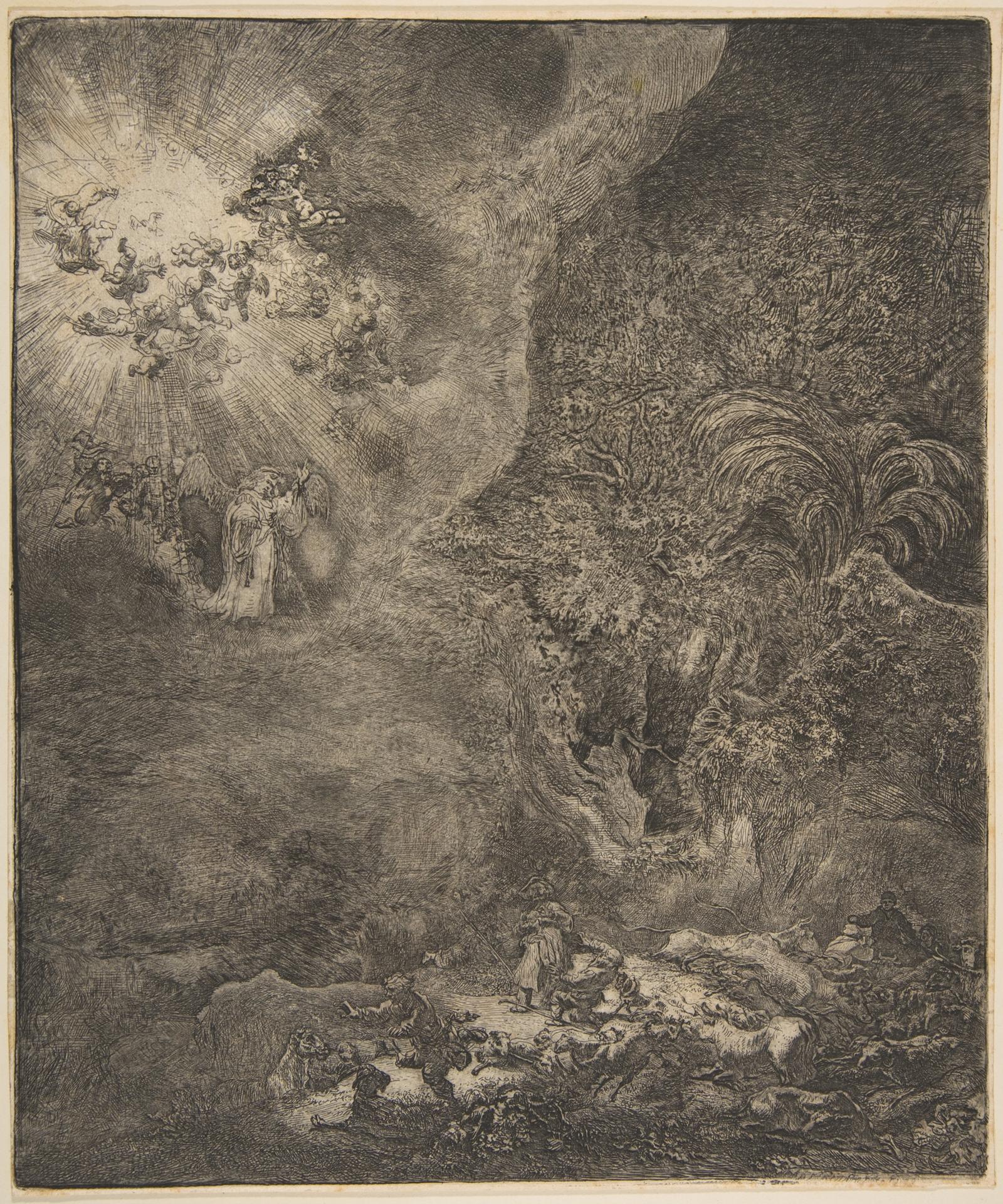
The Angel Appearing to the Shepherds (Etching)
Original title: The Angel Appearing to the Shepherds
kurzbeschreibung
Rembrandt van Rijn took up the biblical scene of an angel announcing Christ's birth to the shepherds for this 17th-century etching. While the shepherds and their sheep rest in the foreground, a choir of angels appears behind them in radiant light.
Description
A dark sky dominates the image, but a bright glow breaks through it, emanating from the angels. Several angels hover in the background, some in motion, others still. In front, shepherds and sheep lie and move on the ground. Gray tones define the print, with sharp contours and nuanced shading bringing out the structure of clouds and figures.
Context
In the first half of the 17th century, Rembrandt devoted himself increasingly to biblical subjects; this etching dates from that period. The Annunciation to the Shepherds was a common theme in the Dutch Baroque, as it emphasized the Incarnation. Rembrandt was known for his experimental printmaking and often reworked plates in multiple states to refine effects of light and shadow.
Impact
A tense mood arises between the dark, nocturnal foreground and the bright light of the heavenly apparition. The viewer is drawn into the event and shares the shepherds' surprise at the divine radiance. The nuanced lines and shading give the sheet a lively, almost painterly quality.
Technique
For this etching, Rembrandt worked a wax-coated copper plate with a needle and then etched it. The lines appear sharp and precise, with shading created by fine cross-hatching. He achieved gray tones and light effects through varying etching times and the depth of the lines.
AI-generated description text
Source: Metropolitan Museum of Art · Public Domain (CC0 1.0)