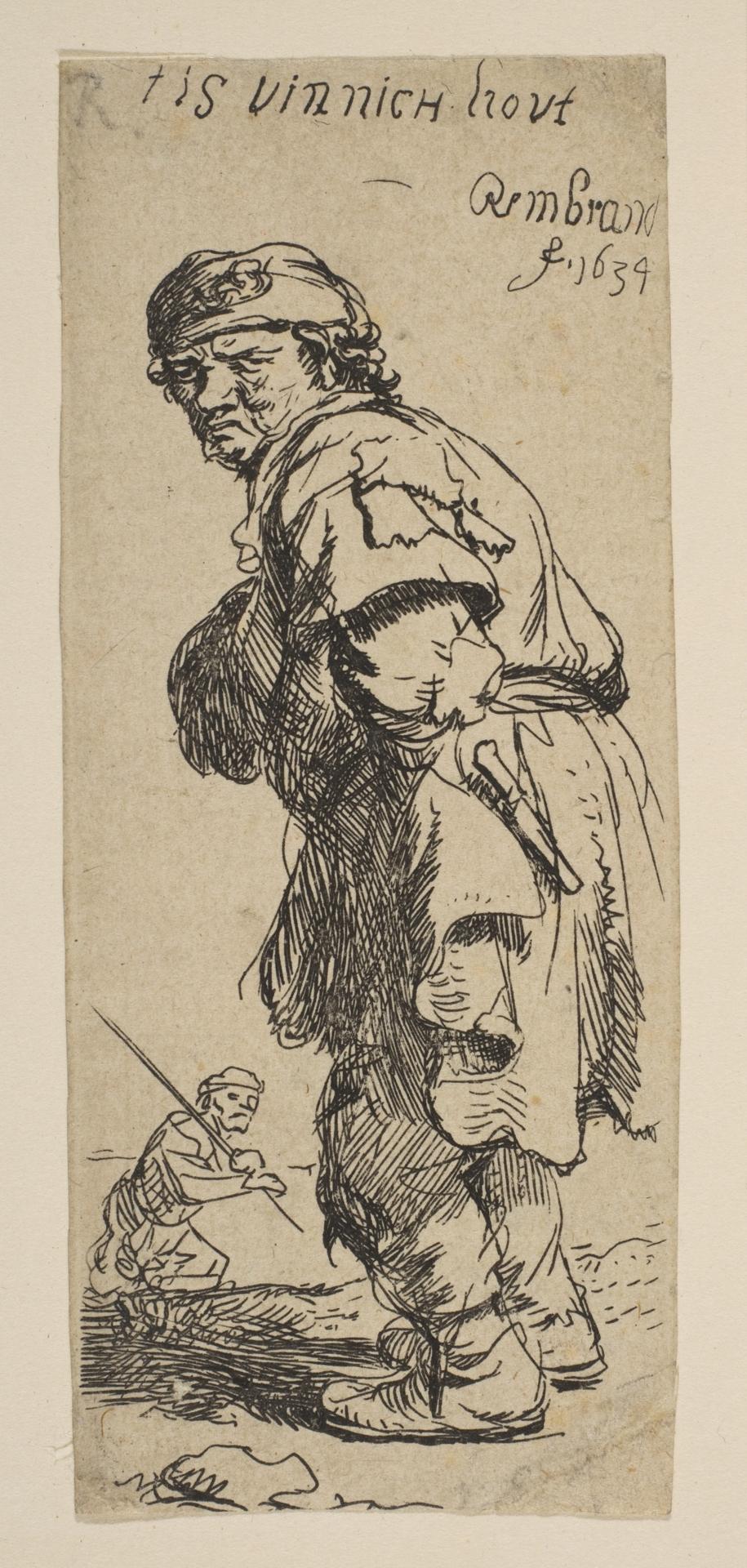
A Peasant Calling Out: "T is vinnich kout"
Original title: A Peasant Calling Out: "T is vinnich kout"
kurzbeschreibung
In 1634 Rembrandt van Rijn made the etching 'A Peasant Calling Out: "T is vinnich kout"' (It is bitterly cold). It shows a bearded man in a headscarf, one hand raised, shouting. A second figure with a stick appears behind him. The black-and-white print uses line to describe surfaces and bodily forms.
Description
A bearded man in a headscarf stands in the foreground, mouth open, hand lifted as if he has just called out. His jacket and trousers are suggested with quick parallel strokes. Behind him, smaller, a second person with a stick looks into the distance. The setting stays bare: only hints of fields or flat landscape. The layout is lopsided—the main figure fills the left half, while much of the right is left empty.
Context
Working in Leiden in 1634, Rembrandt turned increasingly to scenes of everyday life and peasants. The Dutch title 'T is vinnich kout' means 'It is very cold', pointing to the wintry mood suggested by the figures' clothing. Such studies of ordinary people were common in the seventeenth-century Netherlands and often served as models for larger paintings.
Impact
The spare use of line makes the sheet feel lively and direct, as if the moment of calling out had been caught. The open, asymmetrical arrangement draws attention to the peasant's gesture and creates a quiet but present mood. Fine hatching gives the scene a sketch-like freshness characteristic of Rembrandt's early prints.
Technique
For this etching Rembrandt scratched the drawing with a needle into an acid-resistant layer on a copper plate. After biting, he inked the plate and printed it on paper, producing the typical fine lines. By varying the density of strokes he modeled shadows and textures such as cloth or beard, entirely without color.
AI-generated description text
Source: Metropolitan Museum of Art · Public Domain (CC0 1.0)