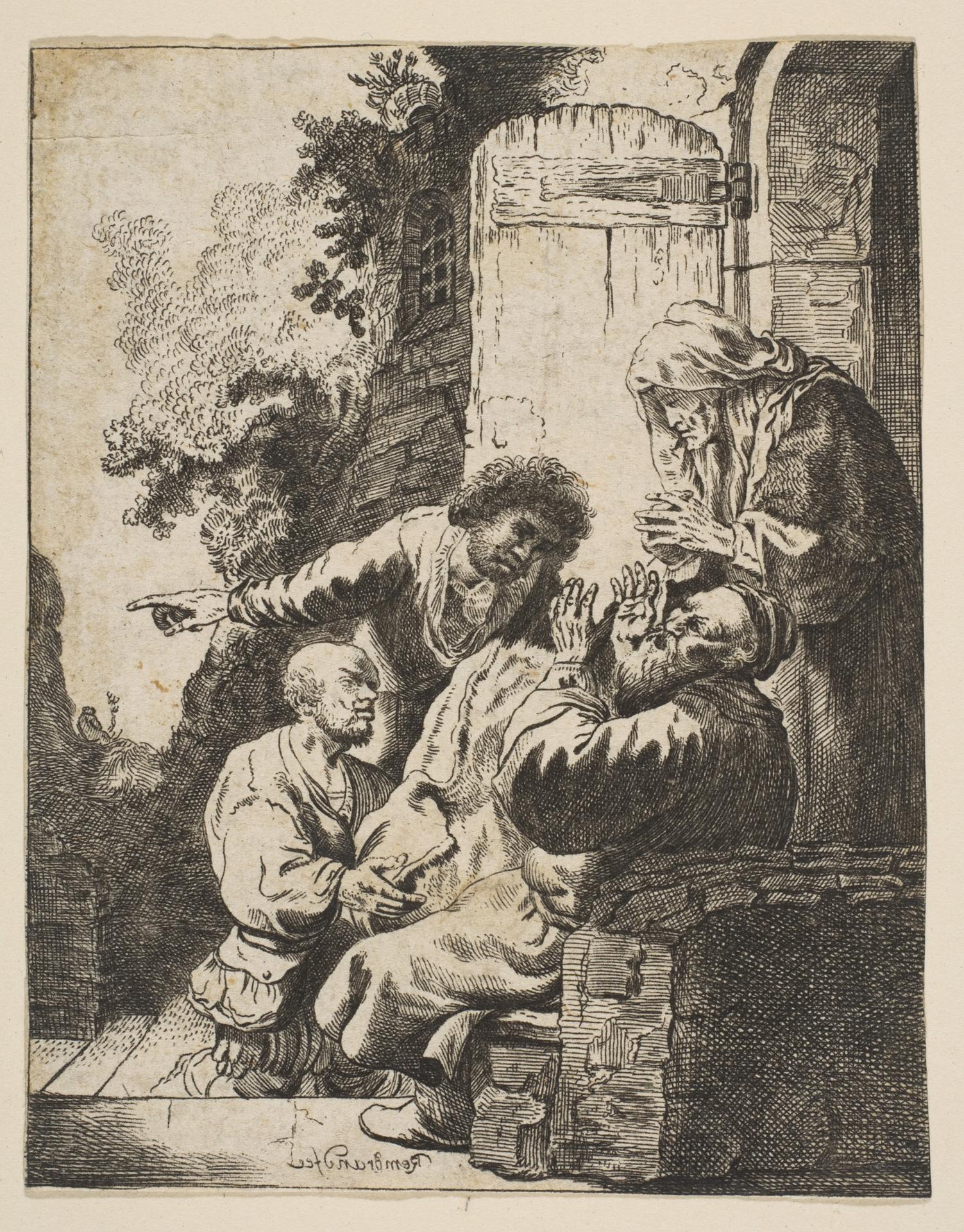
Joseph's Coat Brought to Jacob (ca. 1633, Met-Objekt 5255)
Original title: Joseph's Coat Brought to Jacob
kurzbeschreibung
Unlike many prints of the period that focus on Joseph being sold by his brothers, this etching by Johann Georg Hertel dwells on the moment the bloodied coat is brought to Jacob. Made around 1633, the small sheet measures 11.3 × 8.1 cm and belongs to the printmaking of the seventeenth century.
Description
Four figures are staggered before a house with an open door and window. In front, two face each other, one holding an object; a third turns away, and a fourth appears in profile. Trees and another building suggest the setting. The monochrome print relies on the typical etched line, its frontal lighting making the bodies stand out clearly.
Context
Hertel made this sheet around 1633, amid the Thirty Years' War and its religious and political tensions. He worked as an engraver and etcher, devoting himself mainly to biblical subjects for devotional and collector volumes. No patron is recorded; such small etchings often served as Bible illustrations or single-leaf prints for private devotion.
Impact
The tight group of figures and the clear lighting create a mood of quiet emotion. Because the technique dispenses with colour, gestures and the flow of action come to the fore without distraction. The intimate format invites close looking and thus deepens personal involvement in the biblical narrative.
Technique
This is an etching, an intaglio process: the drawing is scratched into an acid-resistant ground on a copper plate and then bitten by acid. The lines are fine and precise, as is characteristic of seventeenth-century printmaking. The work survives in its original format of 11.3 × 8.1 cm; the distinctive monochrome ink on paper defines its appearance.
AI-generated description text
Source: Metropolitan Museum of Art · Public Domain (CC0 1.0)