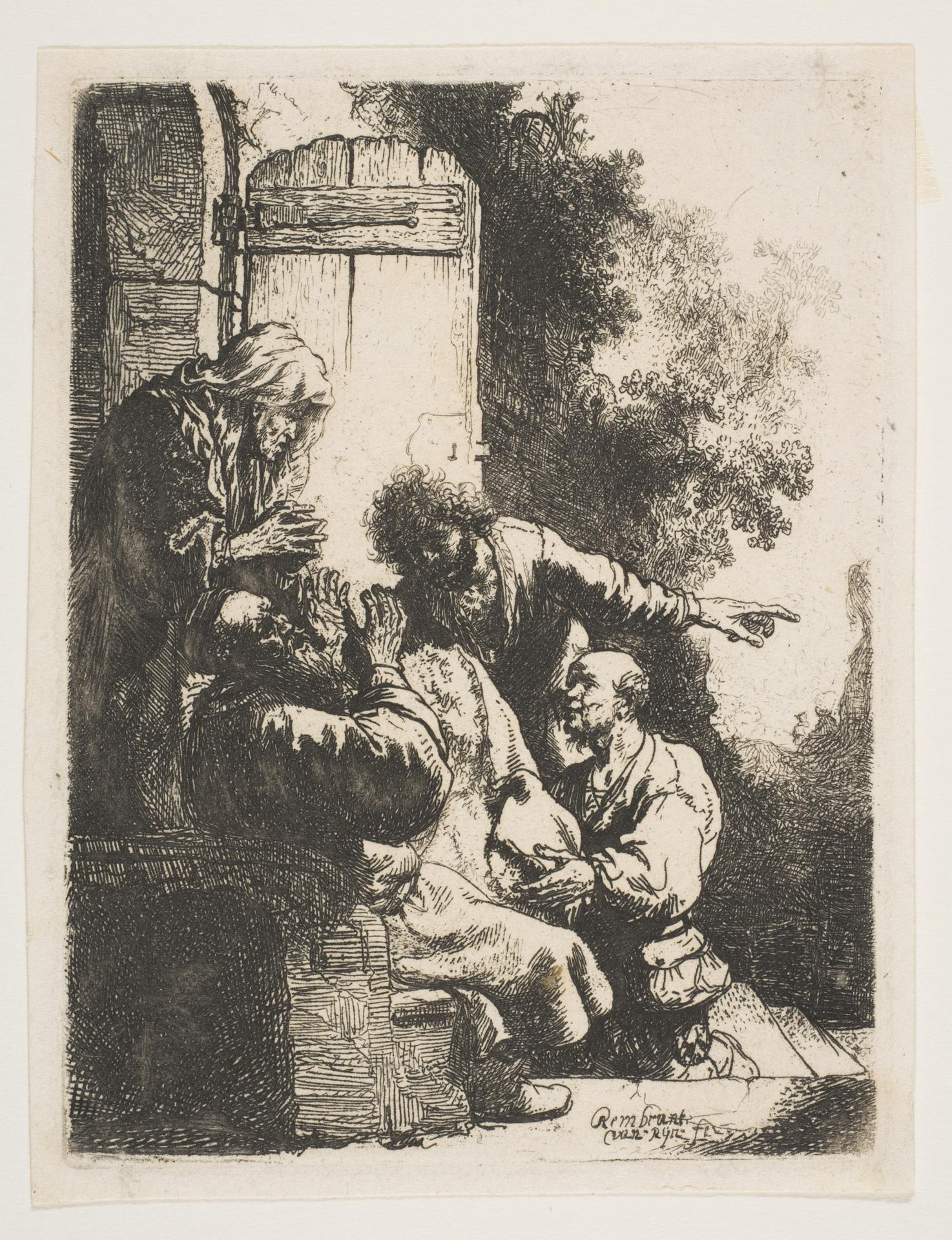
Joseph's Coat Brought to Jacob (ca. 1633, Met-Objekt 5254)
Original title: Joseph's Coat Brought to Jacob
kurzbeschreibung
The biblical story of Joseph and his brothers is the starting point for this etching by Rembrandt from around 1633: the brothers bring their father Jacob Joseph's bloodstained coat. The work is a black-and-white print measuring approximately 11.5 × 8.8 cm (sheet size). This is the second state of two.
Description
Three figures occupy an interior before a wooden door. The figure on the left holds up a garment and offers it, while the seated person in the middle directs his gaze toward it. On the right, another participant kneels, also looking at the clothing. Through an opening in the rear, trees and plants are visible, suggesting a window. Strong light-dark contrasts and fine hatching give the figures and the space a sense of volume.
Context
Rembrandt made this etching during his early Leiden period, when he devoted himself increasingly to biblical subjects with psychological depth. The motif goes back to Genesis 37, where Jacob is presented with Joseph's bloodstained coat as supposed proof of his death. Rembrandt took up the narrative several times and in different techniques, evidence of his lasting interest in the material. The second state contains revisions that further developed the lighting.
Impact
The tight grouping of the figures and the incoming light create a mood that oscillates between intimacy and drama. The viewer is drawn into the emotional tension of the moment, yet the feelings of those involved do not seem exaggerated. The calm arrangement and precise linework give the print a haunting, almost meditative presence.
Technique
For this etching, Rembrandt scratched the drawing into a wax layer on a copper plate and then etched it. During printing, the inked plate transferred the lines to the paper. In the second state, additional work was done on the plate, intensifying the shading and contrasts.
AI-generated description text
Source: Metropolitan Museum of Art · Public Domain (CC0 1.0)