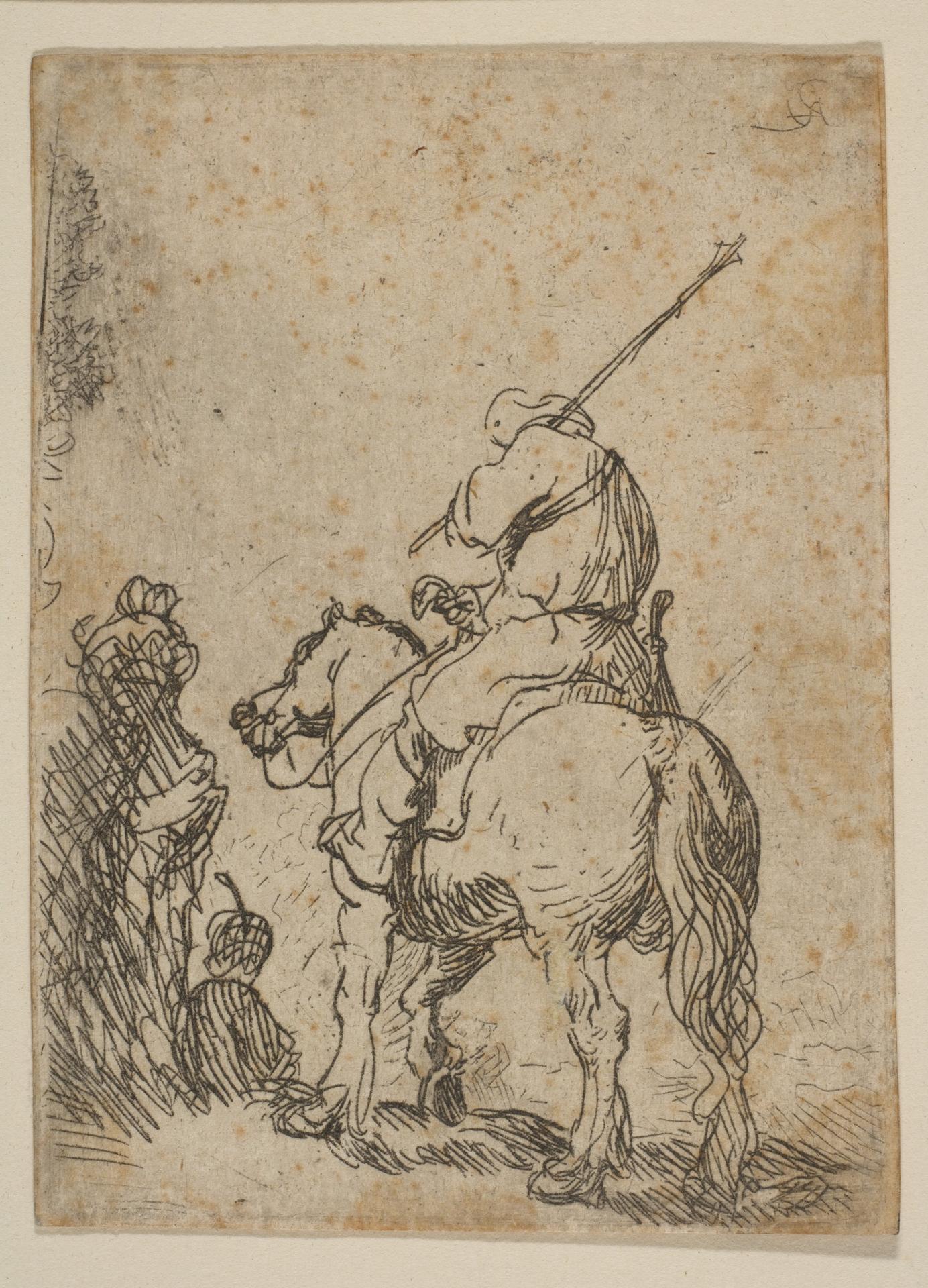
Turbaned Soldier on Horseback
Original title: Turbaned Soldier on Horseback
kurzbeschreibung
A rider wearing a turban and carrying a lance, his horse moving at a brisk pace: this etching by Rembrandt was made around 1629 and is presented here in the second of two states. The soldier belongs to a compact, animated scene devoted entirely to the study of man and animal.
Description
The horseman leans slightly forward, lance in hand, while the horse presses ahead with legs spread and tail streaming. At the left edge of the sheet, a few short strokes suggest bushes and plants. Rider and mount occupy the middle, yet the whole does not feel strictly ordered—it reads like a fragment cut from a larger movement. Gray tones dominate the image; light falls evenly and leaves hardly any shadow.
Context
During his early Leiden years, Rembrandt devoted himself intensively to printmaking, and this etching belongs to that phase. Turbans and orientalizing garments were a common motif in seventeenth-century Holland, bringing an exotic atmosphere into domestic art. The small sheet reads like a private exercise, perhaps for his own study or intended for sale. The dating around 1629 rests on stylistic observations and on the nature of the printing plate.
Impact
The loosely placed strokes give the sheet a sketchy, unfinished quality, and precisely through this the rider seems to move. Because color is absent, all attention goes to the rhythm of the horse's legs and the lance. The etched lines leave a delicate grain, so that the small format displays a surprising amount of structure.
Technique
For the etching, the copper plate was coated with a ground into which the artist scratched the lines before the metal was deepened in an acid bath. Fine and stronger strokes thus produce different gray values and surfaces. Printing was done on paper; the present impression is the second state of the plate, which differs from the first by minor reworkings.
AI-generated description text
Source: Metropolitan Museum of Art · Public Domain (CC0 1.0)