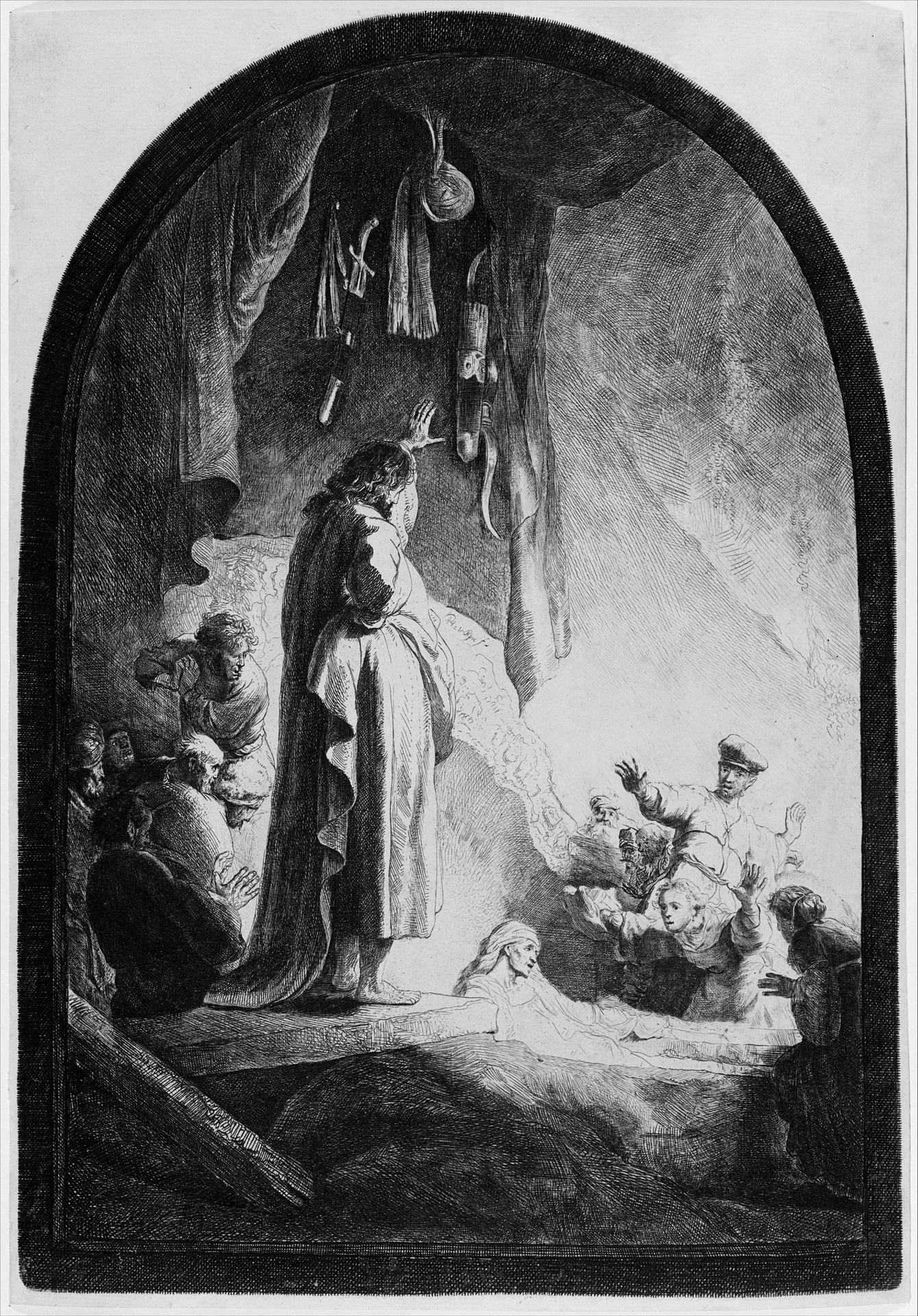
The Raising of Lazarus: The Larger Plate (ca. 1632, Met-Objekt 5249)
Original title: The Raising of Lazarus: The Larger Plate
kurzbeschreibung
Rembrandt van Rijn made this etching, The Raising of Lazarus: The Larger Plate, around 1632, taking the biblical story of Lazarus's revival as its subject. Etching combined with engraving, the sheet survives as the fifth of nine states according to New Hollstein and measures roughly 36.7 × 25.8 cm.
Description
Christ stands at the heart of the picture with his hands raised, touching Lazarus, who lies stretched out on a table. A crowd presses around the two figures, their reactions running from shock to joy. Behind them, objects that recall weapons or tools can be made out. The room stays dark, but light enters through a window and picks out the main figures. The arrangement feels balanced, with Christ as the point the eye returns to.
Context
This print belongs to Rembrandt's early Leiden years, shortly before he moved to Amsterdam. The raising of Lazarus was a popular subject in seventeenth-century Dutch art, since it allowed artists to test dramatic effects of light and dark. During those years Rembrandt worked intensively in printmaking and tried out a range of techniques.
Impact
A striking handling of light stages the miracle of the raising with real force. Fine lines and graded shading build into an almost mystical atmosphere that draws the viewer straight into the biblical event.
Technique
Engraving was added to the etching, which let Rembrandt work out the finest details and the deepest shadows. Repeated reworking of the plate accounts for the nine states; the fifth shows a further developed treatment with refined effects of light.
AI-generated description text
Source: Metropolitan Museum of Art · Public Domain (CC0 1.0)