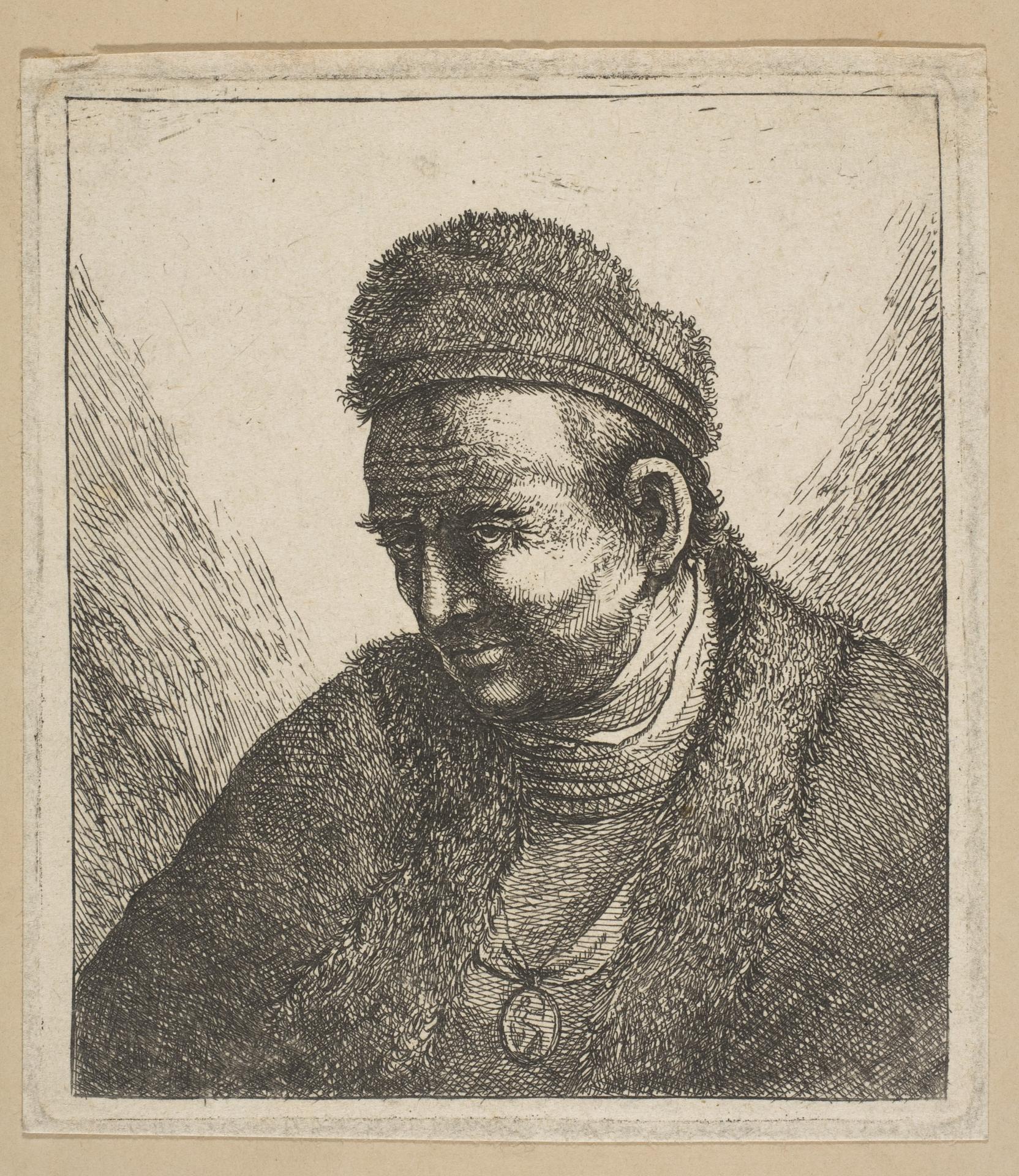
Beardless Man in Fur Cloak and Cap: Bust
Original title: Beardless Man in Fur Cloak and Cap: Bust
kurzbeschreibung
Unlike related portraits of its era, this print puts a clean-shaven man in profile facing left at its center, wearing a fur hat, a fur-trimmed cloak, and a small pendant attached to the garment. David Deuchar made the etching in the second half of the eighteenth century; the format measures 8.8 × 7.8 cm.
Description
Head and upper body fill almost the entire image, with the face turned to the left. A hat of the same material sits above the fur-lined jacket, and a small pendant hangs from the clothing. Behind the figure the ground stays sparse; horizontal lines suggest shadow and surface texture. Light comes from the left, so the right side of the face and the right side of the clothing fall into darkness. No other elements appear, and the gaze remains fixed on the person.
Context
Deuchar worked as a Scottish engraver and portraitist in the eighteenth century. This print belongs to the second half of that century, when prints were valued both as a means of reproduction and as an independent art form. The motif of a bearded or clean-shaven man in fur clothing may point to models from Dutch or Flemish painting that Deuchar reproduced. Biographical details about this specific impression are not recorded.
Impact
The clear profile view and carefully placed lines give the print a collected, quiet presence. Despite the small format, the fur gains body and depth through the lighting. Because all accessories are absent, attention turns almost by itself to the man's facial features.
Technique
The drawing was etched into a copper plate, from which the prints were pulled. Fine hatching and cross-hatching create the tonal steps and textures needed for fur and shadow. Printing was in black on paper, which produces the monochrome appearance.
AI-generated description text
Source: Metropolitan Museum of Art · Public Domain (CC0 1.0)