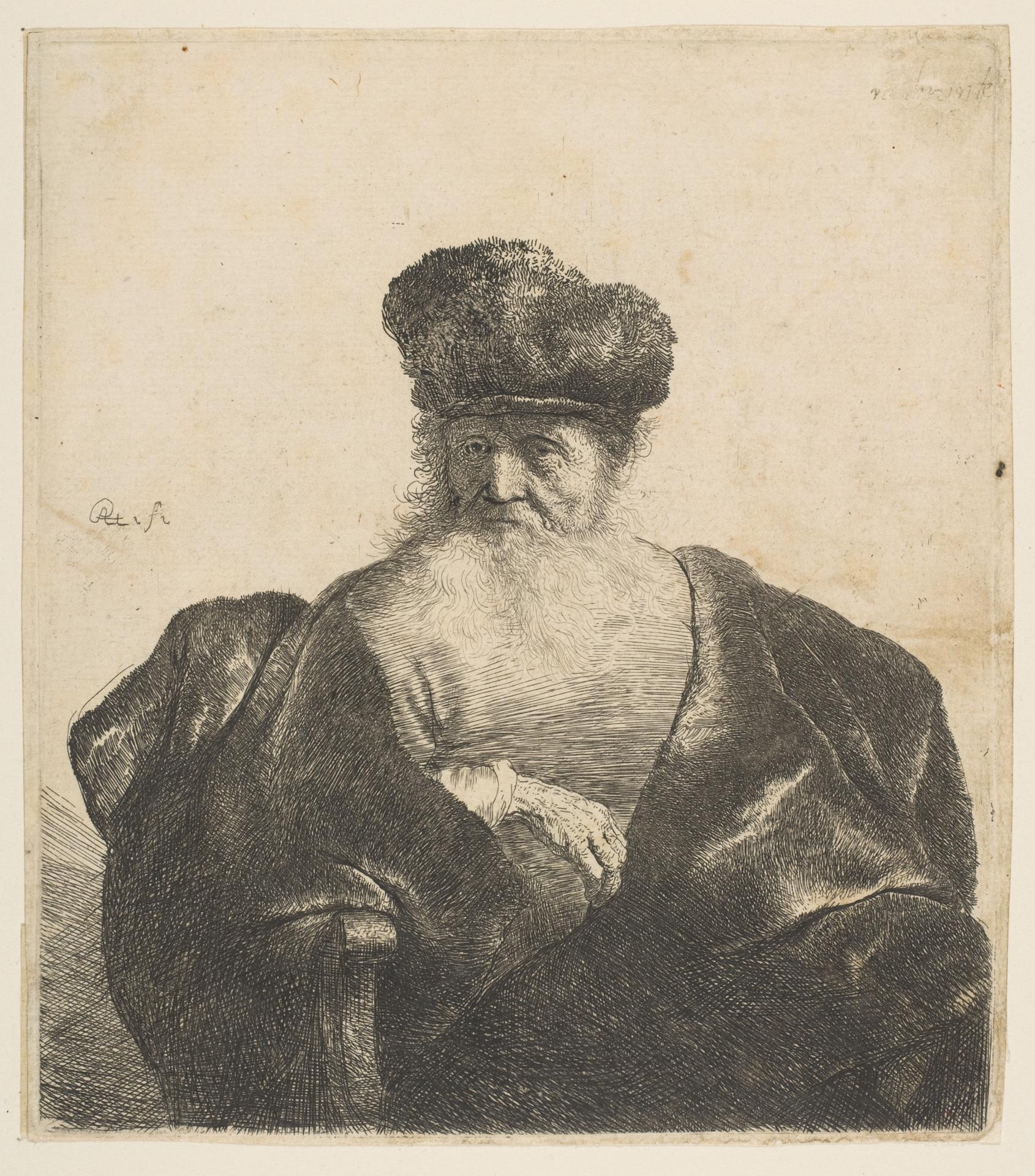
Old Man with Beard, Fur Cap, and Velvet Cloak (ca. 1631, Met-Objekt 5246)
Original title: Old Man with Beard, Fur Cap, and Velvet Cloak
kurzbeschreibung
Rembrandt van Rijn made this etching, Old Man with a Beard, Fur Cap and Velvet Cloak, around 1631. It gives us a bearded old man shown at half length, wearing a fur hat and velvet clothing. His head tilts slightly to the left and his gaze drifts off into the distance. The impression is the third state and measures 14.8 × 13 cm.
Description
A full-bearded elderly man in a fur cap and velvet jacket appears in half profile. His head leans a little to the left, eyes wandering far off, and one hand rests on his thigh. Head and upper body form the pivot of the arrangement. Everything is rendered in monochrome shades of grey, with even light and no harsh contrasts. The ground behind him stays bare, without further objects or figures.
Context
Around 1631, during his Leiden years, Rembrandt devoted himself closely to studying facial expressions and the marks of age. Such studies were typical of his early period and served both as preparations for larger paintings and as independent works. The etching went through several states; the third points to a reworking of the plate. In portraits like this he practised handling light and shadow and capturing textures.
Impact
A quiet, thoughtful mood comes off the sheet, reinforced by the absent gaze and soft lines. Careful shading makes beard, fur and velvet feel almost tangible. The print reads as intimate, focused entirely on the old man himself.
Technique
Etching is an intaglio process in which the drawing is scratched into a metal plate and bitten with acid. Rembrandt used fine lines and cross-hatching to work out the structures of beard, fur and cloth. Printing was in black on paper, and the grey tones arise from varying densities of line. The third state reveals later revisions to the plate that brought finer details or altered contrasts.
AI-generated description text
Source: Metropolitan Museum of Art · Public Domain (CC0 1.0)