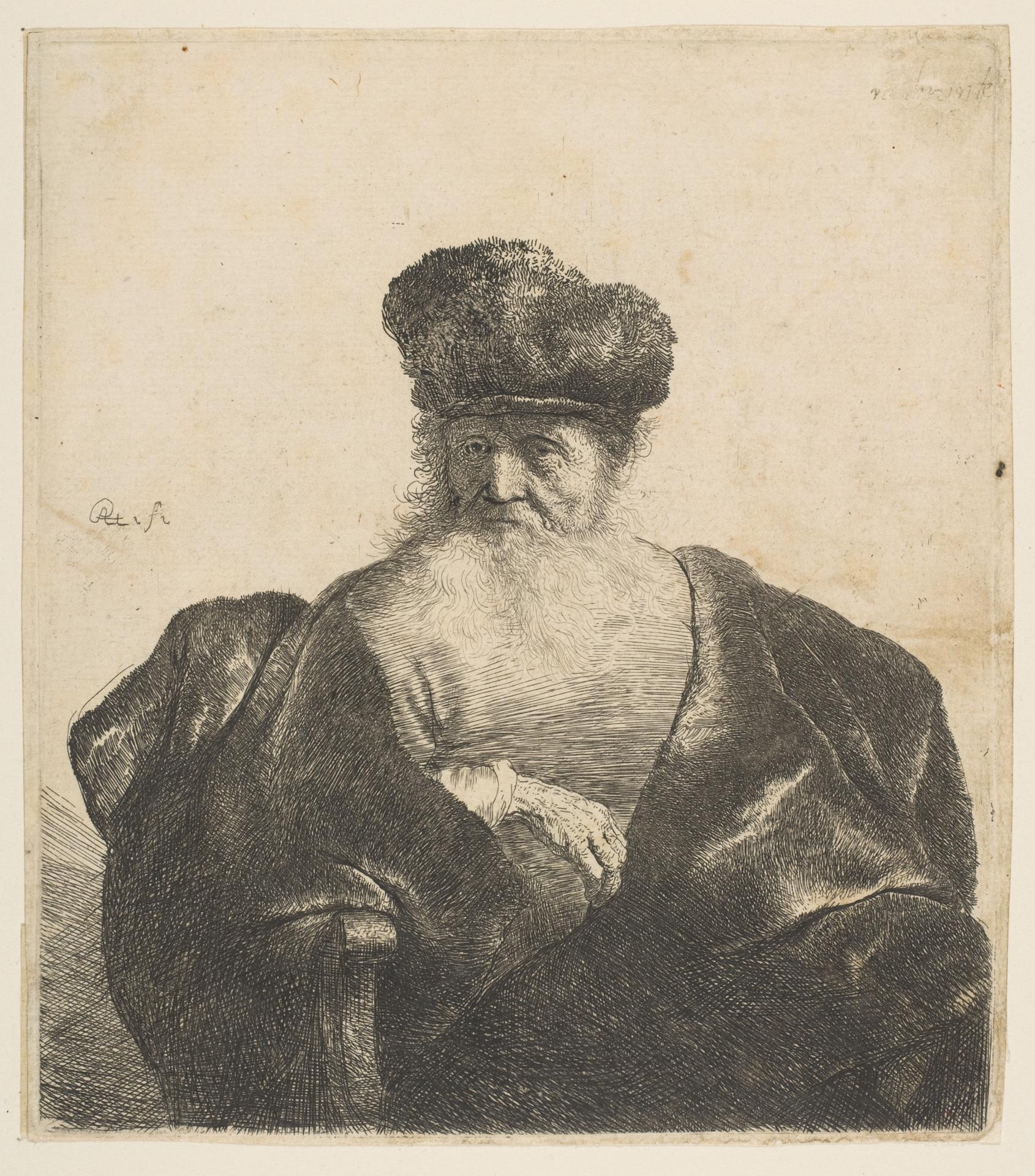
Old Man with Beard, Fur Cap, and Velvet Cloak (ca. 1631, Met-Objekt 5244)
Original title: Old Man with Beard, Fur Cap, and Velvet Cloak
kurzbeschreibung
Rembrandt van Rijn made this etching around 1631. It presents an old man with a full beard, a fur hat, and a dark velvet cloak. The seated portrait draws attention to the meticulously worked face and clothing.
Description
An elderly man with a thick beard and a fur hat appears in the print. He wears a heavy, dark jacket, its sleeve falling over his shoulder. He sits and looks slightly to the left, his left hand resting on his arm. The hatching varies in thickness and subtlety, bringing out the texture of beard and fabric. The background stays bare, focusing attention on the figure. The image is in black and white, revealing the etching technique.
Context
This sheet belongs to Rembrandt's early Leiden years, when he delved into character heads and biblical figures. Studies of old men were common in the seventeenth-century Netherlands and served as models for larger paintings or as independent collector's items. Rembrandt used etching to achieve fine transitions of light and shadow, demonstrating his command of the medium.
Impact
The portrait conveys a calm, dignified view of old age. Precise lines and a simple layout create a pensive mood. Through the accurate rendering of beard and clothing, the image feels almost tangible and draws the viewer closer.
Technique
This is an etching in the second state, meaning the plate was reworked after the first impressions. Rembrandt employed etching, in which lines are bitten into a copper plate treated with acid, to allow fine and varied line widths. The black-and-white reproduction shows the typical linearity and richness of detail of this printmaking process.
AI-generated description text
Source: Metropolitan Museum of Art · Public Domain (CC0 1.0)