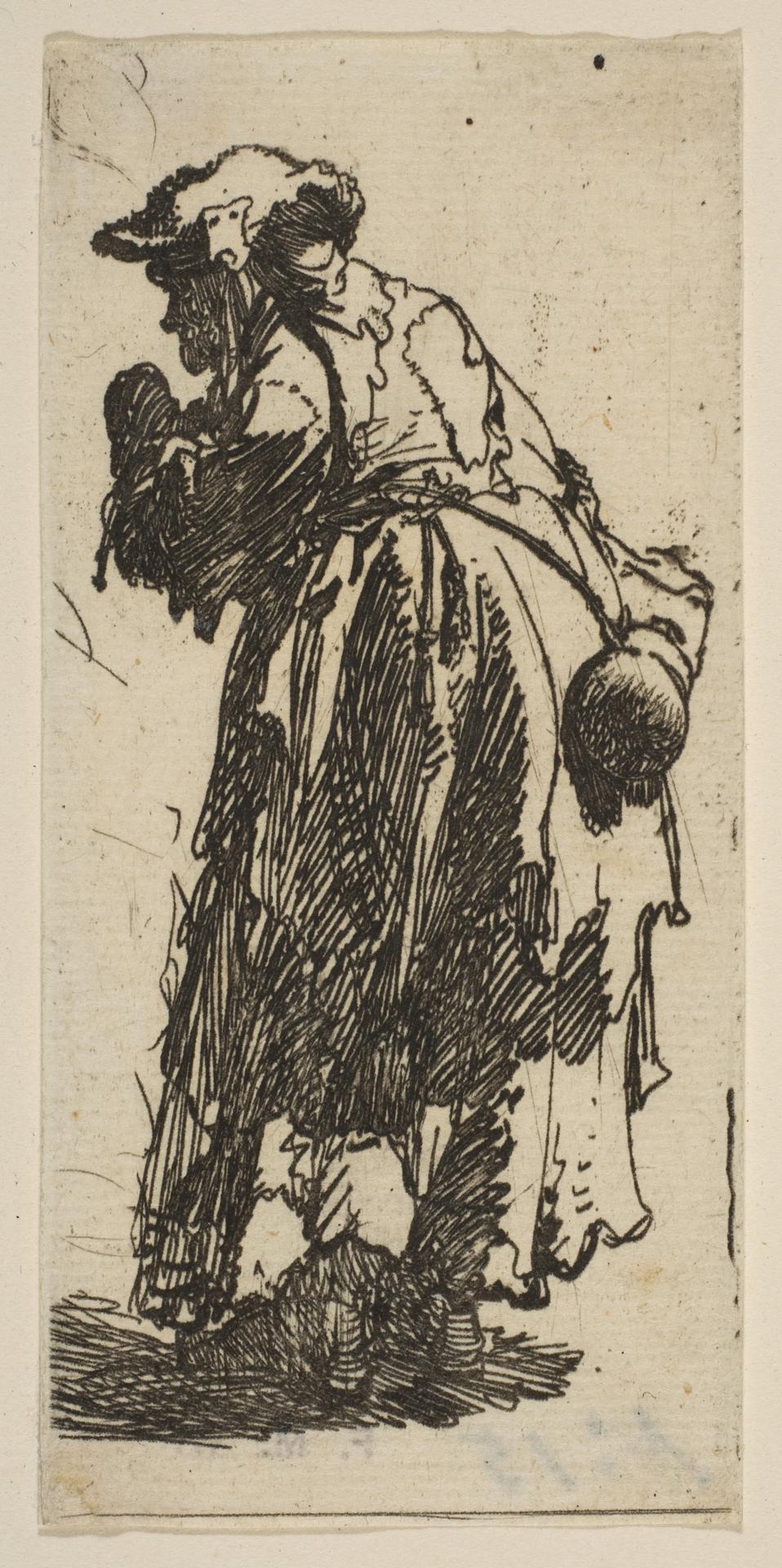
Old Beggar Woman with a Gourd
Original title: Old Beggar Woman with a Gourd
kurzbeschreibung
An elderly woman in plain clothes stands holding a gourd, etched by Rembrandt around 1629. The print belongs to his early work, in which he turned his attention to people on the margins of society, and it ranks among his first experiments in printmaking.
Description
Upright and nearly centered, the woman fills the plate. A cap covers her head; she wears a jacket with fur at the collar and trousers, and a gourd-shaped object hangs at her side. The line is plain yet full of detail, drawing out the textures of cloth and paper. Bare surroundings let the figure stand out clearly. Everything is rendered in black and white.
Context
During his early years in Leiden, Rembrandt devoted himself to scenes of daily life and studies of figures, and this etching grew out of that setting. Beggars were a familiar subject in the seventeenth-century Netherlands, linking social reality with moral overtones. The sheet joins a series of etchings in which Rembrandt varied his etching technique and worked with delicate linework.
Impact
Almost sketch-like and very immediate, the print asserts the old woman's dignity despite her poverty. Because she stands alone and the lines stay fine, a quiet, reflective mood settles over the image and draws the viewer into sympathy.
Technique
In etching, the drawing is scratched into an acid-resistant layer on a copper plate, which is then bitten. The second state of that plate is shown here: after the first printing, Rembrandt made further changes. Finest lines and graduated tones attest to his sure command of the process.
AI-generated description text
Source: Metropolitan Museum of Art · Public Domain (CC0 1.0)