The Blindness of Tobit: A Sketch
Original title: The Blindness of Tobit: A Sketch
kurzbeschreibung
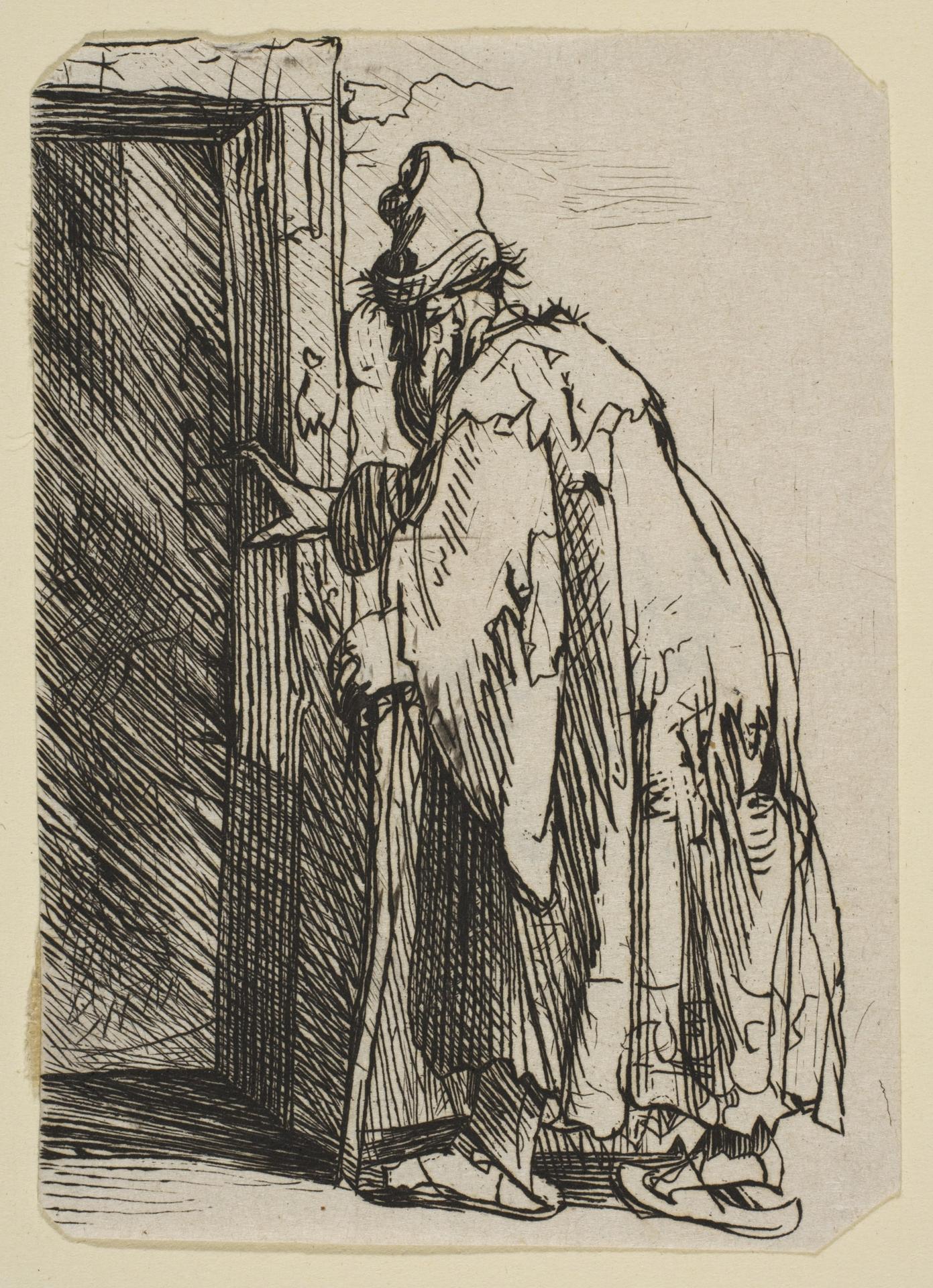
William James Smith made this etching, 'The Blindness of Tobit: A Sketch', around 1825. On a sheet measuring just 7.6 by 5.4 cm, a male figure leans against a door — the biblical Tobit, whose blindness has left him fixed in a brooding stillness.
Description
Light enters from the left edge and picks out the figure and the door, leaving soft shadows to their left. A man stands leaning against a door, wearing a cap and a long-sleeved jacket with a fur collar. His posture reads as pensive and withdrawn, reinforced by the folds of the jacket and his expression. Vertical strokes give the door its structure, while horizontal lines suggest the ground.
Context
Around 1825, biblical subjects were widely taken up in British art. William James Smith, a British artist, was best known for small-format prints. His source was the apocryphal story of Tobit, who went blind after an accident.
Impact
A quiet, melancholy mood comes off the sheet, helped by the spare linework and the man's brooding stance. The etching feels intimate and draws the viewer into the inner world of the figure shown.
Technique
Etching is an intaglio process in which lines are bitten into a metal plate. The detailed line structure and shading show the kind of stroke work typical of etching, which allows delicate transitions between light and dark.
AI-generated description text
Source: Metropolitan Museum of Art · Public Domain (CC0 1.0)