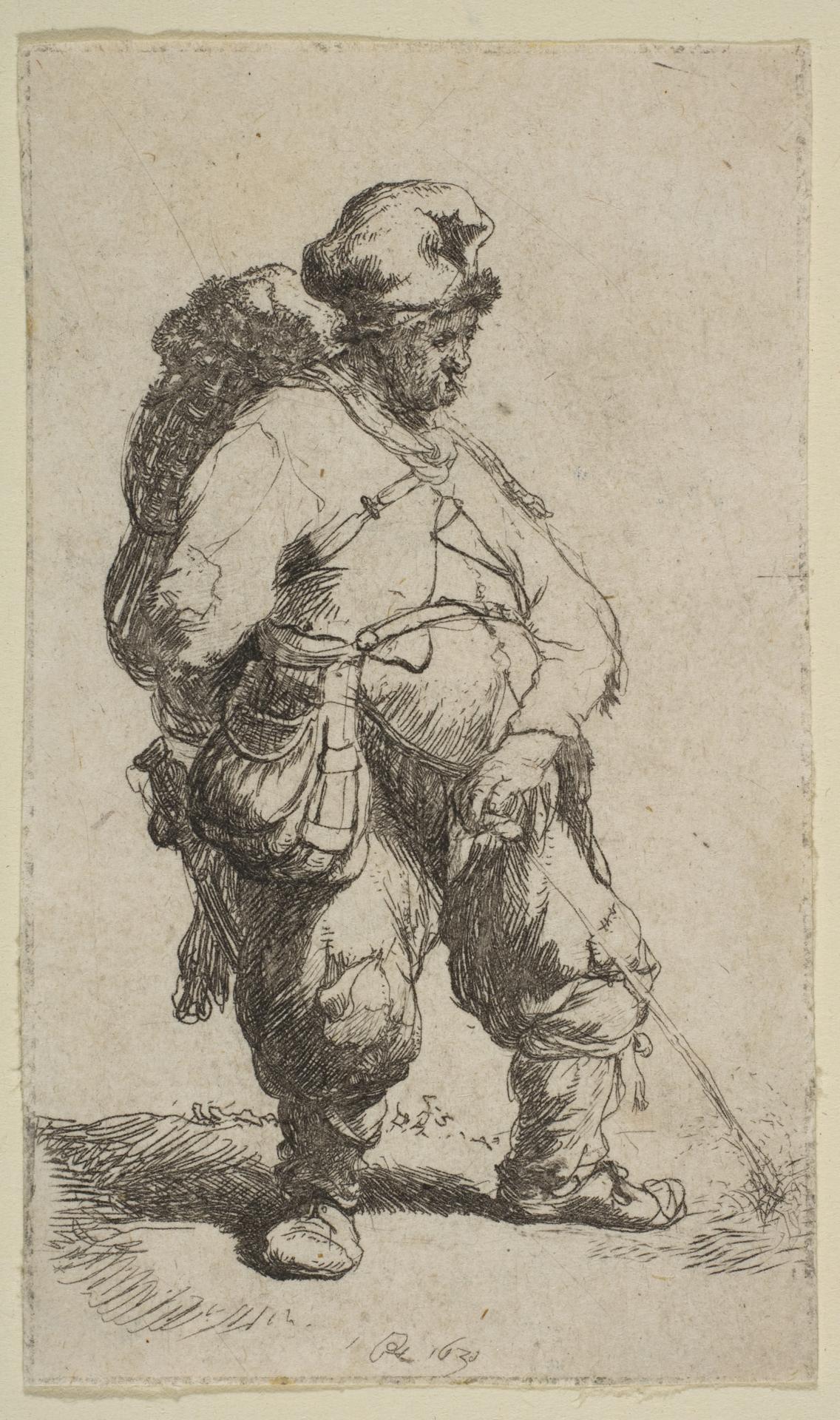
A Man Making Water (1630)
Original title: A Man Making Water
kurzbeschreibung
Rembrandt etched "A Man Making Water" in 1630. A peasant is shown striding forward, legs apart, mid-step. The impression is the fourth of five states.
Description
A man in rural dress steps toward the viewer: a fur-lined jacket over a cap with a star, a belted vest with pockets beneath, trousers and boots. A large pack rides on his back, his right hand grips a stick. His head is lowered and his posture reads as walking. Grass and bare earth are suggested with a few strokes; the landscape stays flat and sparse. Even light without hard shadows hints at daytime.
Context
The etching was made in Leiden in 1630, during a period when Rembrandt studied the lives of ordinary people closely. Scenes of peasant life were widely popular in seventeenth-century Dutch art and met a broad interest in country folk. This sheet belongs to a group of studies made in the late 1620s and early 1630s.
Impact
The print has an immediate, restless effect that comes chiefly from the walker's stance. Dense linework and close attention to the clothing give the figure physical presence. With the setting held back, attention falls almost entirely on the man and his step.
Technique
Rembrandt worked the etching with fine, deliberate lines in the ground, which allowed him to render fabric textures and details of dress precisely. That the sheet survives in the fourth of five states shows the plate was reworked.
AI-generated description text
Source: Metropolitan Museum of Art · Public Domain (CC0 1.0)