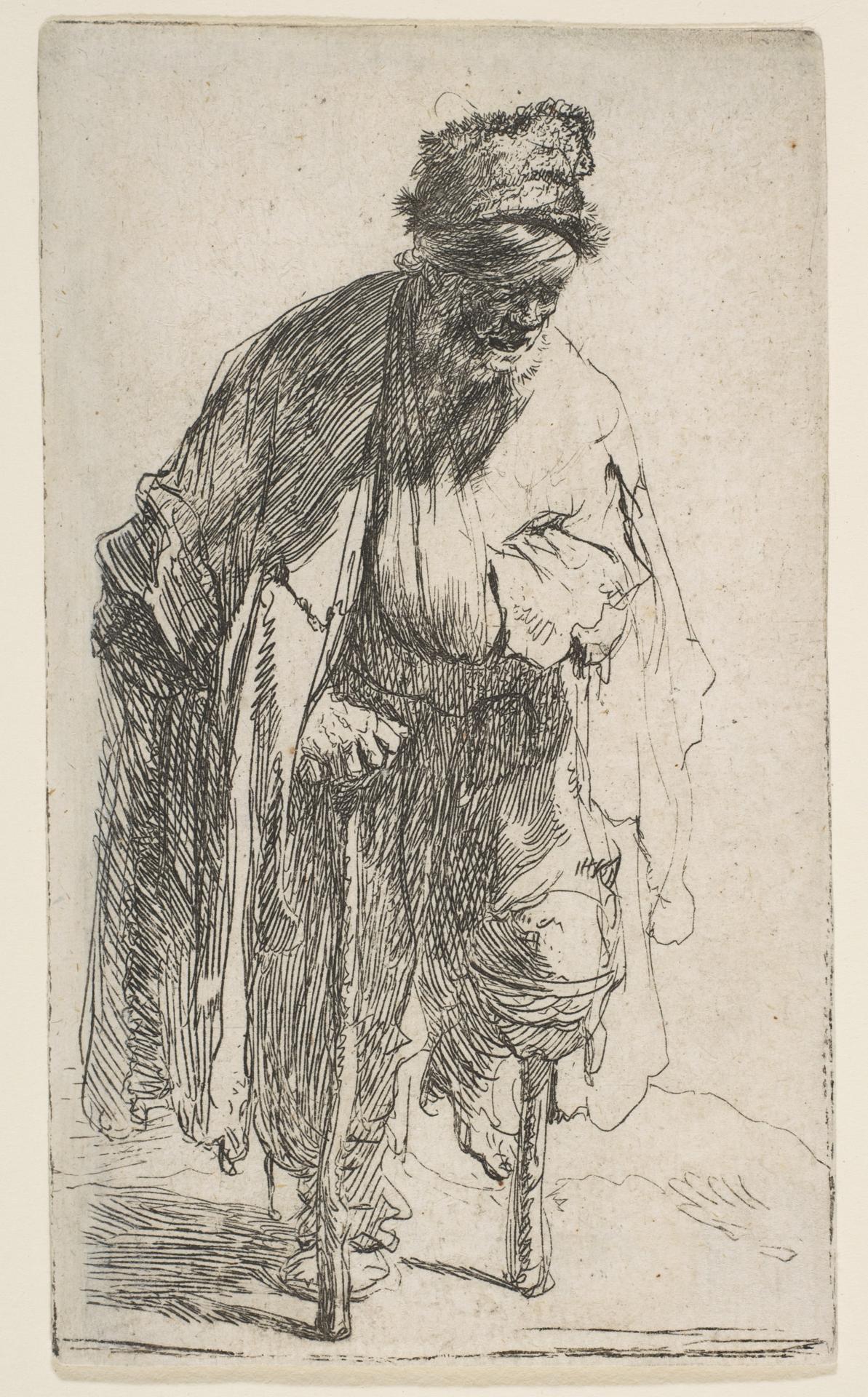
Beggar with a Wooden Leg (ca. 1630, Met-Objekt 5227)
Original title: Beggar with a Wooden Leg
kurzbeschreibung
A beggar leans on a staff, his right leg replaced by a wooden peg. Rembrandt etched this figure around 1630; the print exists in four states and measures 11.3 by 6.6 cm.
Description
The man stands alone, his gaze lowered, conveying bewilderment and exhaustion. His clothes hang loose and worn, and a shaggy cap sits on his head. His right hand grips a pole that serves as support. The layout remains spare, thrusting the figure fully into the foreground. Fine parallel strokes in black and white create graduated tones of light and shade.
Context
This etching belongs to Rembrandt's early Leiden years, when he closely studied beggars and figures on the margins of society. Such subjects were common in seventeenth-century Dutch art and often served as moral or social studies. The work is part of a series of beggar depictions made around 1630.
Impact
The bowed head and the scant space give the print an immediate, pressing quality. The delicate linework lends it an intimate, almost documentary feel, bringing hardship close to the viewer.
Technique
In etching, the plate is bitten with acid. Parallel, finely drawn lines, along with variations in the strength and direction of the stroke, produce graded gray tones. In the second of the four states, reworkings are already visible, making the figure's physical presence more pronounced.
AI-generated description text
Source: Metropolitan Museum of Art · Public Domain (CC0 1.0)