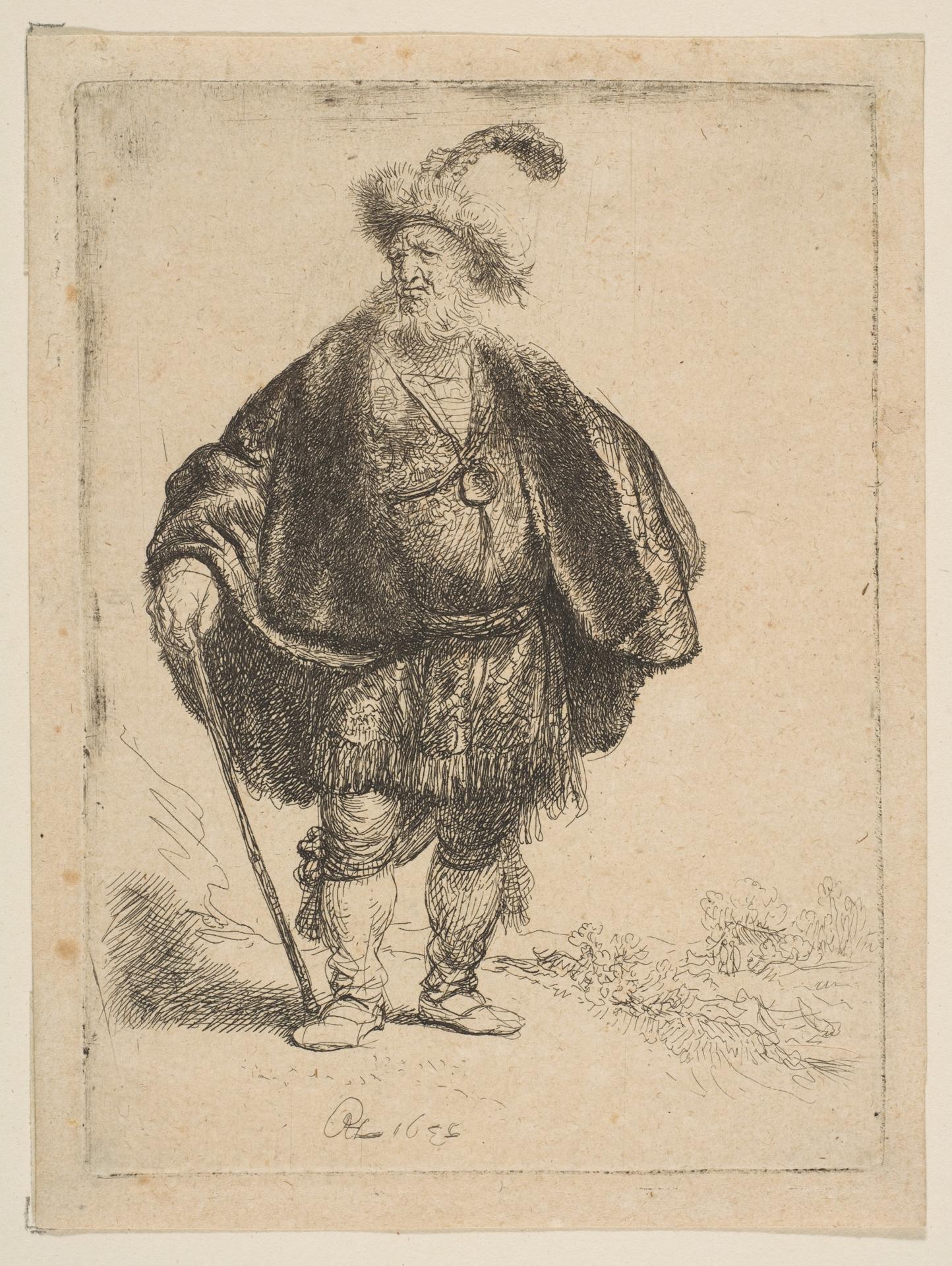
The Persian (1632, Met-Objekt 5208)
Original title: The Persian
kurzbeschreibung
A man in Oriental dress commands this etching, made by Rembrandt van Rijn in 1632. The impression is New Holl.'s first state of three and belongs among the artist's early engagements with exotic figures.
Description
Front and center stands a man in a turban, wearing a fur-trimmed jacket and trousers, with a chain and pendant at his neck. His right hand closes around a staff, and the ground at his feet is dotted with flowers and grass. Bright passages and deep shadows pull hard against each other, while the line varies in weight, drawing out textures and contours alike. Rembrandt's monogram and the date 1632 sit at the bottom of the sheet.
Context
Rembrandt made the etching in Leiden in 1632, a period when he was studying figures closely and working with exotic motifs. Such Oriental subjects were widely popular in the seventeenth-century Netherlands and often fed on trade contacts with the Ottoman Empire. Who the sitter actually was cannot be established with certainty; the title "Der Perser" was added only later.
Impact
The careful rendering of the clothing and the strong play of light and shadow give the figure an immediate presence. Dignity and strangeness meet in his bearing, carrying the viewer into a distant, exotic world.
Technique
This sheet is an etching: the drawing was scratched into a copper plate, which acid then bit. The slender line and its shifting thickness produce varied tones and surface textures. The present impression belongs to the first state, pointing to an early version of the plate.
AI-generated description text
Source: Metropolitan Museum of Art · Public Domain (CC0 1.0)