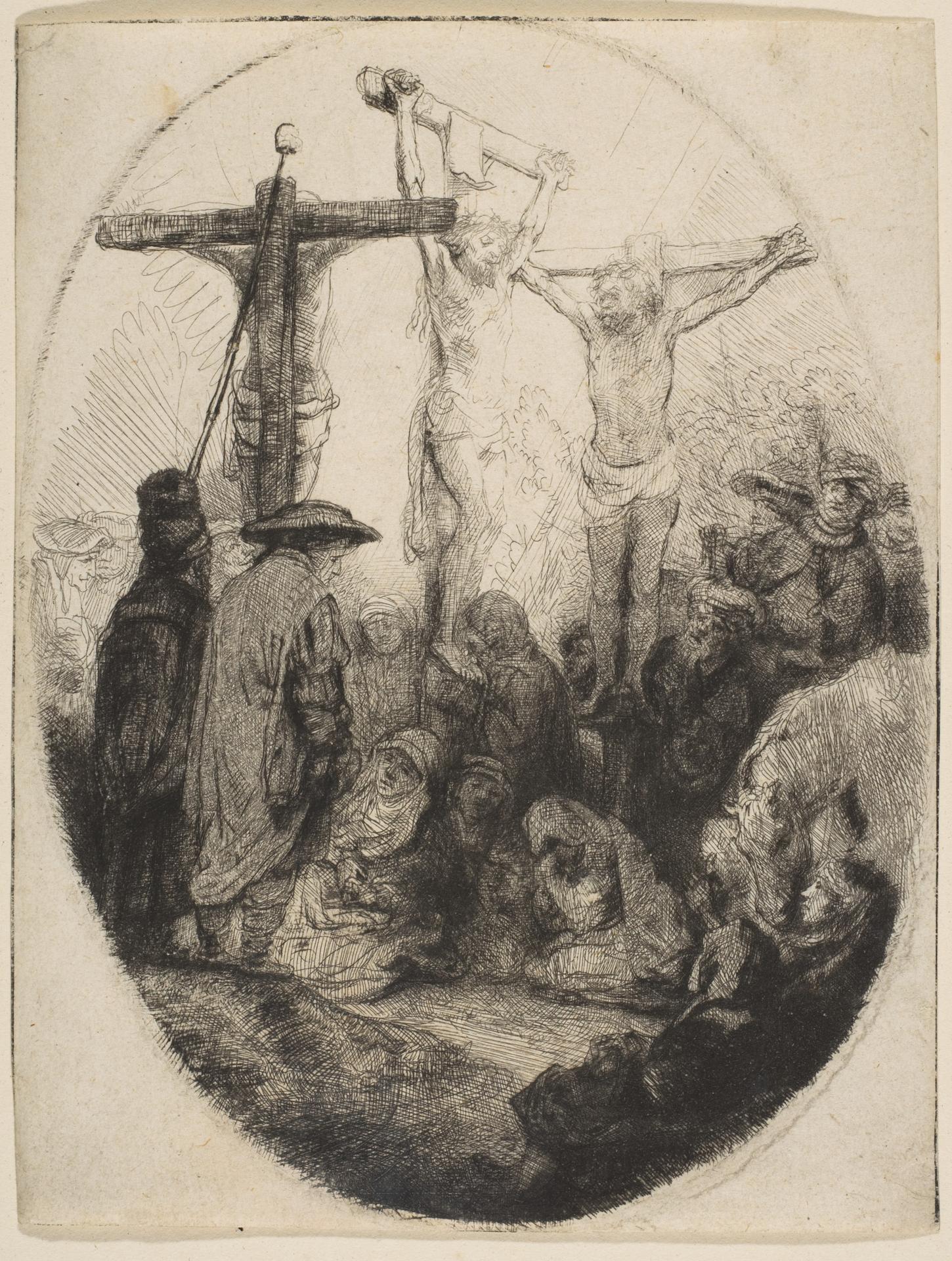
Christ Crucified Between Two Thieves; oval plate
Original title: Christ Crucified Between Two Thieves; oval plate
kurzbeschreibung
Unlike conventional crucifixion scenes, this oval etching by Rembrandt presents the subject on a minute scale: the plate measures just 5.5 by 4 cm. Made around 1641, it places Christ at the center, flanked by the two thieves, while mourning figures surround the event. Despite its tiny size, the arrangement feels concentrated and rich in detail.
Description
Three crosses structure the image: Christ's in the middle, the two thieves' to left and right. A bright background surrounds the figures and draws the eye to the group. Beneath the crosses, men and women crowd together, their postures reflecting grief and shock. Fine hatching and lines create the gray tones; light falling from above highlights bodies and crosses. Precisely worked details give the sheet its drama.
Context
Around 1641 Rembrandt was working in Amsterdam and increasingly devoted himself to biblical subjects in print. This sheet is the first state of two, suggesting later reworking. The small format and oval shape imply it was intended as a devotional image or for a collector.
Impact
The oval form and the light from above create a calm yet penetrating mood. Through delicate linework and shading, the scene gains depth, and the figures' sorrow becomes immediately palpable.
Technique
For this print Rembrandt used etching with drypoint: lines are bitten into a copper plate and also scratched directly with a needle. Drypoint leaves soft, velvety lines that here provide shading and detail. The unusually small paper size demands a precisely worked printing plate.
AI-generated description text
Source: Metropolitan Museum of Art · Public Domain (CC0 1.0)