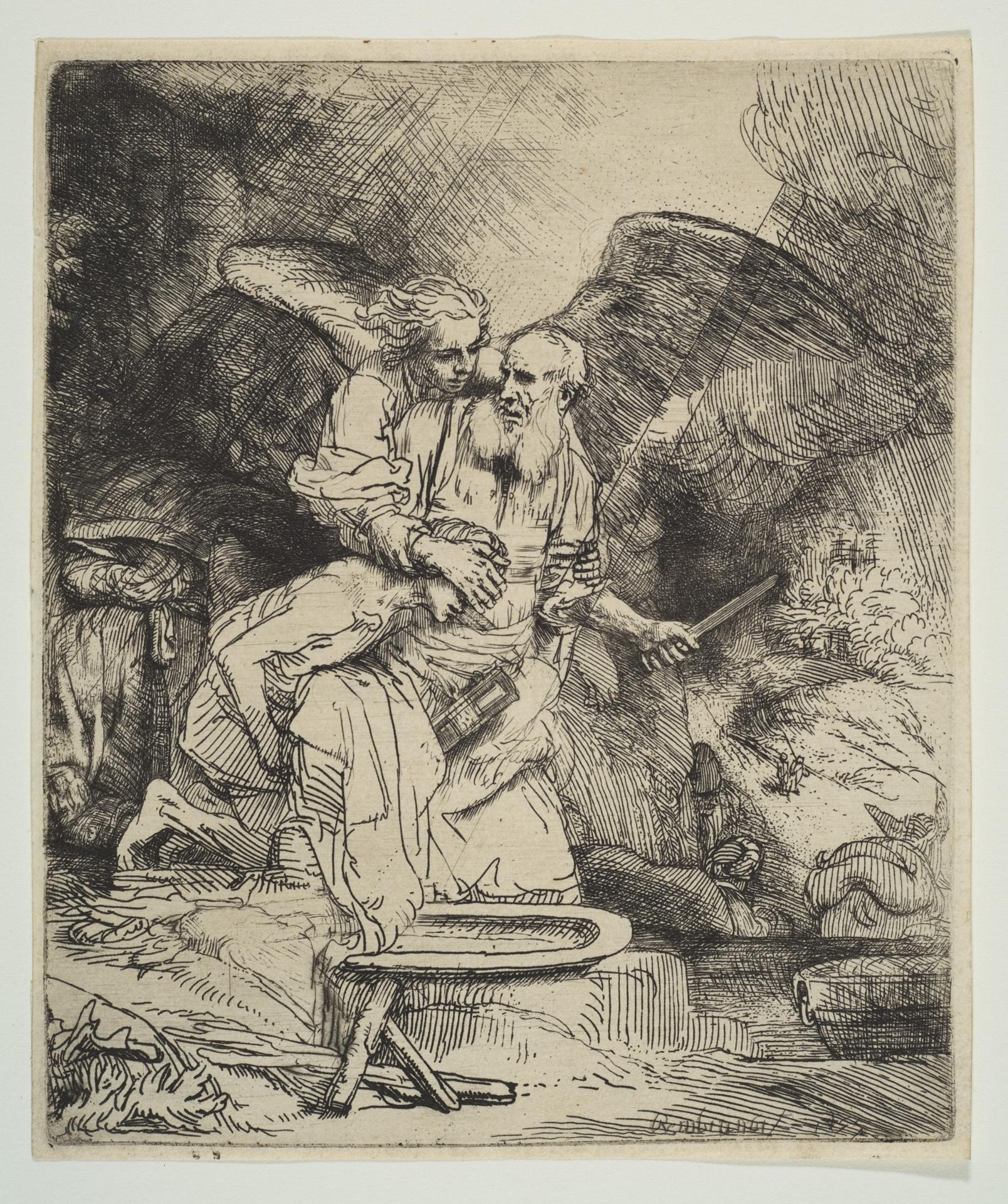
Abraham's Sacrifice (1655, Met-Objekt 5206)
Original title: Abraham's Sacrifice
kurzbeschreibung
Abraham, commanded by biblical tradition to sacrifice his son Isaac, stands at the heart of Rembrandt's 1655 etching. Made as an etching with drypoint on paper, the sheet measures 15.8 x 13.3 cm. It tells the dramatic instant when an angel halts the sacrifice and Abraham, Isaac and the messenger of God converge.
Description
Hunched on the ground is the aged Abraham, the handle of the knife still in his fist, while Isaac lies with his back to him. Behind Abraham an angel steps forward, wings spread wide, one hand resting on Isaac's shoulder. Two animals lie at rest in the distance. A shaft of light falling from above lifts the figures out of the dark ground and sets up harsh contrasts of light and shade. The faces are worked in minute detail; the garments follow biblical tradition.
Context
The etching was made in Amsterdam in 1655, during a period when Rembrandt was deeply engaged with biblical subjects and with printmaking. It belongs to his late work, a time when his handling of light and shadow was considered especially assured. The story follows Genesis 22, with the emphasis placed on the angel's intervention. Several of Rembrandt's prints are devoted to the sacrifice of Abraham.
Impact
Dark hatching and deliberately placed light build into a tense, almost menacing mood. The eye is drawn into the action, which wavers between threatened violence and divine intervention. The carefully wrought faces and the dramatic lighting give the sheet an immediate, almost staged presence.
Technique
Rembrandt turned here to etching and drypoint, a process he used often. In drypoint the line is scratched directly into the copper plate, producing soft, slightly frayed edges. The interplay of the two techniques allowed him finely graded transitions between light and shadow, which carry the dramatic effect of the print.
AI-generated description text
Source: Metropolitan Museum of Art · Public Domain (CC0 1.0)