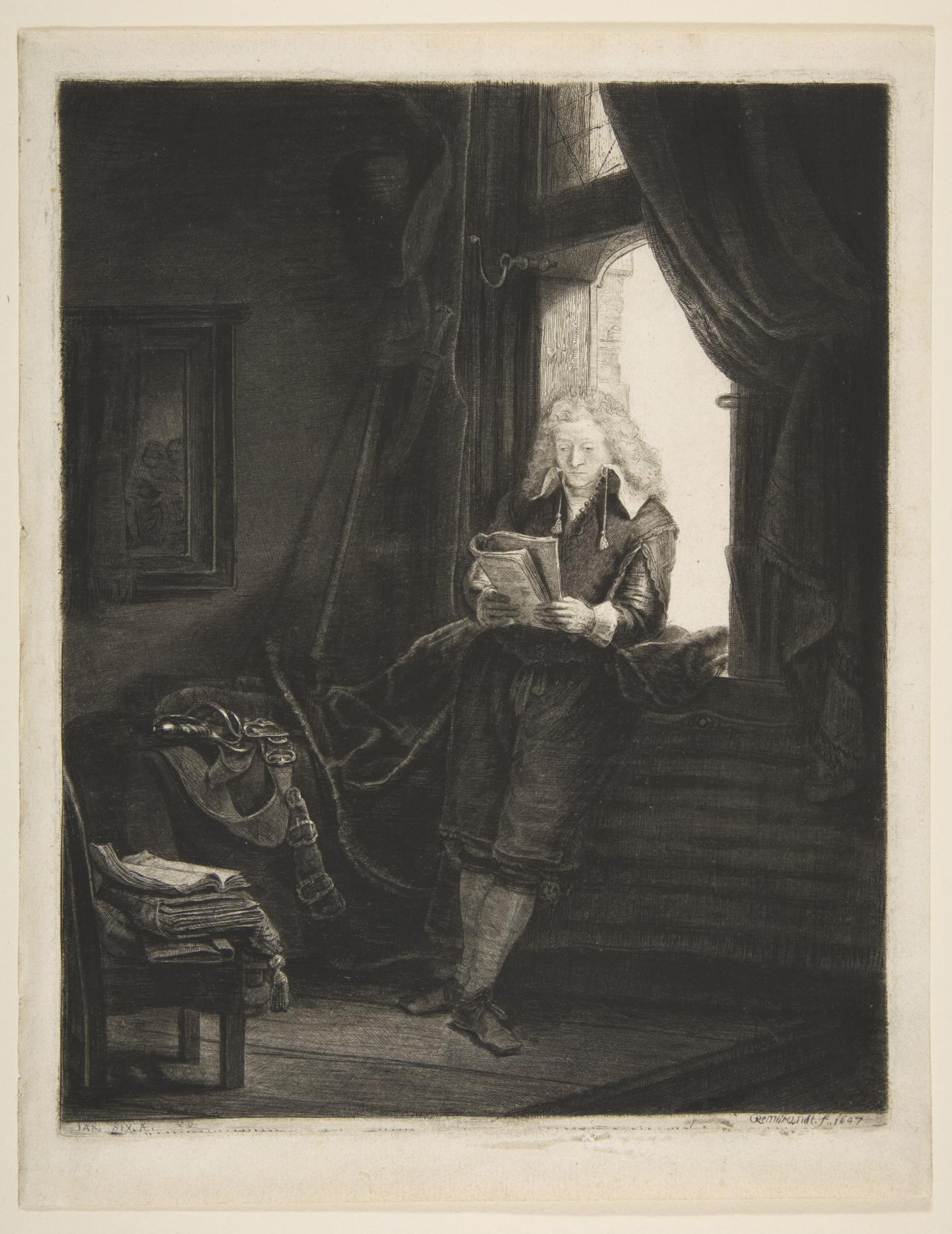
Jan Six (1647, Met-Objekt 5203)
Original title: Jan Six
kurzbeschreibung
A man sits reading at a window, his book held open in both hands — this is Rembrandt's 1647 etching Jan Six, portraying the Amsterdam merchant and future mayor in a quiet interior. The portrait was made in etching, drypoint and burin, and is shown here in the fifth of five states. Six is seated at a table, entirely absorbed in his book.
Description
A broad hat shades the face of the man, who holds an open book with both hands, his gaze lowered. His garment follows the fashion of the day and remains plain. Behind him on the left, light falls into the room through a window with a half-drawn curtain. On a chair in the foreground, more books are piled up. The arrangement feels balanced and calm; fine hatching and soft transitions define the shadowed areas.
Context
Jan Six (1618–1700) was a wealthy Amsterdam merchant, art collector and later mayor. Rembrandt portrayed him in 1647, when Six was about 29, in a private, intellectual pose. The print likely grew out of a friendship — Six supported the artist and later became his patron. The fifth state of the print shows clear traces of reworking with drypoint and burin, suggesting intensive treatment.
Impact
Concentrated and inward-looking, the reader appears; the mild light lifts him out of the darkness. The differentiated linework and soft shadows create an intimate, almost meditative atmosphere. Because the room is sparsely furnished, the eye is drawn entirely to the person and his activity — the print has a timeless calm.
Technique
The etching was further worked with drypoint and burin to gain the finest details and deep shadows. Drypoint leaves characteristic, slightly raised lines with soft burrs that print as velvety tones. The sheet was printed on paper with a visible plate tone, which enhances the spatial depth of the view.
AI-generated description text
Source: Metropolitan Museum of Art · Public Domain (CC0 1.0)