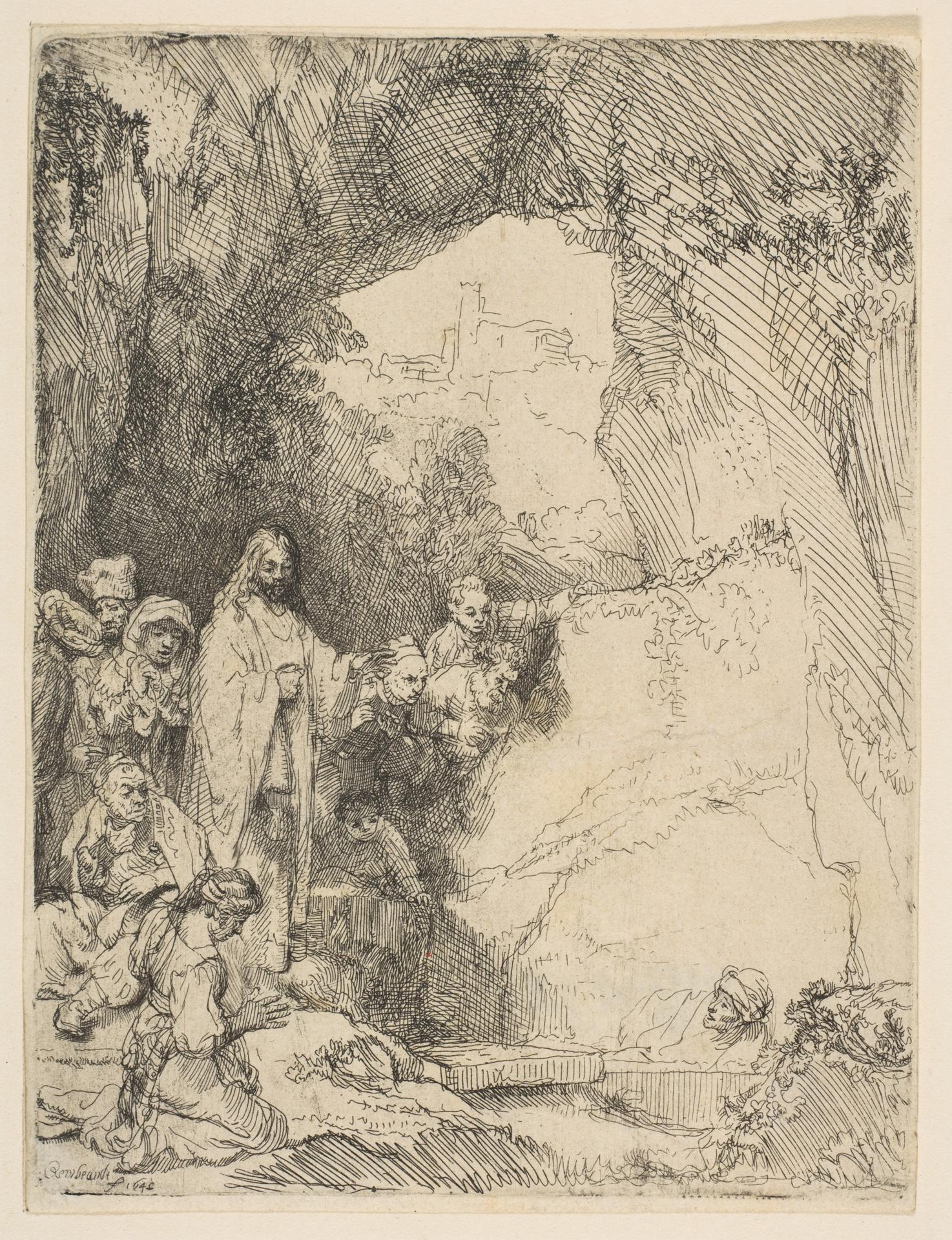
The Raising of Lazarus, small plate
Original title: The Raising of Lazarus, small plate
kurzbeschreibung
In 1642 Rembrandt van Rijn took up the biblical story of the raising of Lazarus and turned it into an etching. The sheet survives in the first of two states and measures 15.2 x 11.5 cm. Jesus is seen calling Lazarus out of the tomb while a group of witnesses looks on.
Description
At the front a figure kneels on the ground, others gathered around; their garments look traditional and point to an earlier age. A cave with an opening through which the raising takes place forms the setting behind them. Trees and shrubs frame the action and suggest a rural surroundings. The layout is restless and draws the eye to the central figure, from whom the event proceeds.
Context
During the 1640s Rembrandt turned more and more to biblical subjects, and the etching of 1642 falls within this phase. The raising of Lazarus was among the common pictorial themes in the seventeenth-century Netherlands. The artist was known for his experiments in printmaking, which included multiple states. The small plate shows how he handled dramatic scenes with delicate lines and graded shading.
Impact
The restless arrangement and the focus on the main figure create dramatic tension. Through the black-and-white rendering with its shadings the scene gains depth and spatial presence. The realistic style, with its emphasis on drama, fits the art of the seventeenth century.
Technique
In etching the drawing is scratched into a metal plate, which is then bitten with acid. Rembrandt worked with thin lines and shading to convey light and depth. Two states of the sheet are recorded; the present first one shows the original version.
AI-generated description text
Source: Metropolitan Museum of Art · Public Domain (CC0 1.0)