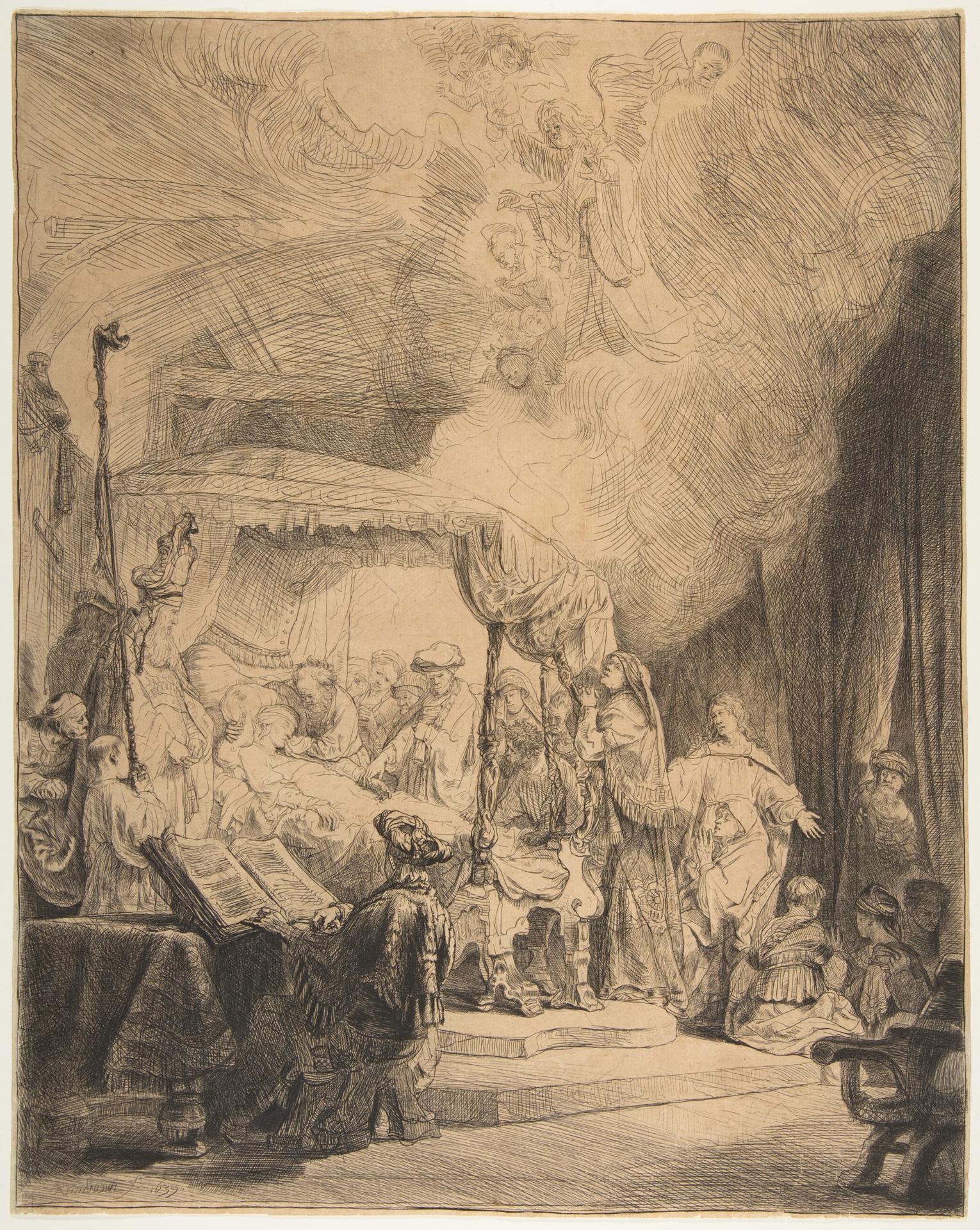
The Death of the Virgin (1639, Met-Objekt 5197)
Original title: The Death of the Virgin
kurzbeschreibung
In 1639 Rembrandt van Rijn etched The Death of the Virgin Mary. The print presents the dying Mary among the apostles, surrounded by angels who hint at her assumption. Rembrandt executed the motif as an etching with drypoint, in the fourth of five states.
Description
Mary lies on a bed at the center, ringed by praying figures. Angels hover above her, wrapping her in rays and signs of glorification. On the left, a man reads from a book, perhaps a prophet or priest. To the right, further figures are scattered in various poses: kneeling, standing, sitting. The layout converges symmetrically on Mary as the pivot.
Context
The etching was made in Amsterdam, which in the seventeenth century was a hub of the art trade. Rembrandt was then devoting himself intensively to biblical subjects. The death of the Virgin was a widespread motif in Catholic tradition that was also taken up in Protestant circles. It draws on the apocryphal account in which the apostles gathered at Mary's deathbed.
Impact
Dramatic light and expressive figures define the print. The delicate hatching and gradations of tone create a quiet, devotional atmosphere. Standing before the etching, the viewer is drawn into the scene and senses the coexistence of grief and heavenly glorification.
Technique
The etching depends on the drawing being scratched into an acid-resistant layer on the copper plate and then bitten. Drypoint is added, its burr leaving fine lines and enabling soft, dark tonal values. The print measures 39.4 by 31.2 cm and belongs to the fourth of five states, which documents a thorough reworking of the plate.
AI-generated description text
Source: Metropolitan Museum of Art · Public Domain (CC0 1.0)