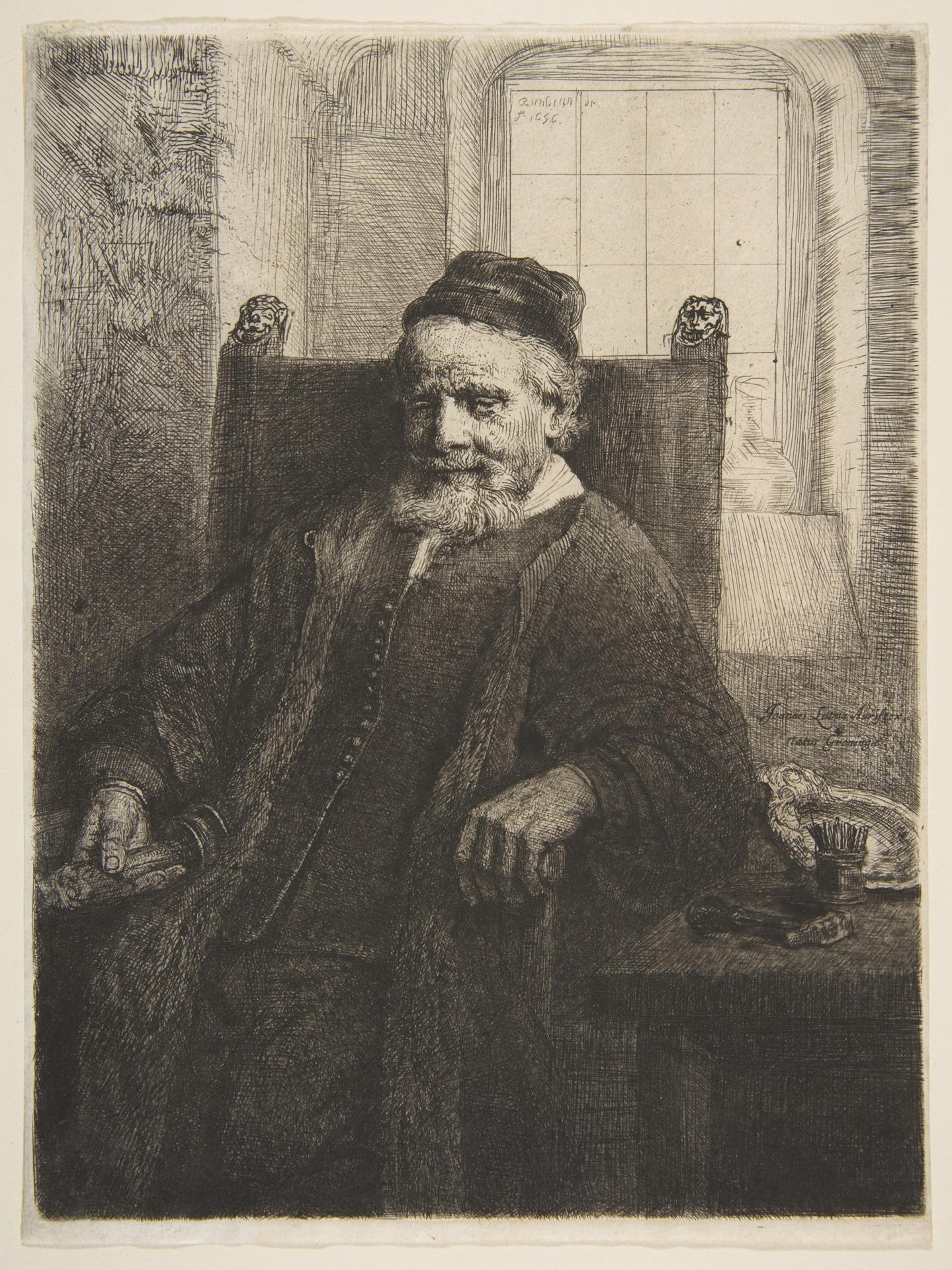
Jan Lutma, goldsmith
Original title: Jan Lutma, goldsmith
kurzbeschreibung
Jan Lutma, the goldsmith, sits half-length in a room crowded with tools and small sculptures. Rembrandt made this portrait in 1656 as an etching, engraving and drypoint, and this impression belongs to the first of four states. The image places the craftsman squarely within his own working surroundings.
Description
The older man occupies the middle of the sheet, wearing a dark jacket and cap, his gaze calm and thoughtful. Behind him a barred window opens, with the year 1656 set above it. On the left a wall runs back in vertical stripes; on the right two small sculptures stand on a pedestal. A cup and what appear to be tools lie in front. The arrangement feels symmetrical, and light falling from the front lifts the figure and the objects nearest to us.
Context
With Jan Lutma, Rembrandt portrayed in 1656 a well-known Amsterdam goldsmith, celebrated for his silverwork and his ties to the art world. During this period the artist turned increasingly to portraits of craftsmen and artists. The date in the window fixes the year of the print.
Impact
The closeness to the sitter and his steady gaze create a concentrated, reflective mood. Textures are rendered with great precision, and the clear handling of light underscores the craftsman's dignity.
Technique
Etching, engraving and drypoint are combined here, producing delicate lines and soft gradations of tone. The first state shows the plate before later reworking, with details such as the sculptures and tools executed precisely.
AI-generated description text
Source: Metropolitan Museum of Art · Public Domain (CC0 1.0)