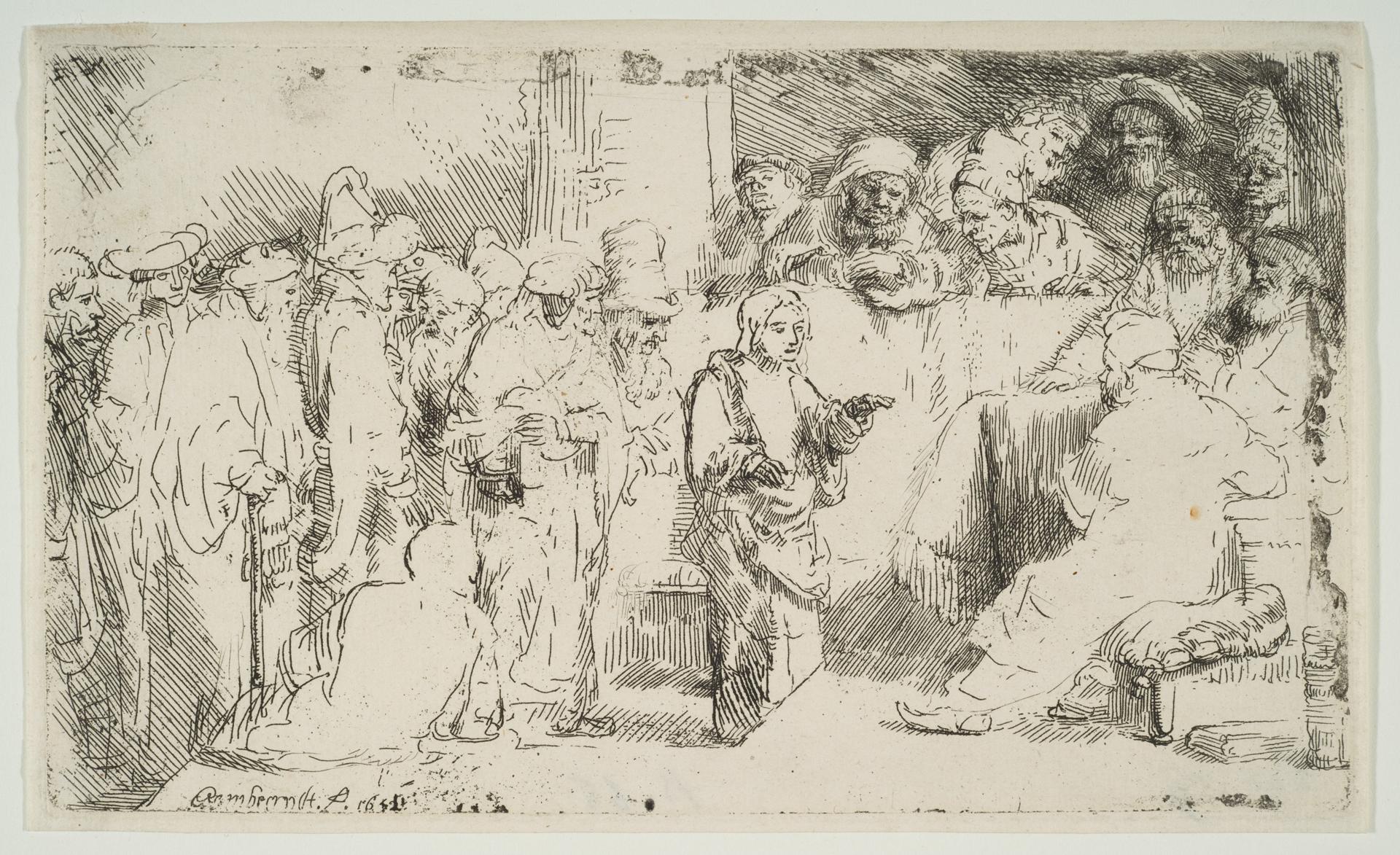
Christ Disputing with the Doctors; a sketch (1652, Met-Objekt 5194)
Original title: Christ Disputing with the Doctors; a sketch
kurzbeschreibung
Rembrandt's 1652 print reduces the temple scene to a terse sketch: the twelve-year-old Jesus disputing with the scholars. The image is executed as an etching with drypoint, in the first of two states, measuring 12.9 x 21.5 cm. An interior serves as the stage, densely packed with figures.
Description
A seated man in traditional robes, likely a scribe, with a head covering and a serious face, catches the eye in the foreground. A woman steps to his side, holding a child, and this child is the focus of the exchange. Around them are other standing and seated figures, their postures and expressions varied. The arrangement presses the people closely together and gains movement from their shifting positions. Soft, diffused light falls from the front, bringing out both the figures and the structure of the space.
Context
This sheet dates from 1652, a period of extensive experimentation in printmaking. The twelve-year-old Jesus in the temple was a common subject for seventeenth-century Dutch artists, as it allowed them to combine scholarship with religious instruction. The sketchy quality suggests that the etching was intended as an independent work rather than a preparatory study for a painting. Rembrandt treated the subject several times, including in a well-known painting of 1627.
Impact
What strikes first is the spontaneity: the tight grouping of figures and the delicate drypoint traces give the sheet an immediate, lively feel. The scattered light draws the eye to the central child, while the scholars around him convey a calm, thoughtful mood. Despite its small format, the sketch acquires a monumental quality, showing how Rembrandt condenses a complex event with economical means.
Technique
The image is worked as an etching with drypoint, supplemented by a framing line in pen and black ink. The drypoint leaves soft, velvety lines and deep blacks characteristic of Rembrandt's prints. In the first of the two states, the plate is still before later revisions, which reinforces the sketchy impression.
AI-generated description text
Source: Metropolitan Museum of Art · Public Domain (CC0 1.0)