The small lion hunt, with two lions
Original title: The small lion hunt, with two lions
kurzbeschreibung
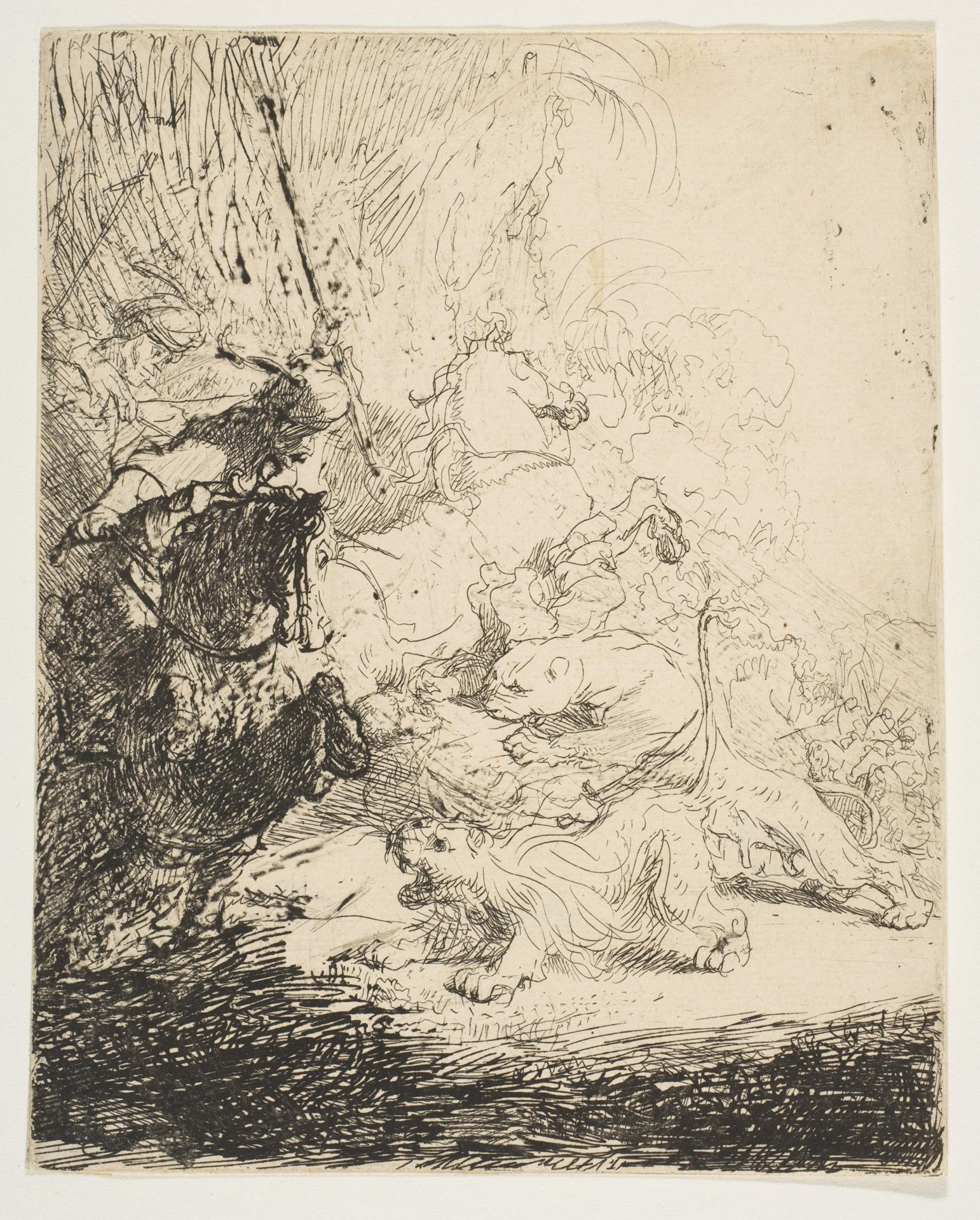
Around 1632, Rembrandt van Rijn made the etching 'The Small Lion Hunt, with Two Lions'. It shows a man armed with a lance fighting two attacking lions, set within dense vegetation. The print was executed as an etching.
Description
A man in motion defends himself with a lance against two lions. One animal lies on the ground while the other springs forward, both in attacking poses. Dense, stroke-like lines fill the background, creating a forest-like setting. The line thickness varies, giving the image a lively, detailed structure. The print remains black and white, with clear contours and graduated shading.
Context
This etching comes from a phase around 1632 when Rembrandt was deeply engaged with printmaking. It belongs to a series of hunting scenes made in the early 1630s. Lions were a popular motif in seventeenth-century Dutch art, often understood as symbols of strength and wildness. Peter Paul Rubens, who had made comparable scenes famous in painting, may have served as a model.
Impact
Strong, high-contrast lines and a dynamic layout create tension at first glance. The attacking lions and the man's defensive stance build a dramatic mood that draws the viewer into the action. Graduated shading gives the print a palpable sense of depth and intensity.
Technique
This is an etching in the second of two states. In this process, the drawing is scratched into an acid-resistant layer on a copper plate and then etched, so that the lines transfer to the print. Rembrandt worked with varying line strengths and hatching to bring out light, shadow, and the movement of the figures. The sheet measures 15.4 × 12.5 cm and bears the artist's typical fine, expressive line work.
AI-generated description text
Source: Metropolitan Museum of Art · Public Domain (CC0 1.0)