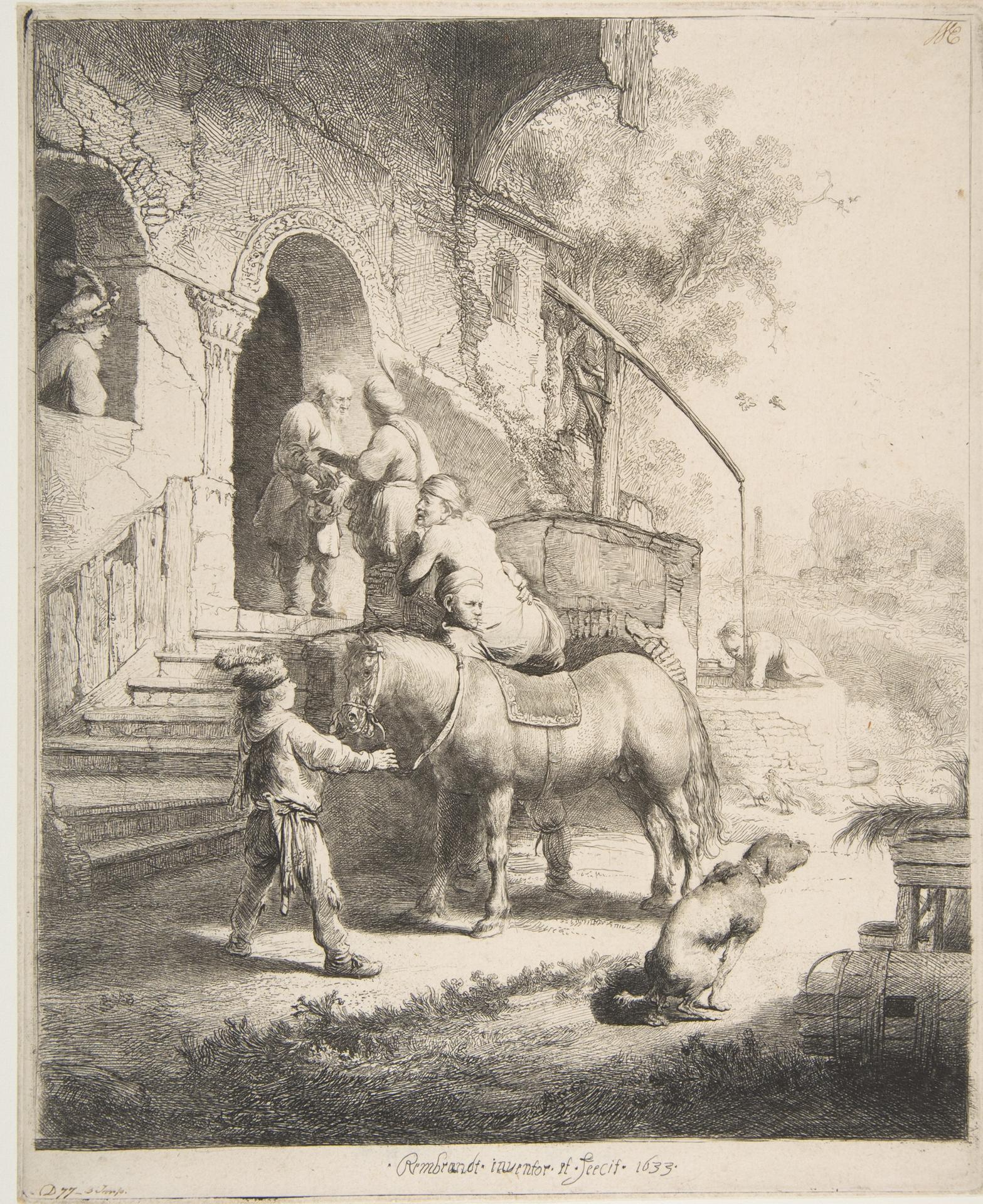
The Good Samaritan (1633, Met-Objekt 5190)
Original title: The Good Samaritan
kurzbeschreibung
Rembrandt van Rijn took up the biblical episode of the Good Samaritan in this 1633 etching. The print combines etching, engraving and drypoint and is the fourth state of four. The paper measures 25.6 × 20.5 cm.
Description
In the foreground a man steers a horse, while a dog crouches beside him. Behind the figures, a building's door stands open, revealing two figures within; another person watches from a platform. On the right, someone has settled on the ground. The arrangement lets the eye take in these separate elements at once; contours are sharp, shading detailed, all in black and white.
Context
The work dates from 1633, when Rembrandt was already in demand in Amsterdam as a portraitist and printmaker. The parable of the Good Samaritan (Luke 10:25–37) often served moral instruction in seventeenth-century Dutch art. Rembrandt devoted several etchings to the theme; this version stands out for its dense narrative structure. The fourth state shows reworkings that reveal careful artistic development.
Impact
Fine shading and closely packed figures create a quiet, reflective mood. Light areas stand against dark shadows, guiding the eye to the central action. The detailed execution invites close looking at the adjacent scenes.
Technique
Etching, engraving and drypoint come together on this sheet; drypoint sets fine, dry lines for details and dark accents. Later reworkings in the fourth state deepen the shading. The format of 25.6 × 20.5 cm is typical of Rembrandt's prints from this period.
AI-generated description text
Source: Metropolitan Museum of Art · Public Domain (CC0 1.0)