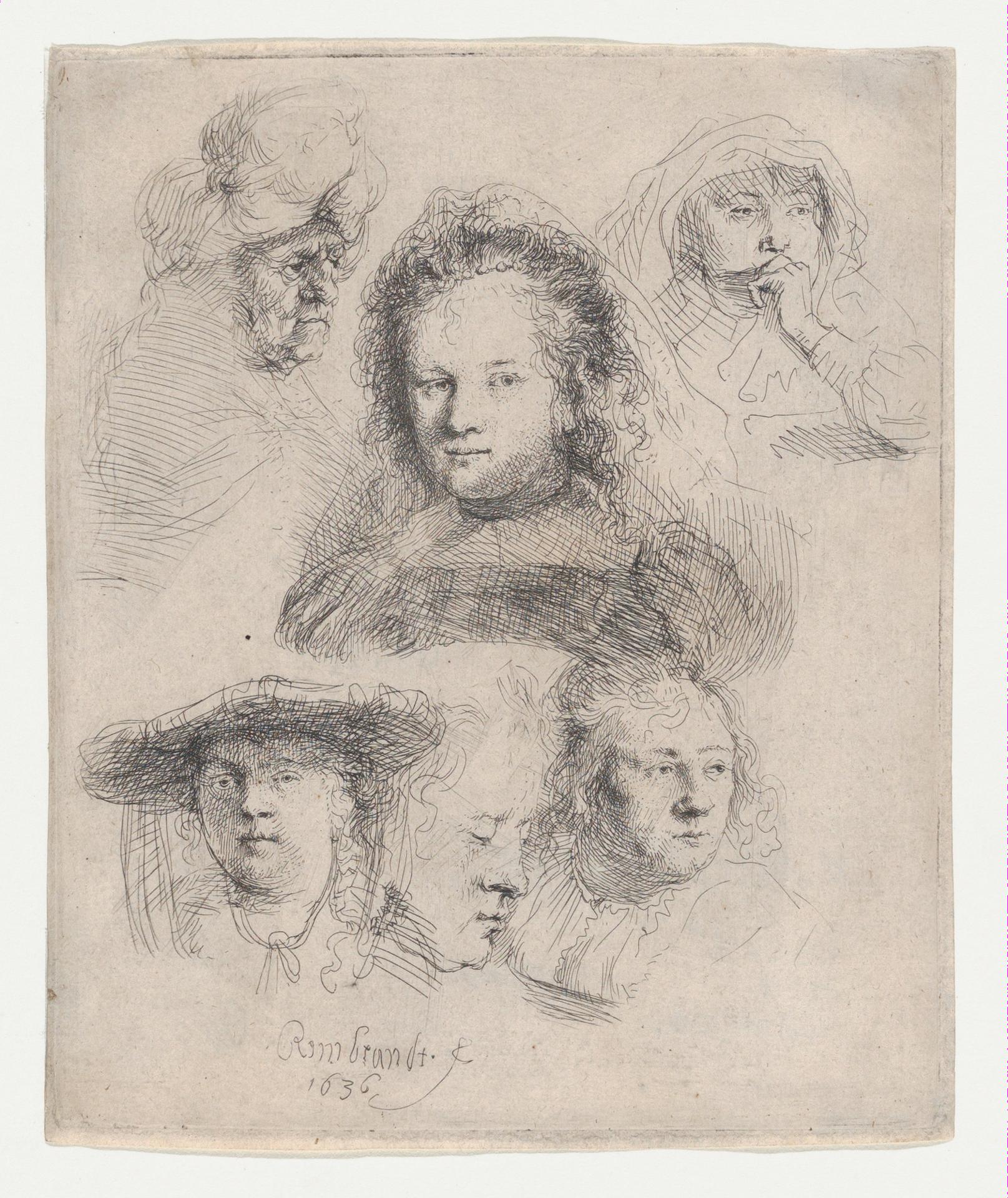
Studies of the Heads of Saskia and Others
Original title: Studies of the Heads of Saskia and Others
kurzbeschreibung
In his 1636 etching 'Studies of the Heads of Saskia and Others', Rembrandt van Rijn brings together six head studies. The subjects appear to include his wife Saskia along with other individuals, each shown in varying poses and looking in different directions. This impression is the first of two states.
Description
Six heads are scattered asymmetrically across the sheet. Some wear head coverings, others are bareheaded. Varying densities of hatching and line thickness create shading and texture in the black-and-white print. Because the figures look in different directions, the arrangement feels animated.
Context
Rembrandt made this etching in 1636, while living and working in Amsterdam. Saskia van Uylenburgh, his wife, often served as a model for such studies. Artists frequently used head studies like these as practice material or as preparatory sketches for larger compositions. The sheet reflects Rembrandt's interest in physiognomy and expression.
Impact
The six heads are arranged to create a lively, almost sketch-like effect that invites comparison between the faces. Subtle gradations of shading give the portraits remarkable depth despite the small format. The study feels immediate and personal, like an intimate glimpse into Rembrandt's working process.
Technique
This work is an etching, an intaglio process in which the drawing is scratched into a wax layer on a copper plate and then etched. Rembrandt varied the direction and strength of his lines to model light and shadow. The sheet is printed in the first of two states, indicating an early version of the plate.
AI-generated description text
Source: Metropolitan Museum of Art · Public Domain (CC0 1.0)