The Ship of Fortune
Original title: The Ship of Fortune
kurzbeschreibung
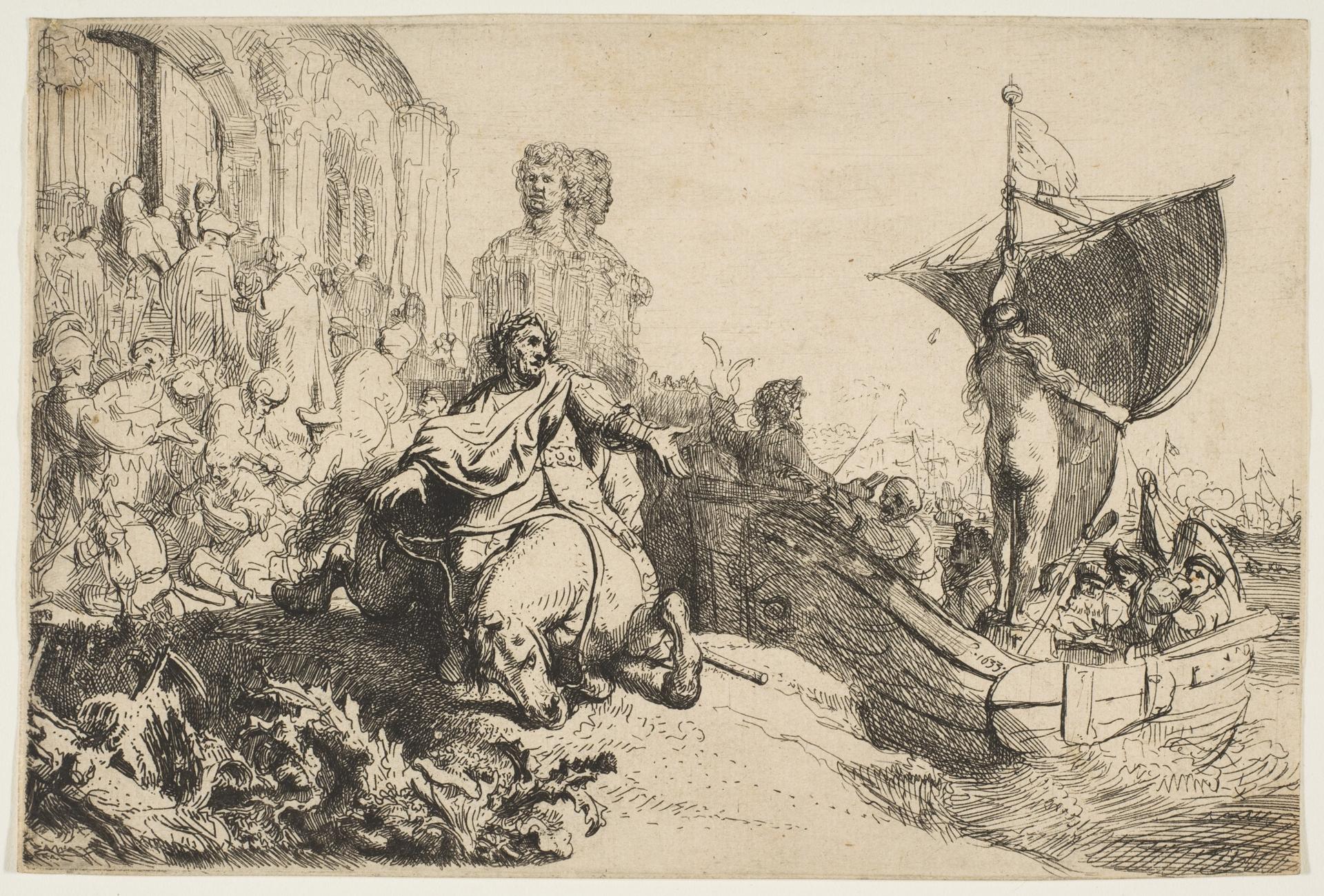
Rembrandt etched Das Schiff des Glücks around 1633, combining an allegorical scene in which a horseman dominates the foreground with a ship on the water behind him. This impression is the second state of two.
Description
A bearded rider moves toward the right, his gaze following the same direction. Behind him several figures stand within a hall-like architectural setting and watch what unfolds, their headgear pointing to an earlier historical period. To the right, on the water, a ship sails with canvas set and a figure standing on its mast. The black-and-white etching relies on fine lines and delicate shading; light falls evenly across the sheet, without strong contrasts.
Context
The print belongs to Rembrandt's early Leiden years, before he moved to Amsterdam in 1631. The motif of Fortuna with a ship was familiar in seventeenth-century Dutch art and stood for the mutability of fate. During this period Rembrandt devoted himself intensively to printmaking and tested a range of techniques. Two states of the etching are known, and this impression reproduces the second.
Impact
Fine lines and a calm, balanced layout define the sheet. The contrast between the moving rider and the static setting behind him generates tension. Because the image stays monochrome, the narrative details and the allegorical meaning come forward clearly.
Technique
The drawing was scratched into a copper plate and bitten with acid, a process that permits the fine lines and subtle shading visible in this print. Compared with the first state, the second shows reworking or additions.
AI-generated description text
Source: Metropolitan Museum of Art · Public Domain (CC0 1.0)