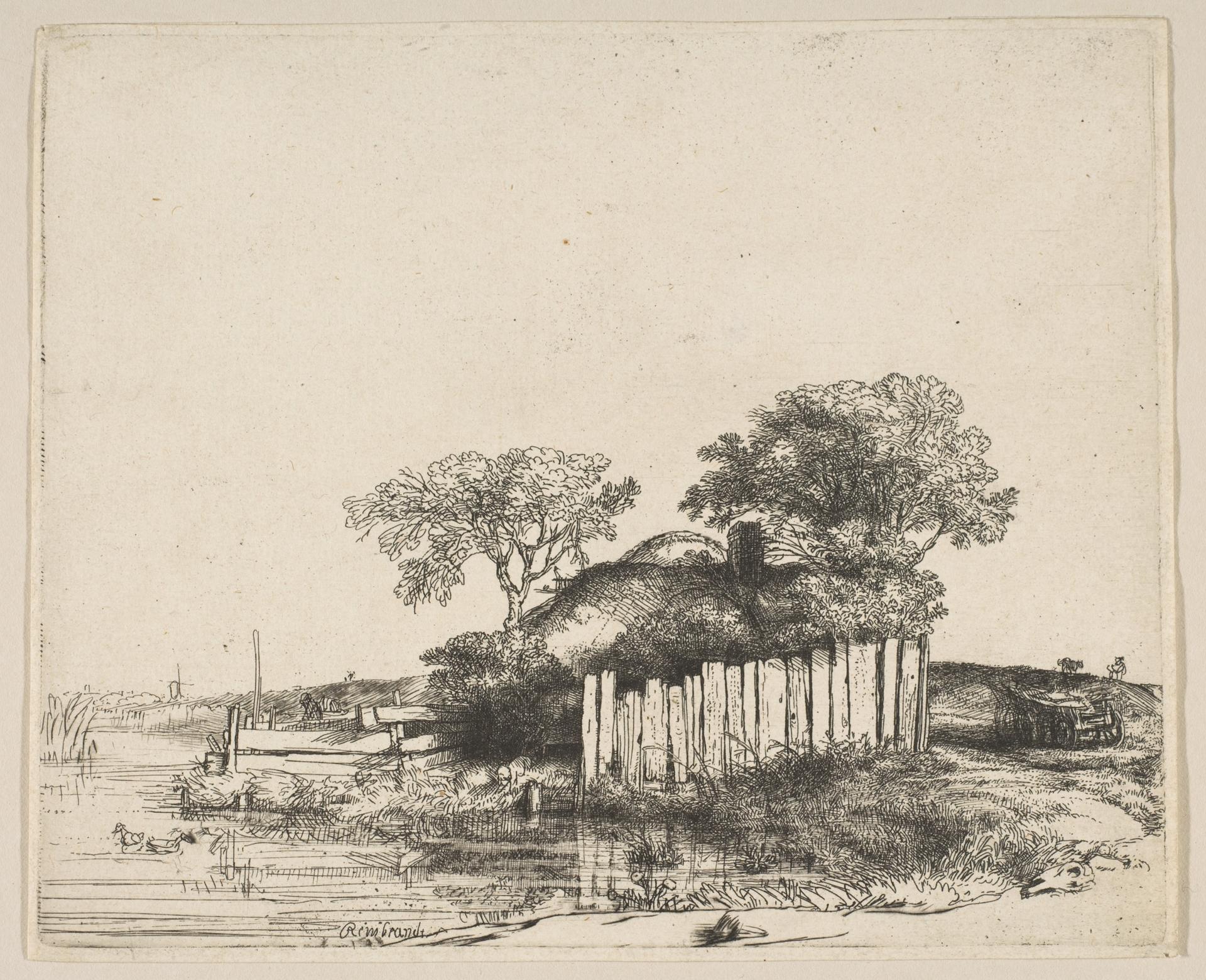
Cottage with a White Paling
Original title: Cottage with a White Paling
kurzbeschreibung
Unlike many of his landscape prints, Rembrandt van Rijn's 1648 etching 'House with a White Picket Fence' gives a single cottage the leading role, framed by trees and a white fence. The sheet is an etching worked with drypoint, in the third of three states.
Description
The layout runs in landscape format, with the cottage as the anchor point. A water ditch crosses the foreground, spanned by a footbridge or small bridge. Trees surround the house, and beyond the property further groups of trees and a windmill can be made out. The view is kept monochrome in shades of grey, with soft, diffuse light and a quiet, idyllic mood.
Context
The etching dates from 1648, a period in which Rembrandt was engaged intensively with landscape. A simple country house with a fence is among the motifs typical of his Dutch landscape etchings, which often record the area around Amsterdam. Etching and drypoint gave him means that allowed fine, immediate lines and so reinforced the naturalistic character of the image.
Impact
Calm emanates from this sheet: the clear arrangement and diffuse light create a contemplative atmosphere. Delicately drawn lines and the precise rendering of nature and architecture lend the picture something intimate, almost poetic, that draws the viewer into the rural idyll.
Technique
The sheet was made as an etching, reworked with drypoint; the third of three states is present. Drypoint produces the characteristic slightly raised lines that leave a soft, velvety tone in the print. At 13.2 x 16.2 cm, the sheet belongs among Rembrandt's small-format landscape etchings.
AI-generated description text
Source: Metropolitan Museum of Art · Public Domain (CC0 1.0)