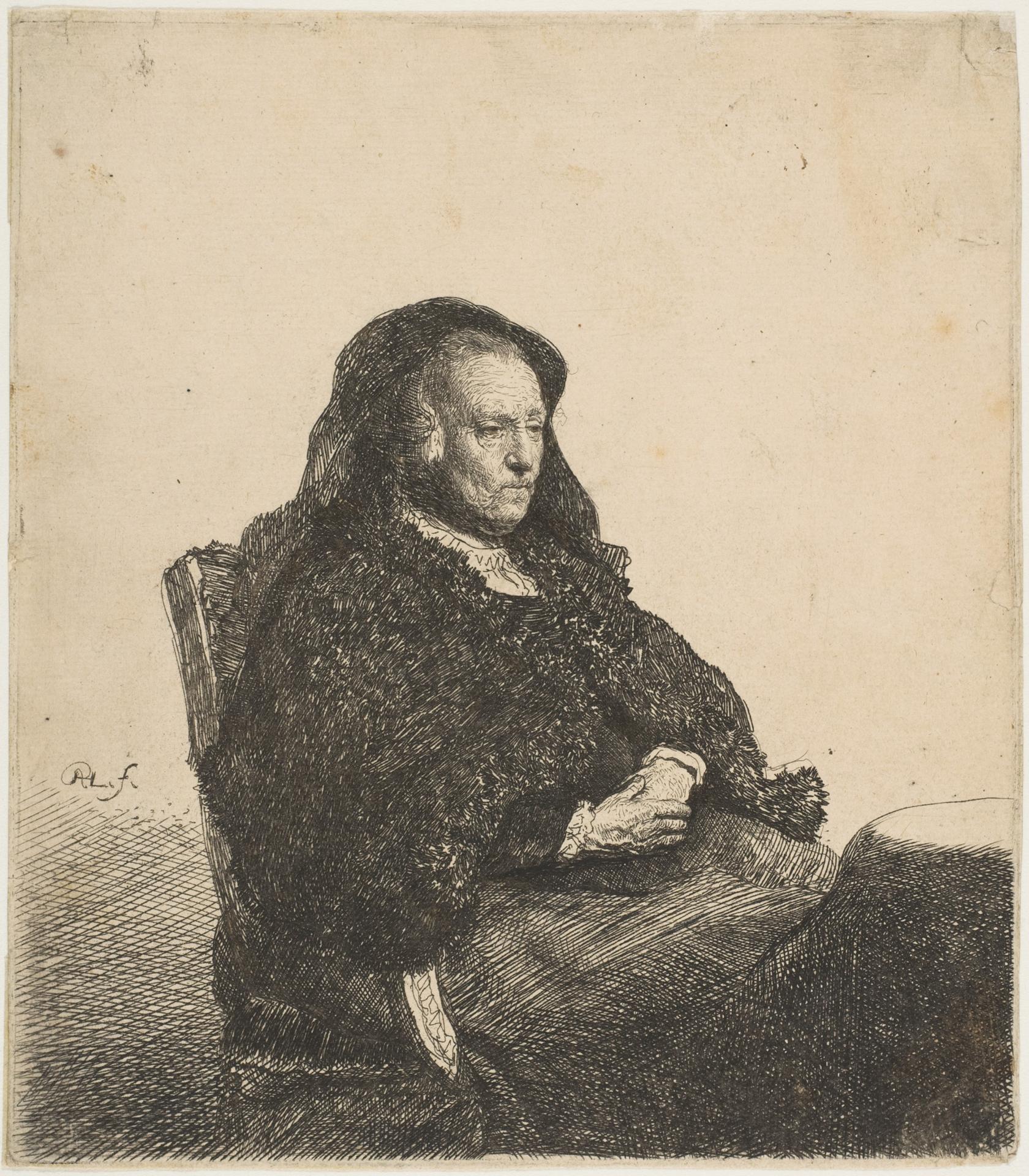
The Artist's Mother Seated at a Table Looking Right: Three-Quarter Length
Original title: The Artist's Mother Seated at a Table Looking Right: Three-Quarter Length
kurzbeschreibung
Around 1631 Rembrandt van Rijn etched a portrait of his mother, shown seated and turned toward the right in three-quarter view. New Hollstein records the print in its second of three states. It is an intimate study of an elderly woman dressed in the clothing of her day.
Description
She sits at ease, her gaze directed to the right, one hand resting on her leg. A dark jacket trimmed with fur covers her, and a headdress frames her face. Behind her stands a table with an object that could be a book or a bowl. The arrangement stays plain and centred entirely on the figure; light comes from the front and picks out the contours. Fine lines and hatching build the greys that draw out texture and form.
Context
Made during Rembrandt's early Leiden years, when he was working closely at the etching plate, this print belongs to a group of studies of his mother, whom he used as a model again and again. Such approaches are characteristic of seventeenth-century Dutch portraiture, which gave room to the everyday and the natural. That the etching survives in several states points to careful reworking by the artist himself.
Impact
A quiet, familiar mood comes off the sheet, carried by the relaxed posture and the open look. The delicate linework and soft shading give it an almost painterly quality that draws the viewer closer to the figure. Because the setting stays so spare, attention settles entirely on the sitter's character.
Technique
In etching the lines are bitten into a metal plate. Different etching times and the printing process produce the fine hatching and graded greys. In the second state, reworkings are visible that strengthen the contrasts and sharpen the details.
AI-generated description text
Source: Metropolitan Museum of Art · Public Domain (CC0 1.0)