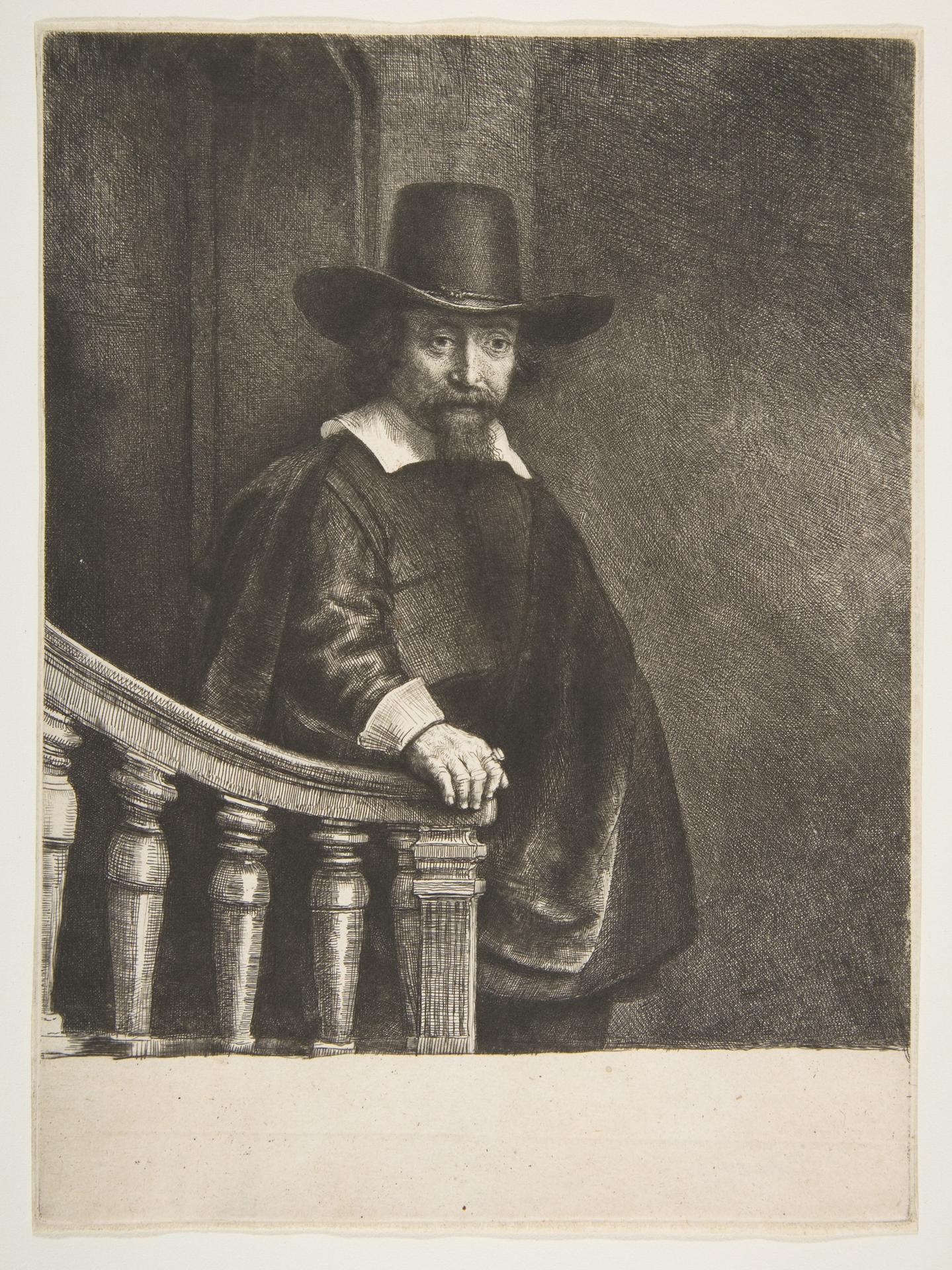
Ephraim Bueno, Jewish Physician (1647, Met-Objekt 5180)
Original title: Ephraim Bueno, Jewish Physician
kurzbeschreibung
Rembrandt's 1647 etching is devoted to the Jewish physician Ephraim Bueno. Reworked with drypoint and burin, the print presents the sitter in a pensive pose against an architectural backdrop.
Description
A man appears in traditional attire: a broad-brimmed hat, a shirt with sleeves pushed up, and over it a long dark coat. One arm rests on a column or pillar. Behind him, a door or window is partly covered by a curtain. The arrangement brings the figure to the fore, and the light falls evenly, without harsh shadows. The rendering stays in grayscale, as is typical of an etching; the linework is meticulous, and both clothing and face are captured in rich detail.
Context
Ephraim Bueno was among the respected Jewish physicians and scholars of Amsterdam and moved in Rembrandt's intellectual circle. Rembrandt portrayed several members of the Jewish community, which suggests close personal as well as artistic ties. The work belongs to a period in which he was deeply engaged with etching technique and had made his mark with portraits. The existence of two states shows that Rembrandt reworked the printing plate to bring out subtleties more clearly.
Impact
The sheet conveys a quiet, dignified presence, carried by the thoughtful posture and the direct gaze. The precise linework and balanced layout give the portrait an intimate, respectful mood in which the sitter appears as a man of intellect.
Technique
The etching was further worked with drypoint and burin, producing fine and exact lines. This method allows for high precision, especially in textiles and facial features. The print was made in two states; the second shows reworked details.
AI-generated description text
Source: Metropolitan Museum of Art · Public Domain (CC0 1.0)