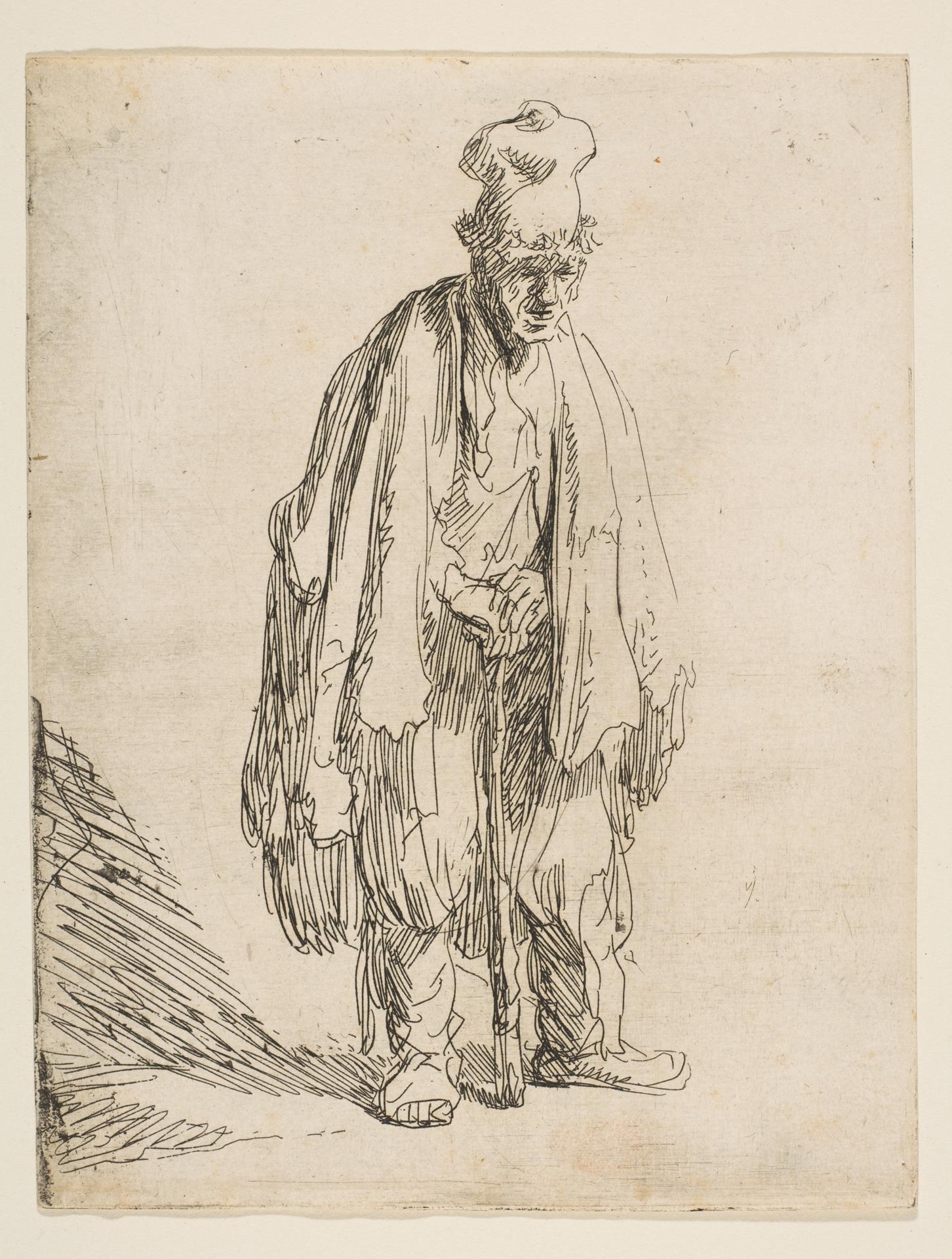
Beggar in a High Cap, Standing and Leaning on a Stick
Original title: Beggar in a High Cap, Standing and Leaning on a Stick
kurzbeschreibung
A beggar in a tall cap, leaning on a stick, stands at the heart of this etching by Rembrandt from around 1629. Made using the etching technique, the print belongs to the artist's early works in which he turned his attention to society's marginal figures.
Description
The figure stands on ground suggested by only a few strokes, body slightly inclined forward, gaze directed to the left. A tall cap sits on his head; below it, a long-sleeved jacket with a loose fall and wide trousers, feet bare. Weariness and resignation speak from his posture. The whole remains monochrome, built from lines and shading that bring out the folds of the fabric and the features of the face.
Context
The sheet was created during Rembrandt's early Leiden period, when he engaged closely with everyday life and the lower strata of society. Beggar depictions enjoyed great popularity in seventeenth-century Dutch art and were often understood as moral or socially critical allegories. The etching survives in the second of two states, suggesting reworking by the artist himself.
Impact
A quiet yet insistent presence emanates from the figure, carried by the precise rendering of clothing and posture. The plain layout lets the eye rest on the figure and its expressive appearance without distraction from details.
Technique
For this etching, Rembrandt bit the plate with acid and then pulled it with printing ink onto paper. The thin lines and hatching reveal his assured command of the etching technique, with which he could accurately reproduce textures and shadows.
AI-generated description text
Source: Metropolitan Museum of Art · Public Domain (CC0 1.0)