The Good Samaritan (1633, Met-Objekt 5178)
Original title: The Good Samaritan
kurzbeschreibung
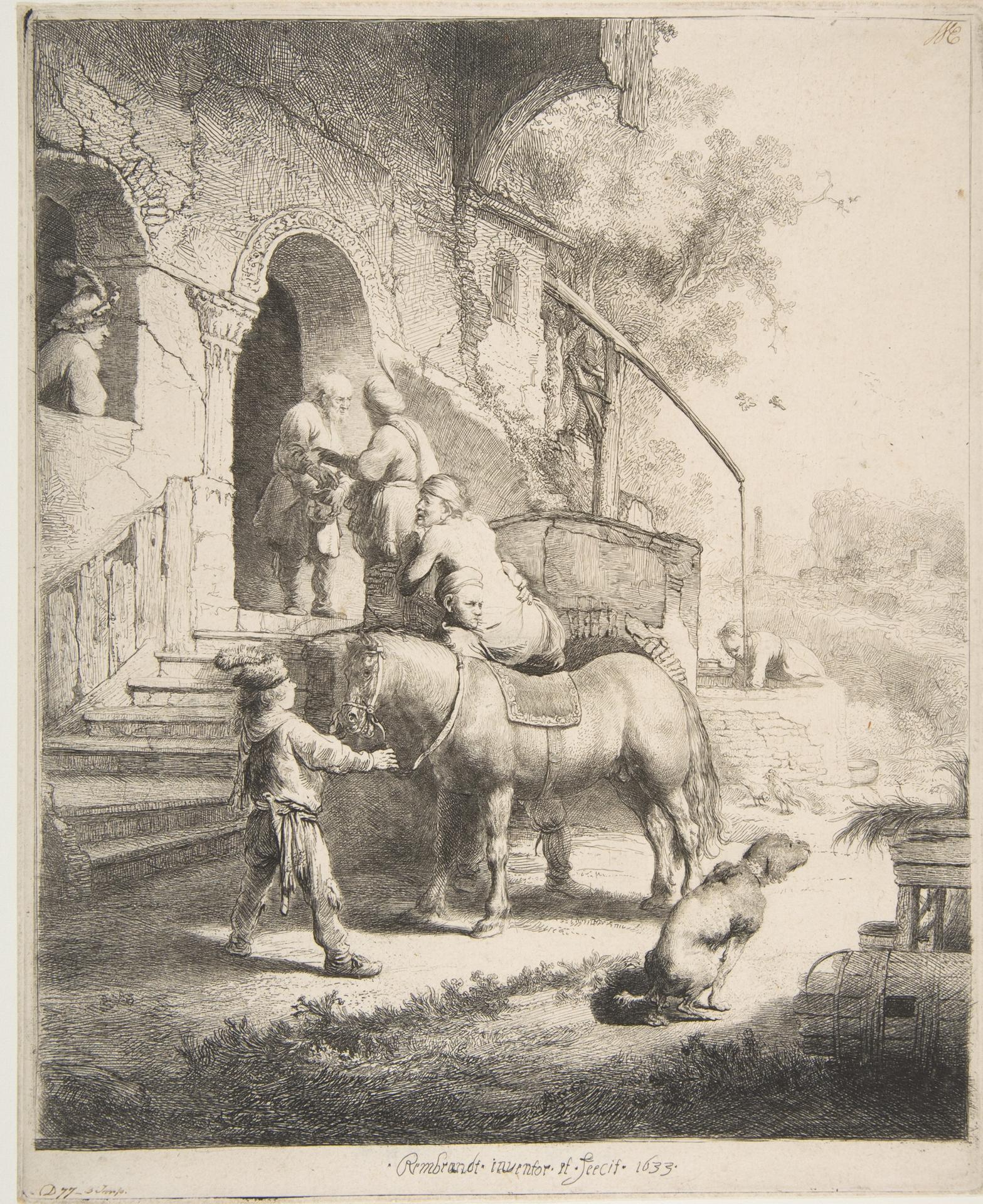
Rembrandt's 1633 etching depicts the parable of the Good Samaritan: a wounded traveller is lifted onto a horse. Made with etching, engraving and drypoint, the sheet survives as the fourth of four states.
Description
Front right, a man sits on horseback, steadied by a second figure — the injured traveller. A child leads the horse by the bridle while a dog crouches on the ground. Behind the group a building opens up, two figures looking out from its doorway, and another person stands raised on a platform. Trees and a farmstead form the rural setting, grazed by light from the right.
Context
This etching dates from 1633, a period when Rembrandt was working intensively on biblical subjects and drawing notice with his prints. The theme of the Good Samaritan was widespread in the seventeenth-century Netherlands because it illustrated Christian charity toward one's neighbour. Rembrandt returned to it several times; this sheet ranks among his early masterpieces in printmaking.
Impact
Light enters from the right and steers the eye toward the group around the horse, whose movement opens up the pictorial space. Dense linework and strong contrasts of light and dark give the sheet its tension. Figures and a richly detailed setting interlock so closely that the viewer is drawn into the action.
Technique
Etched lines, engraving and drypoint are combined here, yielding a broad range of tonal values and surface textures. The delicate hatching and gradations reveal Rembrandt's assured handling of these techniques, which he often reworked across several states.
AI-generated description text
Source: Metropolitan Museum of Art · Public Domain (CC0 1.0)