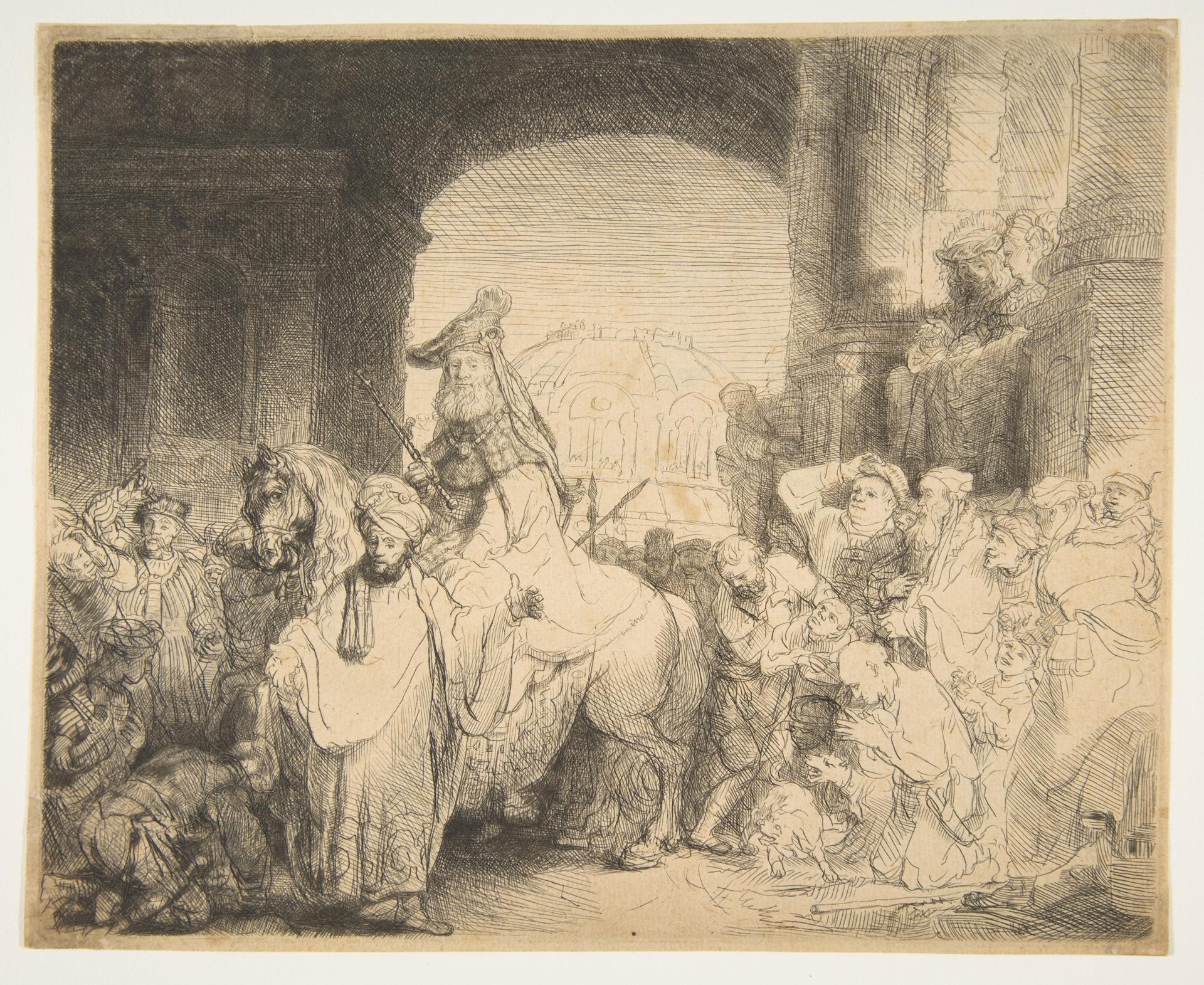
The Triumph of Mordecai (ca. 1641)
Original title: The Triumph of Mordecai
kurzbeschreibung
Rembrandt made this etching around 1641 after the story in the Book of Esther: Mordechai, raised to honour by King Ahasuerus, is led through the city in triumph. For this print the artist combined etching with drypoint in a mixed technique.
Description
Mordechai rides in royal robes, a crown on his head and a lance in his hand. A crowd presses around him, some kneeling, some cheering. Behind rises a building with a roof carried on columns. The figures are fully worked out, with sharp contours and finely graded shading; the light stays muted and the sheet monochrome.
Context
The interest in Old Testament subjects is bound up with Rembrandt's surroundings: Amsterdam was home to a substantial Jewish community. During this period he turned increasingly to biblical themes and made printmaking an independent artistic medium. The source is Esther 6:11, where Mordechai is led through the city on the king's horse.
Impact
The eye goes at once to the rider at the centre, whose triumphant appearance is heightened by the crowd around him. Delicately drawn lines and nuanced shading lend the sheet a narrative, intimate quality that draws the viewer into the event. Movement and quiet monumentality together produce a solemn mood.
Technique
Etched and then reworked with drypoint, the image gains fine, velvety lines and rich depth from the drypoint. The plate was reworked several times, yielding a differentiated range of tones. The work is printed on paper measuring 17.6 x 22 cm.
AI-generated description text
Source: Metropolitan Museum of Art · Public Domain (CC0 1.0)