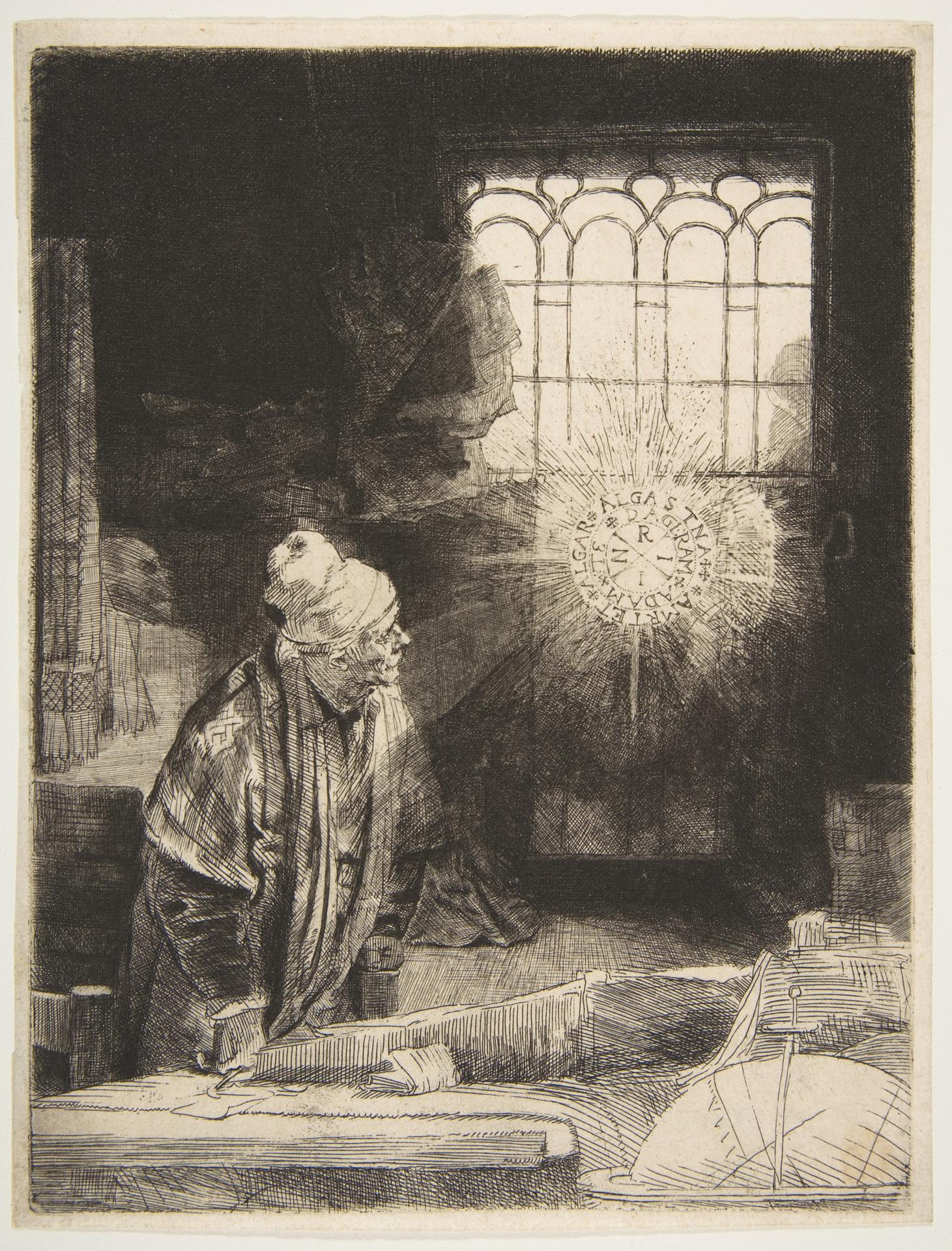
A Scholar in His Study ('Faust')
Original title: A Scholar in His Study ('Faust')
kurzbeschreibung
A scholar sits in a gloomy study, turning his gaze toward a luminous phenomenon. Rembrandt made this etching around 1652, working with etching, drypoint, and burin; the print survives in the fifth of seven states.
Description
A man in half-light, his head tilted upward, wears a cap and a long-sleeved jacket, a staff in his hand. Behind him a large window with Gothic arches opens; through it falls a bright shaft that seems to emanate from a circle of letters and numbers at the window's center. On a table before the scholar lie papers and a book. Black and white, with dense, carefully placed strokes.
Context
This print belongs to the years around 1652, when Rembrandt was experimenting intensively with graphic means. The motif is often linked to the Faust legend, though no direct literary source is certain. The artist used etching to test effects of light and shadow—a concern that grew increasingly important in his late work.
Impact
The viewer's gaze is drawn to the man and the light phenomenon, creating a quiet, enigmatic mood. The dense hatching and the contrast between darkness and brightness give the sheet a strong, almost dramatic presence.
Technique
Etched, then reworked with drypoint and burin—allowing fine lines and deep shadows. In the fifth of seven states the plate is at an advanced stage of work, where Rembrandt further elaborated the light effects.
AI-generated description text
Source: Metropolitan Museum of Art · Public Domain (CC0 1.0)