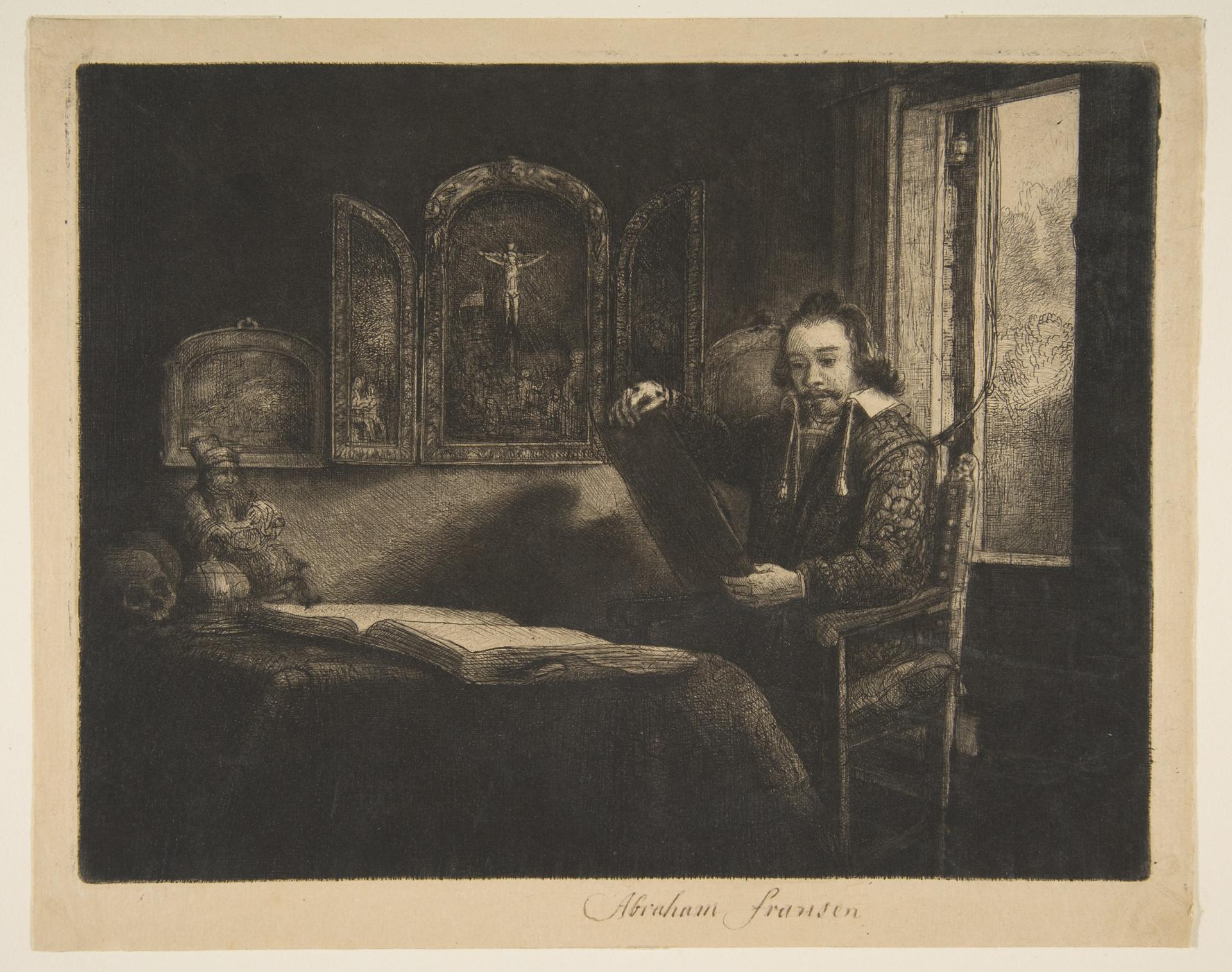
Abraham Francen, Apothecary
Original title: Abraham Francen, Apothecary
kurzbeschreibung
Unlike many related portraits, this print does not present the Amsterdam apothecary Abraham Francen in a formal pose but seated in his study, a book in his hands. Rembrandt made the etching around 1656 as part of a series of twelve states; the present impression is the tenth. The technique combines etching, engraving, and drypoint, with shading added using a mezzotint rocker.
Description
In the foreground a figure dressed in seventeenth-century clothing sits holding an open book. Dominating the background is an altarpiece showing the Crucifixion of Christ. Beside it on the table lie a skull and a small figurine that may represent an apothecary. Light enters from the right and spreads evenly across the scene. The layout feels balanced: the figure occupies the center, while the altarpiece forms a calm counterpart.
Context
Abraham Francen, a friend and apothecary from Amsterdam, was portrayed by Rembrandt several times. During this period the artist devoted himself increasingly to experimental printmaking and varied state impressions. The skull and Crucifixion allude to the vanitas symbolism widespread in seventeenth-century Dutch art. Francen appears here not in a professional portrait but in a contemplative pose, suggesting a personal connection.
Impact
The delicate interplay of lines and the muted gray tones give the sheet a quiet, contemplative air. The balanced arrangement and the incoming light create a solemn, almost reverent mood. The viewer is drawn into the still atmosphere of a scholar's study.
Technique
Rembrandt combined several intaglio processes: etching for the basic lines, engraving and drypoint for details and shadows, and a mezzotint rocker for soft tonal values. The tenth of twelve states documents an advanced stage of work in which the plate was reworked multiple times. Printed on paper, the sheet measures 15.6 × 23 cm.
AI-generated description text
Source: Metropolitan Museum of Art · Public Domain (CC0 1.0)