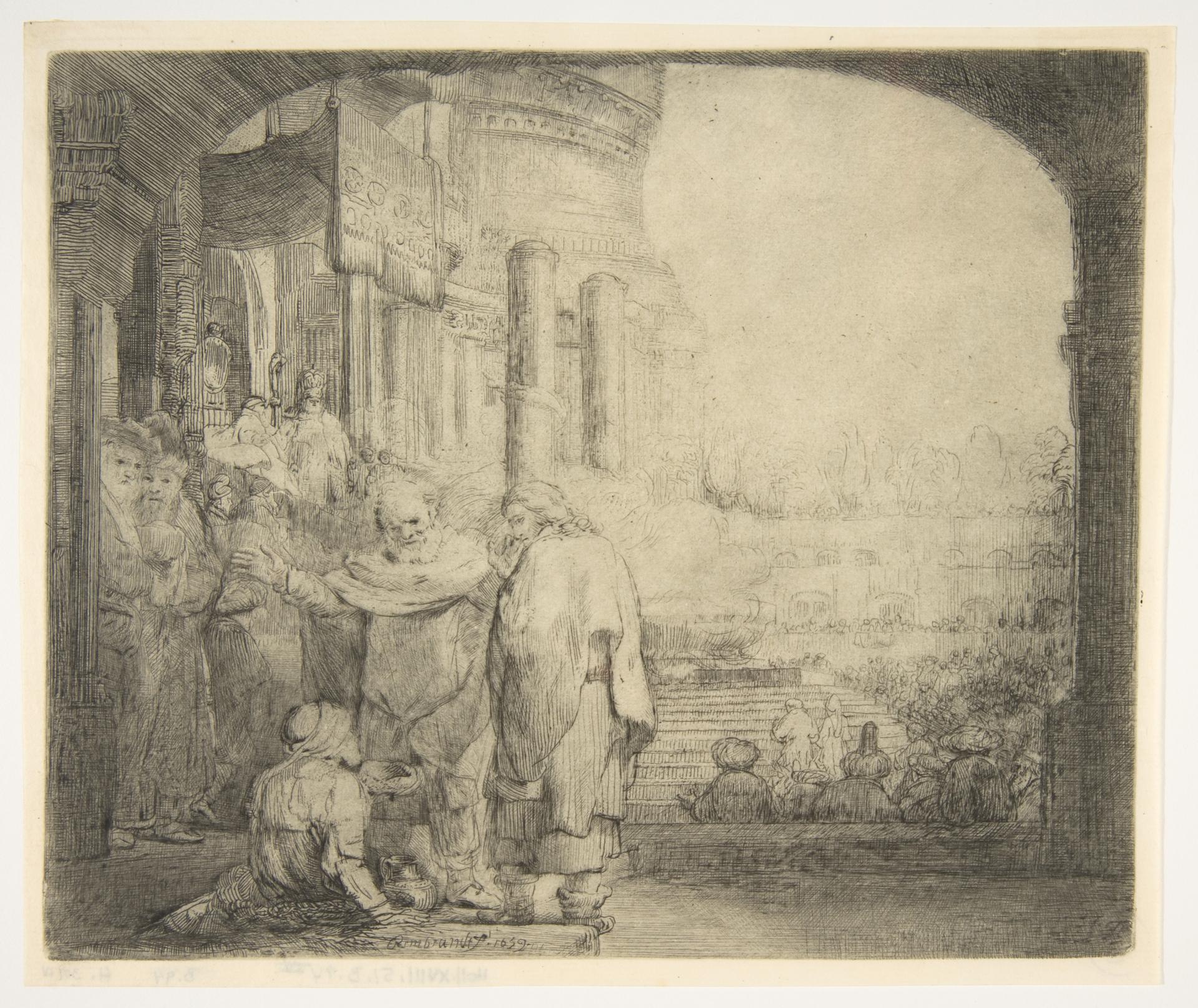
Peter and John Healing the Cripple at the Gate of the Temple (1659, Met-Objekt 5174)
Original title: Peter and John Healing the Cripple at the Gate of the Temple
kurzbeschreibung
In 1659 Rembrandt took up the episode from the Acts of the Apostles in which Peter and John heal a lame man at the Beautiful Gate of the temple. The print is executed as an etching, supplemented by engraving and drypoint; this is the second of six states.
Description
At the lower edge of the image the lame man crouches on the ground while Peter and John bend down to him and touch him. Bystanders watch the action, and further figures appear in the temple-like structure behind. The arrangement is detailed and true to life, with attention focused on the interaction of the three figures and the architecture. Light falling from above emphasizes the contours of bodies and building. The tonal values remain mostly gray, a result of the printing processes.
Context
The subject comes from Acts 3:1–10 and was popular in seventeenth-century Protestant art because it highlighted the power of faith and apostolic succession. Rembrandt made the print during his mature Amsterdam years, when he engaged deeply with biblical themes and the expression of human emotion. The etching belongs to a series of prints intended for the art market and reveals his experimental approach to different printing techniques.
Impact
Through the differentiated linework and the control of light, the print feels immediate and compelling. The interaction of the figures and the architectural setting create a quiet yet tense atmosphere that draws the viewer into the biblical event.
Technique
The print was pulled from an etching plate that was additionally worked with engraving and drypoint; this yields a rich gradation of tones and fine details. Rembrandt established several states, and already the second state, present here, shows changes that enhance the effect of light and shadow. The combination of techniques allowed him both precise lines and soft, painterly effects.
AI-generated description text
Source: Metropolitan Museum of Art · Public Domain (CC0 1.0)