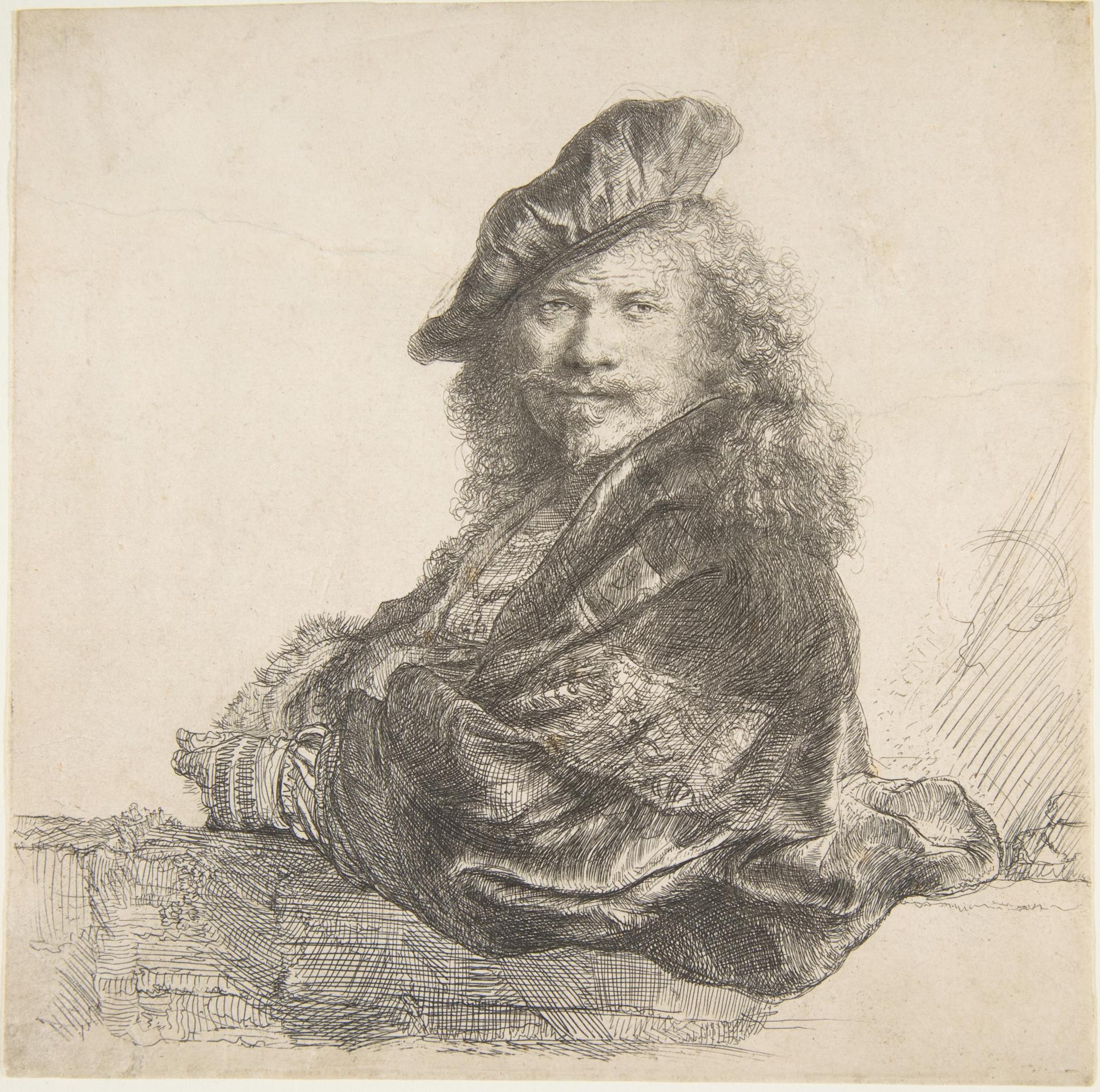
Self-Portrait, Leaning on a Stone Wall
Original title: Self-Portrait, Leaning on a Stone Wall
kurzbeschreibung
In 1639 Rembrandt van Rijn etched his own portrait: the artist appears as a half-length figure, one arm resting on a stone wall, wearing a broad cap and a jacket trimmed with fur. The work is an etching on paper and measures 16 x 16 cm.
Description
A man leans with one arm on a stone wall. A wide, flat cap sits on his head; the edge of his jacket is lined with fur. His expression is serious and thoughtful, his gaze turned slightly aside. The background stays bare and pushes the figure and his clothing to the fore. Kept in monochrome, with even light, texture and forms take their character from the fine lines and hatching of the etching.
Context
The 1639 self-portrait falls in a period when Rembrandt was engaging closely with printmaking. The etching was made in Amsterdam, where he had lived since 1631 and worked as a sought-after portraitist. Self-portraits were a central field for him, one he explored over decades in various techniques and styles.
Impact
Calm and concentration govern the arrangement, and the sitter's pensive expression adds its part. The precise linework and clear lighting create an intimate, almost contemplative mood that speaks directly to the viewer.
Technique
In etching, the drawing is incised into an acid-resistant layer on a copper plate and then bitten by acid. Intaglio printing transfers the inked recesses of the plate to the paper, producing the fine lines and hatching. The sheet measures 16 x 16 cm.
AI-generated description text
Source: Metropolitan Museum of Art · Public Domain (CC0 1.0)