The Return of the Prodigal Son
Original title: The Return of the Prodigal Son
kurzbeschreibung
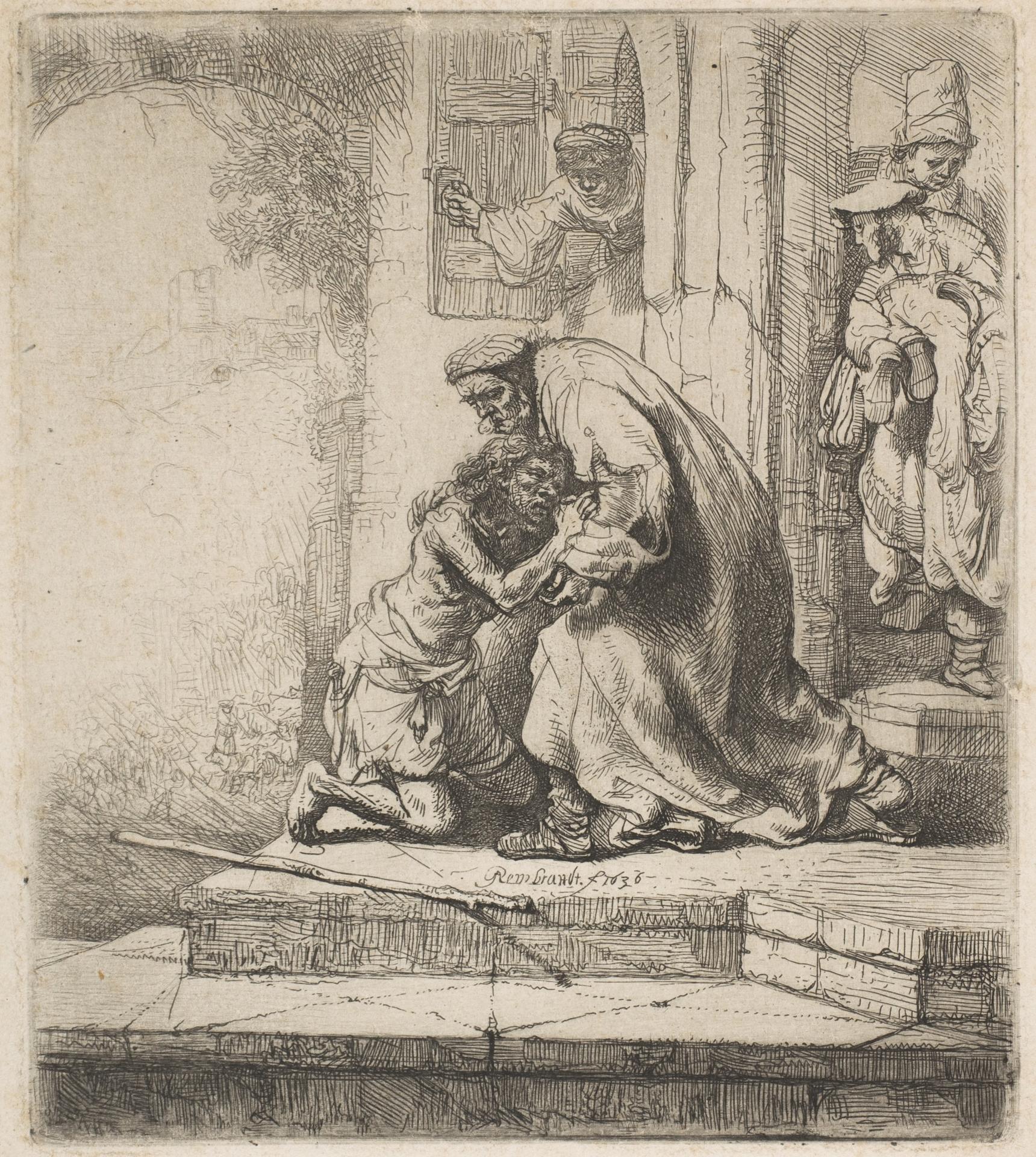
Rembrandt made this etching in 1636, taking up the biblical story of the prodigal son's homecoming. The plate measures 15.6 × 13.8 centimetres and is executed as an etching. It captures the moment when the returning son meets a woman who steadies him, with other figures gathered around.
Description
In the foreground a man kneels in tattered clothes, his gaunt face worn with exhaustion. A woman in a long robe holds him and looks on with concern. Behind them a woman at a window opens a door while two more people watch. An old wall and trees form the rural setting. Subdued light gives the moment its tension, brought out by the etching's fine lines and hatching.
Context
In 1636 Rembrandt was working in Amsterdam and turning more and more to biblical subjects. The figure of the prodigal son recurs several times in his oeuvre. The print dates from a period in which he had established himself as a portrait and history painter. It was probably circulated as a single sheet or as part of a series.
Impact
The print draws its force from the intimate, feeling portrayal of the encounter. Light and shadow lend the event a devotional stillness. The linework guides the eye to the figures and their gestures.
Technique
This is an etching on paper, for which the plate was bitten with acid. Fine lines and hatching are characteristic of Rembrandt's etching manner. The plate measures 15.6 × 13.8 centimetres; the sheet is somewhat larger at 17.4 × 15.5 centimetres.
AI-generated description text
Source: Metropolitan Museum of Art · Public Domain (CC0 1.0)