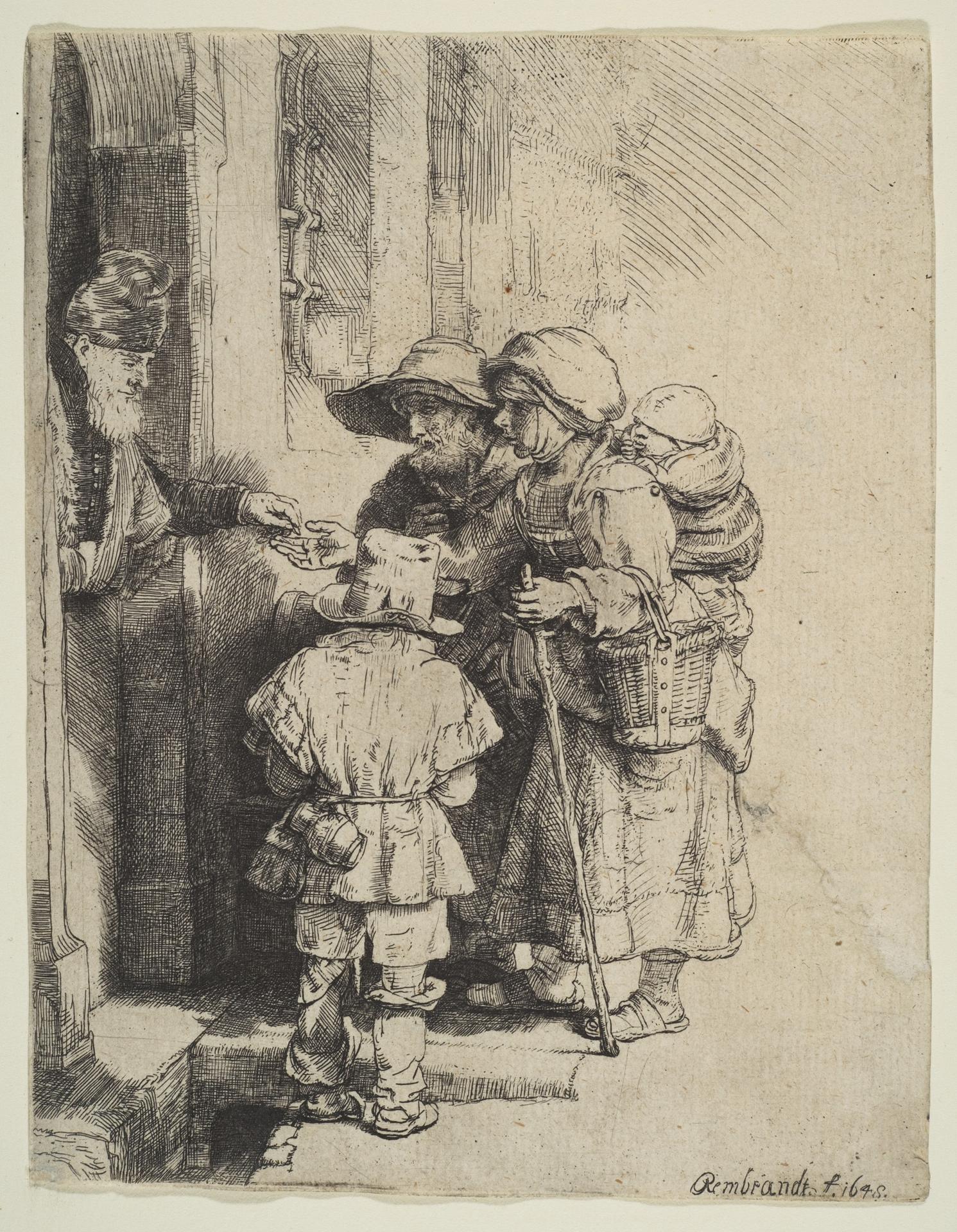
The Blind Hurdy-Gurdy Player and Family Receiving Alms
Original title: The Blind Hurdy-Gurdy Player and Family Receiving Alms
kurzbeschreibung
A blind hurdy-gurdy player stands at a door with his family and receives alms — Rembrandt etched this subject in 1648. The sheet combines etching and drypoint and survives here in the third of five states; it measures 16.5 x 12.9 cm.
Description
At the left a man holds out a coin, his hand already open. Before him stand a woman and a child, while at the right another child and a woman with a bucket can be made out. The figures' period clothing and the delicate etched lines give shape to light and to the texture of surfaces.
Context
In 1648 Rembrandt was devoting himself more intensively to printmaking. Poverty and mercy belonged to the established repertoire of seventeenth-century Dutch art, and in other works of these years he too turned to beggars and people on the margins of society.
Impact
The closeness of the figures and their crowded arrangement produce a quiet, thoughtful tension. Contrasts and dense hatching bring the scene directly before the eye without becoming insistent. The moment of giving stays restrained and piercing at once.
Technique
Rembrandt joined etching and drypoint in this print. Drypoint leaves soft, velvety lines, while etching draws out clear detail. By the third of five states the plate had already been worked over considerably.
AI-generated description text
Source: Metropolitan Museum of Art · Public Domain (CC0 1.0)