Faust (ca. 1652, Met-Objekt 5169)
Original title: Faust
kurzbeschreibung
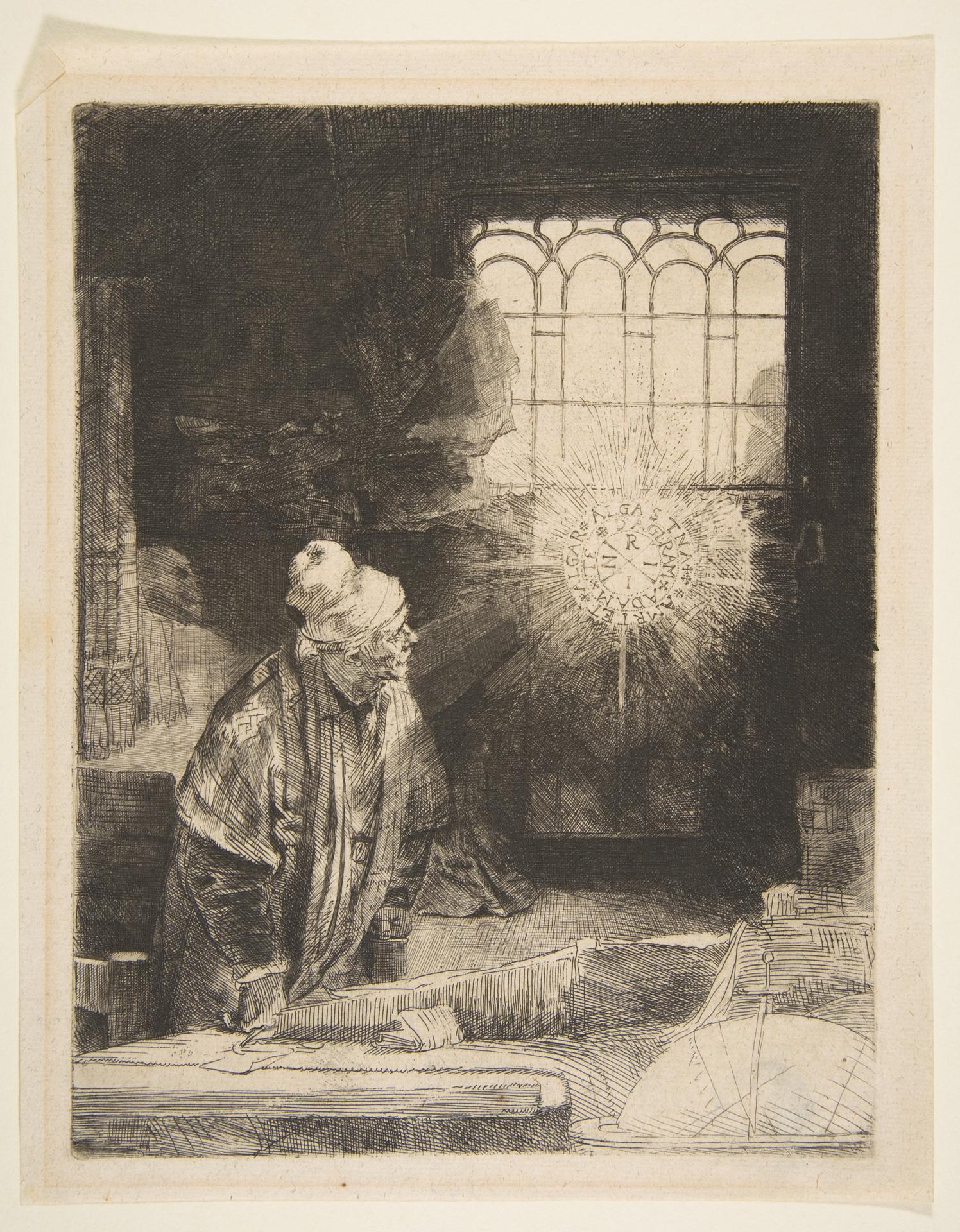
Rembrandt etched Faust around 1652. A seated figure leans over a table strewn with books in a dim room, while bright light pours in through a window. Seven states of this print exist; this is the first.
Description
A figure in a cap and jacket sits at a table holding books and a quill. Behind him a window with an intricate pattern opens, and a shaft of light falls into the room. That beam sets up a strong contrast with the surrounding darkness and draws figure and table forward. The layout is asymmetrical, with window and light determining the structure. Fine lines and hatching build textures and forms in tones of grey.
Context
Rembrandt made this etching around 1652 in Amsterdam, where he worked as a leading artist and circulated prints in large numbers. During this period he explored the effects of light and shadow in depth. The subject is traditionally linked to the Faust legend, though the figure's exact identity remains uncertain. The first state is rare and documents Rembrandt's working process.
Impact
A mysterious, contemplative mood arises from the alternation of dark room and harsh light. The viewer is drawn into an intimate scene whose action never becomes entirely legible. Delicate linework and the play of light and dark give the sheet a dense, almost meditative atmosphere.
Technique
For this etching the drawing was scratched into a copper plate bitten with acid. Rembrandt used a fine needle and hatching to model light and shade. The plate was printed in several states; the first shows the original version of the plate.
AI-generated description text
Source: Metropolitan Museum of Art · Public Domain (CC0 1.0)