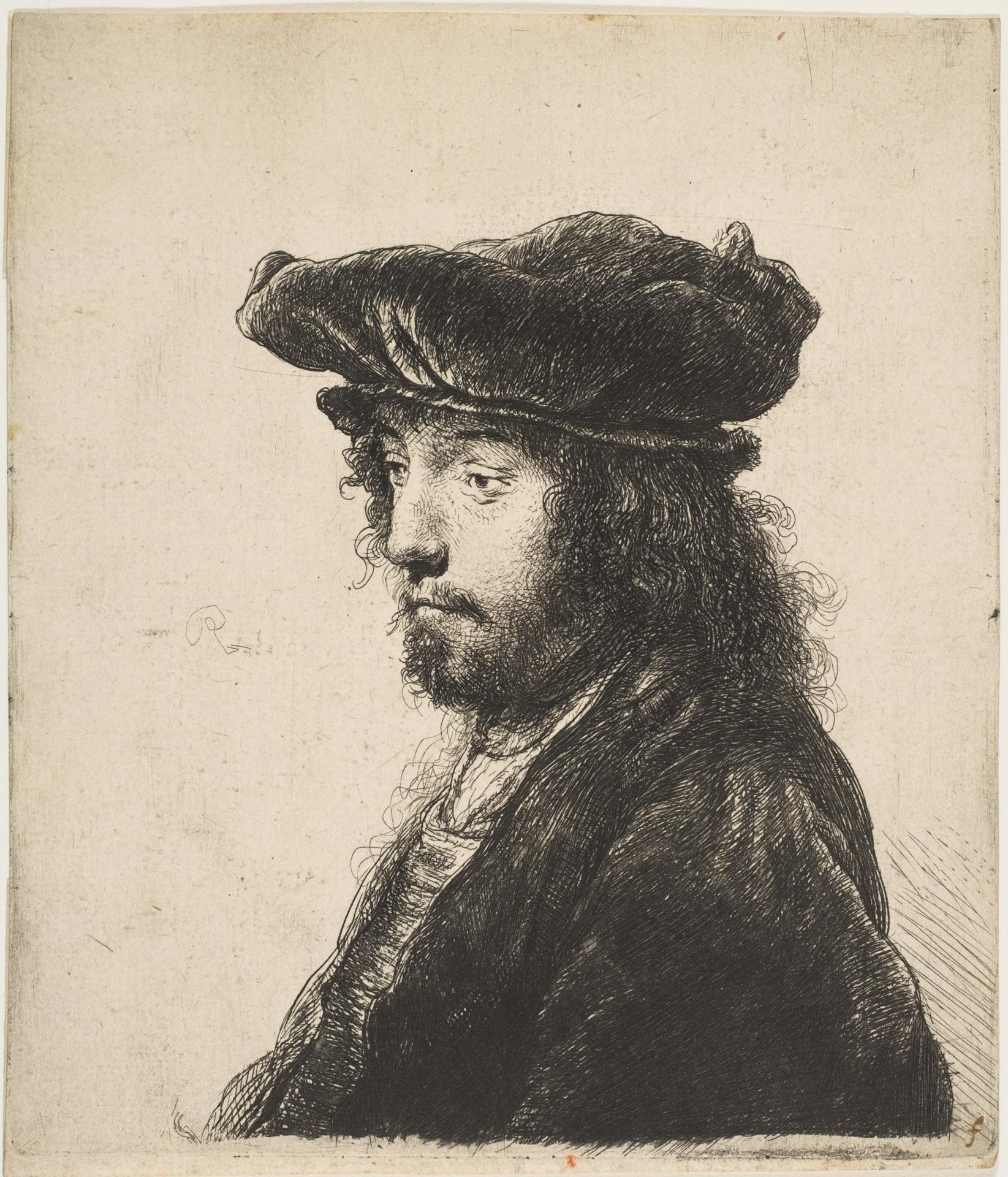
The Fourth Oriental Head
Original title: The Fourth Oriental Head
kurzbeschreibung
Around 1635 Rembrandt van Rijn etched "The Fourth Oriental Head," a bust-length portrait of a man turned in profile. He wears a broad, flat cap and a garment draped over his shoulders. This impression is the second of three states and measures 15.6 by 13.6 cm.
Description
A man's head in side profile anchors the sheet: a wide, flat cap, a cloak across the shoulders, long wavy hair, and a carefully shaped beard with a moustache. His features stand out sharply, and folds and shading give the face real depth. The backdrop stays bare, while light falls from the side and pulls out both contour and shadow with equal clarity.
Context
Rembrandt was working in Amsterdam around 1635, years in which he turned increasingly to eastern subjects. Heads of this kind were hugely popular in the Netherlands and were eagerly collected as studies of exotic appearance. For models he drew on people around him, dressing them in turbans and other props.
Impact
Dense hatching and strong contrasts of light and dark make the portrait feel immediate and alive. Because the light comes from the side, the face gains depth and looks almost sculptural. The bare surroundings keep the viewer's attention fixed on the man's strongly marked features.
Technique
For this etching the drawing was incised into an acid-resistant ground on a copper plate and then bitten with acid. The impression was pulled in black on paper, producing the characteristic fine lines and textured surface. The visible strokes give the image a rough, handmade quality.
AI-generated description text
Source: Metropolitan Museum of Art · Public Domain (CC0 1.0)